25 August 2026 – Former CEO of Agriseta, Jeremiah Sello Madiba (62), pleaded guilty before Kimberley Serious Commercial Crimes Court for contravention of Public Finance Management Act (PMFA) and sentenced to pay a fine of R30 000 or 12 months imprisonment. Madiba was arrested in June 2022, by the Hawks Serious Commercial Crime Investigation team.
The Hawks spokesperson in Northern Cape, Warrant Officer Nomthandazo Mnisi said during June 2016, an NPO named Business Against Crime misrepresented themselves that they were in partnership with Dipalemo Strategic Trading Services and requested funding from Agriseta to the amount of R1.9 million. Mnisi said the funds was received and mentorship took place, but BAC misused the credentials of Dipalemo Strategic Trading Services in order to receive the contract.
“Furthermore, procurement procedures were not followed by Agriseta in awarding the contract to BAC. After several court appearances, the accused pleaded guilty and was sentenced as mentioned above.
“He is expected to pay R20 000 by the end of 31 August 2026 and R10 000 payable in instalments of R2500 until its fully paid by 7 October 2026,” she said.
The Provincial Head of the Hawks in Cape, Major General Steven Mabuela applauded the team for the great work done.
25 August 2026- The police in Schweizer Reneke are investigating a case of inquest following a fatal incident at an animal auction on 24 August 2026.
The police said they attended the scene and found a man (31) who had sustained fatal injuries after being electrocuted by electrical transformer.
The North West police spokesperson, Sergeant Kelebogile Morake said the Emergency Medical Services (EMS) personnel attended the scene and certified him deceased. Morake said circumstances surrounding the incident are being investigated.
“Thr members of the public are urged to exercise extreme caution around electrical installations, transformers and power infrastructure.
•Never touch or approach an electrical transformer, even if it appears to be inactive. Do not climb on or tamper with transformers, electrical poles, cables or substations. Keep children away from electrical infrastructure and educate them about the dangers of electricity.
“Never enter fenced or restricted electrical areas. Stay away from damaged or fallen electrical cables and treat them as live. Report damaged transformers, exposed cables, sparks or other electrical hazards to the relevant electricity provider immediately,” she said.
Morake further said people should not attempt to repair or investigate electrical equipment themselves. She added that electricity can cause serious injury or death without warning.
“Keep a safe distance, do not touch electrical equipment, and report hazards to the authorities or electricity provider. Safety starts with awareness. Stay away. Stay safe,” said Morake.
Picture: The Northern Cape MEC for Education, Abraham Vosloo
By AGISANANG SCUFF
25 August 2026 – The Northern Cape MEC for Education, Abraham Vosloo will officiate the National Teaching Awards (NTAs) ceremony aimed at recognising, celebrating and honouring teachers and school principals who have performed remarkably well and showcased excellence in Education. Vosloo said the NTAs is a prestigious event, where the hard work, diligence and commitment of teachers are recognised and awarded for their outstanding leadership across the school spectrum.
“The award ceremony will be held at Old CRC Building in Kimberley on Tuesday at 12pm. The Provincial Winner in each category will represent our province at the National Awards Ceremony on 1 October 2026,” he said.
Picture: Some of drugs confiscated by the police/Supplied
By BAKANG MOKOTO
25 August 2026 – A suspect (30) was arrested by the members of Mahikeng Crime Intelligence, together with members of Lichtenburg Crime Prevention for possession of drugs in Lichtenburg. On Thursday, members were on duty when they received a tip-off regarding an individual allegedly involved in dealing in drugs in Extension 1, Lichtenburg.
The North West police spokesperson, Captain Majang Skalkie said the information was followed up and the police proceeded to the identified area, where they arrested the suspect and charged him with possession of drugs. Skalkie said the suspect briefly appeared before the Lichtenburg Magistrate’s Court on 24 August 2026.
Picture: The Greater Taung Local Municipality handed over two road construction projects
By BOINEELO KGOPE
25 August 2026 – The Greater Taung Local Municipality mayor, Itumeleng Maribe, handed over two access roads to the Baga-Mothibi Tribal Authority on Monday. The municipality said it is pleased with the work of the two contractors.
According to Maribe, the Nkemeleng Construction and Leope Services did a diligent job after completing their tasks beforehand. He further said the contractors constructed a 2km road in Shaleng village and 2.2km road in Seoding that were expected to be completed in a period of two financial years.
The Member of Mayoral Committee (MMC) responsible for Infrastructure, Bontsi Chubane shared the same sentiments. Chubane said both projects were completed in less than a year.
“Both internal roads were supposed to be completed in 8 months but the contractor in Seoding completed the job in 6 months. While working as a contractor in Shaleng for 5 months.
“The municipality spent at least R26m for both roads and promised to attend to the concerns raised by community members in Shaleng as soon as possible. Each project is estimated at R13m and the municipality retains a certain amount to ensure that the services delivered are of a great value,” he said.
Chubane further said because there are concerns in Shaleng, the contractor will only receive their balance after fixing these issues.
Meanwhile, the community members in Seoding village, welcomed the road and pleaded with the municipality to provide maintenance to the road to ensure it is well-preserved.
A member of the community, Lesego Motlhatlhedi said: “We will have less vehicle services because we have a better internal road in our village. We thank the municipality for having heard our cry during CPBs about poor internal roads.”
In contrast, the community members in Shaleng village sang a different tune. They alleged that the internal road in their area has brought nothing, but problems for them. According to them, the pavement floods water to some of their yards and calls on the municipality to fix the pavement before more damage is done.
A community leader, Kabelo Gwate said Nkemeleng Construction did a shoddy job with this road.
“Our vehicles cannot drive on this road because of the flow of the water coming from the storm water in Mothelesi Secondary School. Therefore, we are ill-fated with this handover and request the municipality to rectify its mistakes,” he said.
25 August 2026 – The Chairperson of the Select Committee on Education, Science and the Creative Industries, Makhi Feni has called on law enforcement agencies to do all in their power to bring to justice the killers of champion boxer Zolani Tete on the weekend. The committee sends its heartfelt condolences to the Tete family and friends and to the boxing fraternity.
Feni said lawlessness and access to illegal firearms is threatening not only the lives of our people, but South Africa’s stability.
“The ease with which these thugs are able to just disappear among communities and when arrested get bail, is becoming a pandemic. Law enforcements and government agencies need to deal decisively with the killing of innocent South Africans. South Africans have no other home other than South Africa, so it is unacceptable that people are killed for no apparent reason.
“Tete’s murder has made it clear now that arresting these thugs and serving is no longer enough. When people get arrested for contact crimes to only be released on parole or bail to come and perpetuate exactly the things they were arrested for, it is clear arrest is not deterrent enough,” he said.
Feni further said these kinds of crimes must carry serious punishment. He added that this kind of killing is just continuing unabated.
“That is a serious concern and something that the government and the police must resolve. Arrests are no longer enough when we continue to count bodies. Tete was killed in his Mdantsane home on the weekend and four suspects are already in custody.
“The committee welcomes the arrest, but that is woefully inadequate when a person has died. To the family we say akuhlanga lungehlanga, thuthuzelekani ngoko,” concluded Feni.
25 August 2026 – The Portfolio Committee on Science, Technology and Innovation calls for stronger and more coordinated action to ensure that women and girls can enter progress and lead in South Africa’s science, technology and innovation system. As South Africa marks National Women’s Month, the committee recognises the important contribution women and girls are making in research, innovation and technological development, while also emphasising the need to address the barriers that continue to limit their full participation and advancement.
The Chairperson of the Portfolio Committee, Lusizo Makhubela said South Africa cannot build a competitive and inclusive innovation economy, while girls and young women continue to face barriers in scientific and technological fields. Makhubela said women and girls must not only be encouraged to enter science, technology, engineering and mathematics (STEM).
“They must be supported to remain, advance and lead. The country needs their talent, ideas and leadership if science, technology and innovation are truly to be for everyone. The committee believes that the participation and advancement of women and girls in science, technology and innovation is not only a gender equality issue.
“It is central to national development, economic transformation, skills development, competitiveness, innovation and social justice. This is particularly relevant in 2026, when South Africa has launched its inaugural National Science Month,” she said.
Makhubela further said for this principle to have practical meaning, women and girls must have genuine opportunities to enter, progress and lead across the science, technology and innovation system. She added that South Africa has made important progress in strengthening women’s participation in the research and higher education system.
“The Department of Science, Technology and Innovation’s (DSTI) most recent end-term assessment of its 2020–2025 Strategic Plan, records that women constituted 48% of the country’s research workforce in 2024/25, up from a baseline of 45.1% in 2019/20.
“The National Advisory Council on Innovation’s 2025 Science, Technology and Innovation Indicators Report also indicates that women’s representation among permanent academic staff at public universities increased from 46% in 2010 to 52% in 2022,” said Makhubela.
She said, however, participation does not necessarily translate into equal representation at the highest levels of the system. Makhubela said in 2020, women accounted for 37.5% of permanent professors, including associate professors, compared with 27.8% in 2011.
“At the same time, there are encouraging indications of women’s advancement into recognised research leadership, with women holding 57% of Research Chairs under the South African Research Chairs Initiative by March 2023.
“These indicators present a mixed, but important picture. South Africa is making progress towards greater gender representation in the research workforce and in areas of research leadership, but women remain underrepresented in most senior academic positions and across key STEM disciplines,” she said.
Makhubela said men continue to dominate fields including engineering, computer and information sciences, mathematics and statistics. The committee therefore believes that the measure of transformation must extend beyond how many women enter the system,” she said.
Makhubela said Parliament and the National System of Innovation must also ask how many remain, how much progress, who controls research resources, who leads institutions and research programmes, and whether women are able to translate knowledge and innovation into economic and social value.
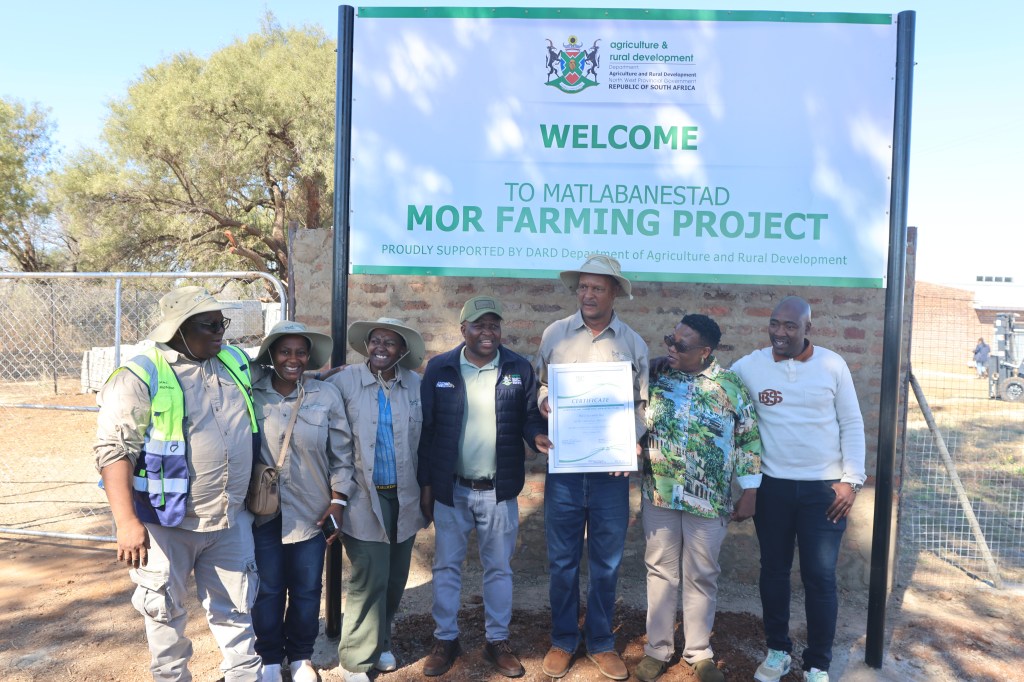
Picture: North West MEC for DARD, Madoda Sambatha and municipal leaders officially launch the Mor Farming Packhouse/Supplied
By OBAKENG MAJE
25 August 2026 – The North West MEC for Agriculture and Rural Development, Madoda Sambatha has officially opened and handed over a state-of-the-art vegetable packhouse at Mor Farming’s Matlabanestad Farm, outside Bloemhof. Sambatha said the new facility marks a significant milestone in the province’s efforts to strengthen agricultural production, improve market access for emerging farmers, and stimulate local economic growth.
He further said as part of its commitment to farmer development and agricultural transformation, the department invested in the construction of the packhouse to enhance Mor Farming’s operational capacity. Sambatha added that the facility will serve as a critical hub, where harvested produce is cleaned, graded, sorted, and packaged to meet food quality, safety and market standards before reaching consumers.
“Mor Farming has grown into a successful horticultural enterprise producing a range of vegetables, including butternut, pumpkin, beetroot, watermelon, green beans, and green peppers. The farm currently supplies produce to markets across the North West, as well as neighbouring provinces such as Gauteng, Free State and Northern Cape, while also serving local and informal markets in Bloemhof.
“In addition to the packhouse, the department has supported the enterprise through the provision of essential agricultural inputs and equipment, including seeds, packaging materials, harvest bins, baskets, a forklift, food processors, and vegetable cutters,” he said.
In bringing interventions, Sambatha said this has significantly improved productivity and strengthened the farm’s readiness to access formal markets. He said the development of packhouses across the province forms part of the department’s broader strategy to strengthen the agricultural value chain, improve post-harvest handling, reduce losses and increase farmers’ competitiveness in formal markets.
“The Mor Farming Packhouse is among seven packhouses constructed by the department across the province, with the remaining facilities set to be officially launched in the coming months. Several packhouses have already been completed across the province and we will be launching them soon.
“We are deliberately investing in infrastructure that enables farmers to grow and expand their businesses. When farmers grow, they create jobs, strengthen local economies, and contribute meaningfully to provincial economic development,” said Sambatha.
He said through investments such as these, they are creating opportunities for current and future generations of farmers, while building a more inclusive and competitive agricultural sector in the North West Province. Sambatha emphasised that the department’s investment is aligned with its objective of growing the number of successful farmers in the province, while encouraging more young people to enter the agricultural sector.
“The Bloemhof facility forms part of a broader provincial initiative aimed at supporting farmers, increasing agricultural production, and unlocking new market opportunities,” he said.
Meanwhile, to ensure the sustainability of the project, the farm owner, Pako Moroeng, also participated in the South African Good Agricultural Practices (SA-GAP) training programme. The programme focuses on food safety, quality assurance, good agricultural practices, and the proper handling of produce.
Speaking about the impact of the training, Moroeng expressed gratitude for the department’s support.
“I am grateful for the support and guidance I have received from the department. Through the SA-GAP programme, I have gained valuable knowledge and practical skills in food safety, soil management, chemical handling, post-harvest management, quality control, traceability, record-keeping, and compliance with agricultural standards.
“Most importantly, SA-GAP has shown me how to maintain high-quality standards and ensure that the produce leaving my farm is safe for consumers. This has improved the marketability of my products and opened opportunities to access more profitable local and potential export markets,” he said.