Four suspects nabbed for dealing in dagga


Picture: Some of dagga seized by the police/Supplied

By REGINALD KANYANE

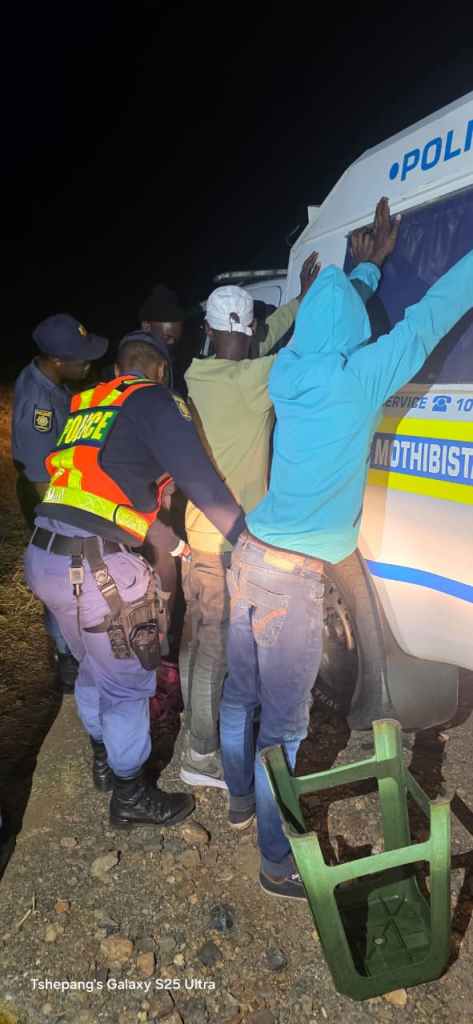
24 August 2026 – Four suspects aged between 20 and 26, were arrested for dealing in dagga. This comes after the police received a tip-off at approximately 10:45pm, and followed up on the information.

The Namakwa District police spokesperson, Captain Ivan Magerman said the police proceeded to a residence in Commercial Street, Fraserburg. Magerman said upon arrival, they found four suspects allegedly busy packaging dagga into small bankies, suspected to be intended for distribution.

“The police seized dagga with an estimated street value of R6 700. A woman (21) and three men aged between 20 and 26, were arrested for dealing in drugs. The suspects are expected to appear before the Fraserburg Magistrate’s Court on 25 August 2026.

“In an unrelated incident, members of SAPS Port Nolloth discovered hydroponic dagga abandoned in the business area of Port Nolloth on 22 August 2026, at approximately 11am. The hydroponic dagga has an estimated street value of R60 600,” he said.

Magerman further said an enquiry has been opened and police investigations are continuing to determine the circumstances surrounding the abandonment of the drugs and to identify those responsible. He added that the South African Police Service (SAPS) in the Namakwa District continues to strengthen its partnership with communities in the fight against crime, in line with the SAPS Reset Agenda, which places emphasis on visible policing, community participation, accountability and responsive policing.

Meanwhile, the Namakwa District Police Commissioner, Brigadier Schalk Andrews, applauded the police for their swift response and importantly, expressed appreciation to the community members who continue to provide valuable information to the police. Andrews said the success of this operation demonstrates the importance of a strong partnership between the SAPS and the communities they serve.

“Community members are our eyes and ears on the ground and information provided by vigilant residents enables the police to respond swiftly and decisively to criminal activities. The fight against drugs requires a collective effort and that the SAPS Reset Agenda reinforces the importance of community-

centred, professional and accountable policing.

“Removing drugs from our communities is not only the responsibility of the police. It requires the active participation of all sectors of society. We encourage residents to continue working with the SAPS and to report suspicious and criminal activities,” he said.

Andrews said together, they can disrupt the drug trade and create safer communities for all. He said the SAPS in Namakwa remains committed to intensifying operations, following up on information and working closely with communities and other stakeholders to prevent and combat crime.

taungdailynews@gmail.com

Residents call for effective implementation Water Services Amendment Bill


Picture: Taung Dam

By OBAKENG MAJE

24 August 2026– The residents of the Dr Ruth Segomotsi Mompati District Municipality have expressed overwhelming support for the Water Services Amendment Bill (B24-2025), while calling for effective mechanisms to ensure that the proposed legislation translates into tangible improvements in water and sanitation services. The Portfolio Committee on Water and Sanitation conducted the first of three public participation sessions in the North West at the Depot Hall in Taung, where residents welcomed the Bill, emphasising that its success would ultimately depend on enforced effective implementation.

The Chairperson of the Portfolio Committee on Water and Sanitation, Leon Basson said the participants cautioned against the culture of well-intentioned legislation with poor or no implementation on the ground. Basson said they argued that poor implementation of the Bill diminishes the purpose of legislation and more importantly, denies communities’ constitutional rights to access quality water and sanitation services.

He further said a significant concern raised during the hearing was municipalities’ poor performance in providing reliable, quality water services. Basson added that participants expressed their hope in the Bill that it would lay new foundations of accountability and a culture of performance in the municipalities and of forcing water service providers to deliver on their obligations.

“Participants also welcomed the Bill’s provisions on consequence management for licence holders, stressing that the possibility of sanctions, including the forfeiture of a licence, could lead to water service providers improving their performance and ensuring better service delivery.

“Some community members described the Bill as a direct response to their longstanding concerns and prayers for improved water services. They argued that many of the challenges experienced by communities are rooted in poor governance and management at the municipal level,” he said.

Basson said calls were also made for stronger law enforcement to address alleged corruption within local government. He said participants argued that corrupt practices and poor governance contribute directly to failures in the provision of water services and that those responsible should be held accountable.

“Participants further called for improved communication channels through which residents can report poor or inadequate water services. They argued that effective enforcement of the proposed licensing regime would require communities to be able to provide information to the relevant licensing authorities about service-delivery failures.

“Participants also called for greater transparency, including public access to information on approved licence holders, as a means of strengthening accountability and enabling communities to know which entities are authorised to provide water services and what obligations they are required to fulfil,” said Basson.

He said the proposed enforcement powers of the Minister were also supported by participants, who also argued that the ability of the Minister to intervene where water service providers persistently fail to deliver quality services could help prevent lengthy delays in addressing serious service-delivery failures. Basson said although the public hearing focused on the provisions of the Bill, community members also used the opportunity to bring their immediate water challenges to the attention of the committee.

“In Taung, participants raised concerns about the perceived disconnect between the area’s water resources and the services received by local communities. Some participants told the committee that in spite of the existence of a dam with water in Taung, local communities do not sufficiently benefit from this water resource.

“They alleged that the dam supplies water to other areas. Another major concern was the overreliance on water tankers as a means of addressing water shortages. Participants argued that tanker provision is costly and often irregular, leaving communities without reliable access to water. Concerns were also raised over municipalities purchasing water tankers when, in the view of participants, those resources could be better utilised to address underlying infrastructure and service-delivery challenges,” said Basson.

taungdailynews@gmail.com

NCOP raises concerns over central challenges confronting Northern Cape


Picture: NCOP visit to Northern Cape

By AGISANANG SCUFF

24 August 2026 – The National Council of Provinces (NCOP) Northern Cape delegation commended the provincial departments for the improvements it described as remarkable in implementing infrastructure projects since the last two Provincial Week visits. However, the delegation remains concerned about the persistent implementation gaps in areas, including municipal capacity, financial management and accountability as the central challenges confronting the province.

The Provincial Whip, Patrick Mabilo said while the delegation acknowledged pockets of progress, it highlighted the recurring patterns of contractor failures, project delays, reliance on consultants and inadequate financial management that continue to undermine service delivery and diminish public trust. Mabilo said the Auditor-General highlighted excessive reliance on consultants and R656 million in irregular expenditure across municipalities.

“Nine municipalities remain distressed with 30 of 144 senior management posts vacant. Non-revenue water stands at approximately 45%, resulting in an estimated R2.93 billion annual revenue loss. No water system achieved Blue Drop certification in the 2023 assessment.

“The visit of the delegation to the province was part of the annual Provincial Week of the NCOP – an oversight and public participation programme, to assess progress on previous recommendations and examine the state of service delivery in the Sol Plaatje, Siyancuma and Siyathemba local municipalities,” he said.

Mabilo further said during the visit, the delegation inspected water treatment plants, housing projects and a tiger-eye mining plant. He added that they have seen that the Northern Cape’s principal challenge is not the absence of plans or commitments, but weak implementation and follow-through.

“The effectiveness of the NCOP oversight process will depend on time-bound implementation of recommendations, regular reporting on undertakings and firm consequence management where commitments are not honoured. In the Siyancuma Local Municipality, significant delays plague the 150 low-cost Housing Programme in Griekwastad, Schmidtsdrift, Campbell and Bongani. The project, originally intended to take eight months, has now been running for approximately 24 months, with only 20 of 150 houses completed.

“The municipality has qualified audit opinions for four consecutive years, with R66 million in unauthorised expenditure and approximately R21.256 million in irregular expenditure. The municipality owes approximately R321 million to Eskom and water boards,” said Mabilo.

He said revenue collection sits at approximately 49%, contributing to cash-flow constraints. Mabilo said the Schmidtsdrift Communal Property Association raised serious concerns regarding insufficient post-restitution support, lack of financial and institutional capacity, and poor cooperation from government departments.

“The community also reported severe water shortages and a poor gravel road to Douglas that is used daily by learners. In the Siyathemba Local Municipality, the municipality has received qualified audits for five consecutive years, with R611 million in unfunded budget overspend (dating back to 2011) and R350 million in Eskom debt.

“The stalled housing development in Prieska remains a critical concern. Phase 2 of the project, comprising 200 units, has 61 incomplete houses following contractor default in 2023. The incomplete site has become a hub for vandalism and criminal activities,” he said.

taungdailynews@gmail.com

Residents support revocation of licence amid service delivery failures


Picture: Ngaka Modiri Molema District Municipality building

By BAKANG MOKOTO

24 August 2026 – The residents of Ngaka Modiri Molema District Municipality have overwhelmingly supported the Water Services Amendment Bill, particularly the solidification of provisions to suspend and revoke the licences of water service providers that fail to deliver quality water services. The residents expressed their views on the Bill during the second leg of the North West public hearings on the Bill held at the Mahikeng Civic Centre in Mahikeng.

Participants argued that due to the current challenges within the district, they are of the view that the licence of Ngaka Modiri Molema should be the first to be revoked with immediate effect as they spend countless days without water. They also argued that, in most cases, municipalities are not adequately capacitated to meet the standards of their licences, and that renders them unable to deliver quality services.

The Chairperson of the Portfolio Committee on Water and Sanitation, Leon Basson said they told the committee that their support for the Bill is largely based on the Bill’s potential to address the lack of access to quality water and sanitation within the municipality. Basson said they pointed out that their support for the Bill should translate into legislation that will work for the people.

“They called for the effective implementation of the Bill to ensure that it yields the expected fruit. There were concerns that were highlighted that the Bill does not specifically address the plight of rural communities and the quality of water they should expect.

“There was a proposal for a clause in the Bill which explains, among other things, the quality of water the people will receive, and sanctions for non-compliance by water services licence holders,” he said.

Basson further said participants expressed concerns over the continued overreliance on water tankers. He added that they argued that the financial resources used on water tankers could be used for a long-term water provision arrangement.

“Some participants told the committee that water tankers supply questionable water and expose communities to health hazards. Some participants raised concerns that the provision of quality water was overemphasised than the provision of sanitation services, yet both are equally essential.

“Similar to other hearings already held in other provinces, participants raised various challenges regarding the provision of water, with many of them highlighting that they depend on untested boreholes,” said Basson.

He said some participants told the committee that communities rely on very few boreholes, despite the rising number of people that results in more demand. Basson said participants also told the committee that they live without water for a number of days sometimes in their communities.

“They described that as a gross deprivation of their constitutional rights to water,” he said.

taungdailynews@gmail.com