
A call to ensure women and girls enter science, technology and innovation


Picture: Women embarking on STEM/Generic 

By REGINALD KANYANE

25 August 2026 – The Portfolio Committee on Science, Technology and Innovation calls for stronger and more coordinated action to ensure that women and girls can enter progress and lead in South Africa’s science, technology and innovation system. As South Africa marks National Women’s Month, the committee recognises the important contribution women and girls are making in research, innovation and technological development, while also emphasising the need to address the barriers that continue to limit their full participation and advancement.

The Chairperson of the Portfolio Committee, Lusizo Makhubela said South Africa cannot build a competitive and inclusive innovation economy, while girls and young women continue to face barriers in scientific and technological fields. Makhubela said women and girls must not only be encouraged to enter science, technology, engineering and mathematics (STEM).

“They must be supported to remain, advance and lead. The country needs their talent, ideas and leadership if science, technology and innovation are truly to be for everyone. The committee believes that the participation and advancement of women and girls in science, technology and innovation is not only a gender equality issue.

“It is central to national development, economic transformation, skills development, competitiveness, innovation and social justice. This is particularly relevant in 2026, when South Africa has launched its inaugural National Science Month,” she said.

Makhubela further said for this principle to have practical meaning, women and girls must have genuine opportunities to enter, progress and lead across the science, technology and innovation system. She added that South Africa has made important progress in strengthening women’s participation in the research and higher education system.

“The Department of Science, Technology and Innovation’s (DSTI) most recent end-term assessment of its 2020–2025 Strategic Plan, records that women constituted 48% of the country’s research workforce in 2024/25, up from a baseline of 45.1% in 2019/20.

“The National Advisory Council on Innovation’s 2025 Science, Technology and Innovation Indicators Report also indicates that women’s representation among permanent academic staff at public universities increased from 46% in 2010 to 52% in 2022,” said Makhubela.

She said, however, participation does not necessarily translate into equal representation at the highest levels of the system. Makhubela said in 2020, women accounted for 37.5% of permanent professors, including associate professors, compared with 27.8% in 2011.

“At the same time, there are encouraging indications of women’s advancement into recognised research leadership, with women holding 57% of Research Chairs under the South African Research Chairs Initiative by March 2023.

“These indicators present a mixed, but important picture. South Africa is making progress towards greater gender representation in the research workforce and in areas of research leadership, but women remain underrepresented in most senior academic positions and across key STEM disciplines,” she said.

Makhubela said men continue to dominate fields including engineering, computer and information sciences, mathematics and statistics. The committee therefore believes that the measure of transformation must extend beyond how many women enter the system,” she said.

Makhubela said Parliament and the National System of Innovation must also ask how many remain, how much progress, who controls research resources, who leads institutions and research programmes, and whether women are able to translate knowledge and innovation into economic and social value.

taungdailynews@gmail.com

Taking STEM education to every learner


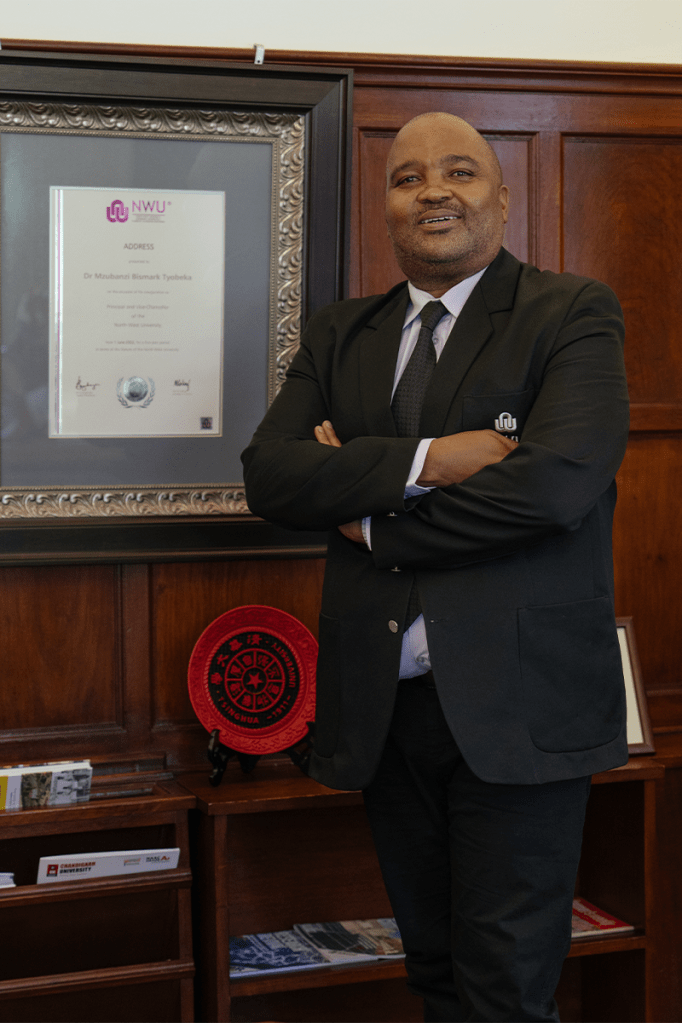
Picture: NWU vice-chancellor and principal, Bismark Tyobeka 

By AGISANANG SCUFF

4 August 2026 – The North West University (NWU) vice-chancellor and principal, Professor Bismark Tyobeka said science, technology, engineering and mathematics (STEM) education is essential to South Africa’s future. Tyobeka said the country needs a new generation of scientists, engineers, innovators and technically skilled professionals to address challenges such as energy security, water scarcity, food production, healthcare, climate change and digital transformation.

He further said a strong foundation in STEM also equips young people with critical-thinking, problem-solving and analytical skills that are valuable in almost every modern career. Tyobeka added that, yet talent is not determined by geography, family income or access to well-resourced schools.

“Promising young minds can be found in every community, including rural areas where learners may have had limited exposure to laboratories, researchers or STEM career opportunities. By inspiring learners to pursue these fields, South Africa can broaden its skills base, reduce inequality and ensure that more young people can participate meaningfully in the industries and innovations that will shape the country’s economic and social development.

“This is why the NWU is deliberately taking science beyond its campuses and into rural communities. The 2026 Vice-Chancellor’s Science Day, to be hosted at Hoërskool Wolmaransstad on 5 August 2026, reflects the belief that science belongs to everyone and should never be restricted by location, background or opportunity,” he said.

Tyobeka said presented under the theme: “Science, technology and innovation are for everyone”, the event will give learners from Wolmaransstad and surrounding schools an opportunity to interact with researchers, innovators and industry experts. He said choosing a town outside a major urban centre is an important part of the initiative.

“It brings possibilities directly to learners who may otherwise have little contact with universities or scientific careers. Through practical demonstrations, conversations and exposure to real-world applications, the NWU hopes to awaken curiosity, build confidence and help learners recognise that a future in STEM is both achievable and worth pursuing,” said Tyobeka.

taungdailynews@gmail.com

‘A concerted effort needed to address the sluggish uptake in STEM subjects’


By OBAKENG MAJE

13 January 2026 – The Portfolio Committee on Basic Education has welcomed the marginal increase in the pass rate achieved by the 2025 Grade 12 cohort, attributing the steady year-on-year improvement to the solid foundation laid by previous administrations. The committee said while the 88% is commendable, there is a need for a concerted effort to address the sluggish uptake and throughput in STEM subjects (Science, Technology, Engineering and Mathematics).

The Chairperson of the Portfolio Committee, Joy Maimela said they welcome the increase, especially as it reflects the maturity of the system and work done by the department over the past few years. However, Maimela said the low uptake and throughput in STEM subjects continue to limit the country’s drive towards economic growth, technological development and global competitiveness.

“The committee agrees with the Department of Basic Education (DBE) that efforts should be directed towards establishing a technical school in every district to help drive growth in these subjects.

“The committee also welcomed the overall improvement in performance, noting that the 2025 cohort began their high school journey in the midst of the COVID-19 pandemic, which had a significant impact on teaching and learning,” she said.

Maimela further said the committee welcomed the progress made across all districts, with every district achieving performance above 80%. She added that the enormous work put in by all stakeholders, including teachers, parents and district officials, has been central to this cohort achieving this important milestone in their basic education journey.

“May these gains be doubled in the coming years to ensure that our young people receive quality basic education. Despite commendable progress in social justice principles within the basic education sector – access, redress, equity and inclusivity – the committee has called for the improvement in efficiency and quality.

“The committee highlighted the ever-decreasing number of educators against a growing learner population as a major impediment to quality education,” said Maimela.

She said it is unacceptable that while the system caters for an increasing number of learners, teacher posts are not increasing at the same pace. Maimela said the DBE must move with speed to improve quality where challenges exist.

“Regarding throughput, the committee called for renewed focus on understanding and addressing the number of learners who pass Grade 12 compared to those who registered for Grade 1 in 2014. While noting a marginal improvement in throughput, the committee expressed concern that the number of learners who fall by the wayside remains worryingly high.

“The committee welcomed the assurance by the Minister that there is a renewed focus to understand through data, to find targeted solutions and support to ensure that the system’s health is maintained,” she said.

Maimela said while the committee notes the progress made, it emphasised the importance of a fully functional system. She said in this regard, early childhood education and strong support structures at the lower levels of education are critical.

“Education does not exist in isolation, and the many socio-economic challenges faced by society must be addressed to build a functional, quality education system that produces learners who can meaningfully contribute to the country’s economic development.

“The committee also welcomed progress in no-fee-paying schools, particularly in townships and rural areas, which bodes well for the development of these areas. It extended a special commendation to KwaZulu-Natal (KZN) for continued excellence even under the challenging circumstances the department faces,” said Maimela.

She said the results of the 2025 cohort by KZN highlight what a resilient system can produce. Maimela said the committee urged the department to ensure that all its systems are fully in place to allow teaching and learning to start on the first day of school.

“These include the timely availability of learning and teaching support materials, adequate teacher provisioning, the protection of learning time, and the effective implementation of the National School Nutrition Programme,” she said.

taungdailynews@gmail.com

TIA to sign MoU with MICT SETA


By REGINALD KANYANE

23 June 2025- The Technology Innovation Agency (TIA), an entity of the Department of Science, Technology, and Innovation (DSTI) in partnership with the Media, Information and Communication Technologies Sector Education and Training Authority (MICT SETA), set to officially sign a strategic Memorandum of Understanding (MoU), aimed at powering digital skills and innovation in South Africa.

The Alkemi Collective from Martin Slabbert, who released an invite on behalf of the Technology Innovation Agency (TIA), Martin Slabbert said this landmark partnership sets in motion a multi-year strategic partnership that will see TIA and MICT SETA jointly design and implement targeted digital and Fourth Industrial Revolution skills programmes.

Slabbert said: “These initiatives aim to broaden access to innovation driven learning, improve employment readiness among youth and strengthen South Africa’s National System of Innovation.

“The MOU will unlock various opportunities, including co-funded digital skills and incubation programmes. Bursary schemes and a dedicated Research Chair in Innovation Management. The internship and placement opportunities for graduates.”

He further said accelerated support for entrepreneurs through hackathons, mentorship, and commercialisation platforms. Slabbert added that this event marks a significant step toward bridging South Africa’s digital divide and enabling a future ready workforce that reflects the country’s diversity and potential.

“The event will take place at MICT SETA Offices, Gallagher Convention Centre, Midrand at 11am until 1pm. TIA is a national public entity that serves as the key institutional intervention to bridge the innovation chasm between research and development from higher education institutions, science councils, public entities, the private sector, and commercialisation,” he said.

taungdailynews@gmail.com