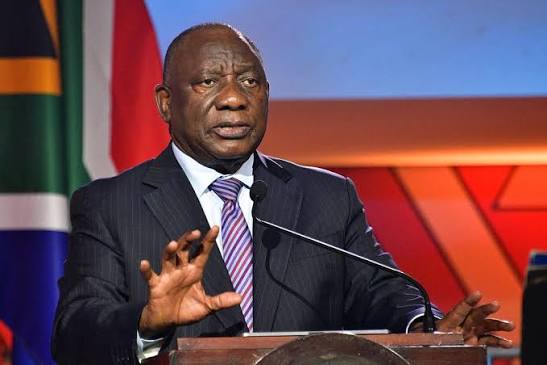
Picture: RSA president, Cyril Ramaphosa
By KEDIBONE MOLAETSI
29 July 2026 – The Republic of South Africa (RSA) president, Cyril Ramaphosa said last week, he spoke about their commitment to give effect to the constitutional right of access to water for all South Africans, with particular reference to communities that have remained underserved. Ramaphosa said this past week, they released the National Water Action Plan, which sets out his government’s determination to ensure that every community in the country has access to a reliable supply of quality drinking water, no matter where they live.
He further said for too many South Africans, turning on a tap has become an act of uncertainty. Ramaphosa added that in too many cities, towns and rural areas, water disruptions have become a fact of life.
“Families cannot cook or clean. Children cannot wash. Shops and businesses have to close. We are determined to change that. The National Water Action Plan sets out a clear, focused programme of immediate interventions and far-reaching reforms to address the root causes of water supply failures in many municipalities.
“Our main priority lies in implementation, clear responsibilities and accountability. The National Water Crisis Committee, known as WATERCOM, will meet regularly to oversee implementation, track progress and hold the responsible departments and public entities accountable for delivery,” he said.
Ramaphosa further said just a few years ago, they faced a similar national crisis in electricity. He added that by acting boldly to implement reforms, improve Eskom’s performance and enable massive investment in new generation capacity, they brought an end to load shedding.
“We are now applying that same approach to water. South Africa is a water-scarce country. We must continue to invest in dams, pipelines, treatment works and other bulk water infrastructure to secure our long-term water supply. The immediate challenge, however, is not mainly a shortage of rain or a lack of dams.
“The problem is that municipal water systems are not being properly managed, maintained and financed. In too many municipalities, revenue collected from the sale of water is used to fund other municipal functions. This leaves too little money to repair pipes, replace pumps or employ qualified engineers and technicians,” said Ramaphosa.
He said as a result, on average across the country, close to half of all the water pumped never reaches paying customers. Ramaphosa said it leaks out of broken pipes, is stolen or is simply never billed for.
“That is water that has been treated at great cost and then lost, along with the revenue that should have paid for maintenance. We cannot build our way out of the crisis if we do not properly maintain and manage the infrastructure we already have.
“The National Water Action Plan will address the root cause of this crisis by changing the way that water services are delivered. The Water Services Amendment Bill currently before Parliament will establish a clearer separation between the municipality’s role as the authority responsible for water and the role of the operator that actually delivers it, so that both can be held to account,” he said.
Ramaphosa said water service providers will be required to obtain operating licences based on their technical, managerial and financial capability. He said municipalities will only be able to appoint providers that meet the required standards and can demonstrate that they are capable of delivering reliable water and sanitation services.
“Where a municipality is failing, unwilling or unable to provide an acceptable service, government will intervene in accordance with the Constitution and the law to provide the required services to our people. Where necessary, another capable water utility will be appointed to run the service in the municipality’s place.
“The plan will also reform the way municipal water services are financed. Through the Metropolitan Trading Services Reform Programme, the country’s eight metropolitan municipalities are being supported and incentivised to ring-fence their water revenue. This means that money collected for water and sanitation must remain within the water utility and be reinvested in infrastructure, maintenance and improved operations,” said Ramaphosa.

