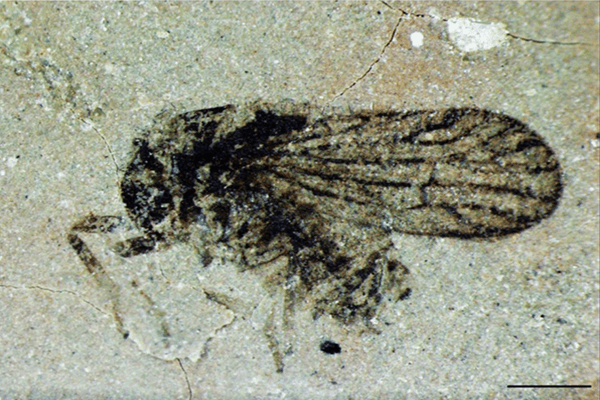
Picture: New species of jumping plant lice: Paternapsyllidium mckayi/Supplied
By KEDIBONE MOLAETSI
15 October 2026 – Three tiny insects that lived about 90 million years ago have helped a North West University (NWU) researcher uncover new clues about life on earth during the age of the dinosaurs. The discovery also sheds light on how insects fed on plants and how some became the crop pest farmers face today.
A senior lecturer in Agriculture at the NWU’s Potchefstroom Campus, Dr Sandiso Mnguni, has identified plant-feeding insects as fossils, which includes two new species of jumping plant lice and one aphid, found at Botswana’s Orapa Diamond Mine. Mnguni said the aphid is unique as it is the first complete fossil aphid from Africa and it had an unusual mouthpart.
“The insect has distinct body parts that helped him identify it. The other two insects have unusual wing patterns that set them apart from previously known species of jumping plant lice. The fossils were collected at the diamond mine during the 1980s and stored at the University of the Witwatersrand, where they remained available for further study.
“I began examining the collection in 2018, while studying towards my PhD. I had previously studied ancient beetles, but decided to explore other insect groups. One of the discoveries (the first jumping plant lice) has special meaning for me,” he said.
Mnguni further said he named it Paternapsyllidium mckayi in honour of his late PhD supervisor, Dr Ian McKay, who trained him in the study of ancient insects. He added that the second jumping plant lice, Derivatupsyllidium kimperlitis, takes its name from kimberlite, a type of rock linked to diamond deposits.
“The name reflects the fossils’ origin at Botswana’s Orapa Diamond Mine. A volcanic eruption triggered by volatile gases like carbon dioxide, steam and mineral-rich fluids from the kimberlite resulted in a crater lake in the centre and helped form the rock deposits at the mine.
“The third insect, an aphid named Oviparosiphum adamas, takes its name from the Latin word for diamond. The name reflects the diamond mining operation where the fossils were discovered. The findings help scientists understand how insects lived and survived millions of years ago,” said Mnguni.
He said the work contributes towards a more accurate documentation of diversity and enables us to map their distribution at the time. Mnguni said during that period, flowering plants became more common, which changed the environment and created new food sources for insects.
“Like their modern relatives, these ancient insects fed on plant sap. Today, similar insects damage crops, spread plant diseases and affect food production. The descriptions provide further insight into the insect diversity of the Orapa Diamond Mine during the Cretaceous period, a time between 145 million and 66 million years ago when dinosaurs roamed the earth.
“We worked with researchers from the Agricultural Research Council, Citrus Research International and the University of Fort Hare due to their expertise on working with modern relatives of the ancient insects,” he said.
Mnguni plans to continue studying the fossils to understand how these insects are related to other species. His work will help scientists build a clearer picture of ancient life and how insects have changed over millions of years.
Mnguni said the work will also help crop farmers to understand how the insect pests have evolved over the years. He said the work shares insights into plant-insect relationships.
“The knowledge can support the development of more effective and sustainable crop protection and integrated pest management strategies in the future,” concluded Mnguni.

