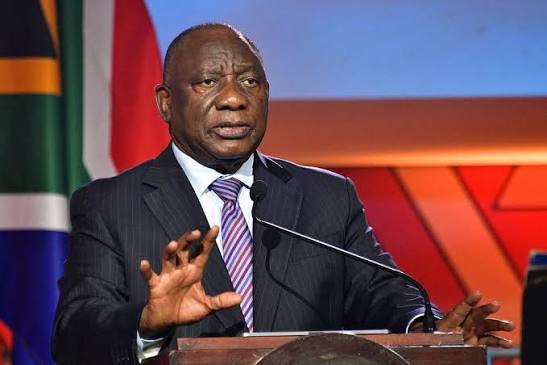
Picture: RSA president, Cyril Ramaphosa
By REGINALD KANYANE
6 October 2026 – The Republic of South Africa (RSA) president, Cyril Ramaphosa said in communities, public spaces and landscapes across the country, millions of new trees are taking root. Ramaphosa said since April 2026, more than seven million trees have been planted across all provinces under the Presidential One Billion Trees Campaign.
He further said more than two million trees have been planted in the Western Cape alone, with more than one million trees in each of Gauteng and KwaZulu-Natal. Ramaphosa added that it is particularly impressive that more than half a million trees have been planted in the country’s driest province, the Northern Cape.
“The Presidential One Billion Trees Campaign is part of the existing National Greening Programme. We aim to plant one billion trees over the next five years, working in partnership with communities, traditional leaders and the private sector.
“Trees and green spaces provide recreation and shade. They help to mitigate the impact of climate change and biodiversity loss. But more than that, this greening campaign is a response to the spatial inequality created by apartheid-era urban planning that saw historically white suburbs lined with trees and green spaces, whereas there was sparse vegetation in the townships,” he said.
Addressing and overcoming the geography of inequality, Ramaphosa said they inherited necessitates those greening programmes must also substantively contribute to advancing food security, rural development and the economic empowerment of women. He said the trees that are being planted are mainly indigenous and have been chosen for their suitability to local conditions.
“Importantly, a number of varieties of fruit trees have been planted, including citrus, avocado trees and grapes. These fruit trees will add to food security at a household level and support the expansion of community and school food gardens. The surplus from these trees could generate income.
“The goal of this intervention would be that a subsistence farmer can then reinvest that income in purchasing additional trees and inputs, and gradually expand into an income-generating enterprise,” said Ramaphosa.
He said the Department of Forestry, Fisheries and the Environment (DFFE) has signed a Memorandum of Understanding (MoU) with the Department of Human Settlements to help ensure that a fruit tree is planted with every new subsidised house. Ramaphosa said there are already a number of successful projects where tree planting has helped to empower women with livelihood support.
“One such example is the She Evolves project in the Tswelopele Local Municipality in the Free State where women have been leading tree planting in the community to provide income. Another such successful project is the Innesfree Park urban garden in the Sandton CBD in Gauteng.
“With the support of a local hospitality chain, a mother and daughter team are growing fruit, vegetables and herbs to support local feeding schemes and create employment for women. Greening programmes are a pathway for skills development that leads to job creation as well as supporting self-employment,” he said.
Ramaphosa said workers from the Expanded Public Works Programme (EPWP) are playing a key role in the campaign, assisting with land preparation, transporting trees to planting sites, planting and horticultural maintenance. He said the environmental sector is one of the most successful contributors to the EPWP, providing unemployed South Africans with work opportunities and skills in conservation, water, waste and fire management.
“With these skills, young South Africans will be able to use what they have learned to seek employment at nurseries and farms, and start their own businesses in landscaping, tree maintenance, plant production and sale.
“The seemingly simple act of planting a tree has the potential to generate many opportunities into the future, especially for young people who have considered a future in farming but did not know where or how to start. Another important aspect of this campaign is the deliberate focus on planting indigenous trees,” said Ramaphosa.
He said large parts of urban and rural South Africa are covered by dense canopies of non-indigenous trees that were planted by former colonial authorities, among other things, to meet the growing demand for timber. Ramaphosa said many of these trees, including Pretoria’s fabled jacarandas, are classified as invasive species.
“Invasive alien trees put a strain on already scarce surface water, threaten indigenous vegetation and are costly to eradicate. Invasive alien tree species also increase the risk and severity of wildfires, as communities in parts of the Garden Route have experienced over many years.
“As government, our environmental policies have been consistent on the need for both the preservation and transfer of indigenous knowledge in the cause of conservation. The removal of invasive species itself is an economic activity with the potential to generate income,” he said.
Ramaphosa said there are already several companies turning alien invasive plants and trees into biomass that is being used in a variety of industrial applications, including green fuel. He said the DFFE and South African National Parks have a successful Eco-Furniture Programme that trains EPWP workers to produce school desks, benches and other wood products from cleared invasive alien trees.
“Indigenous tree planting, nurturing and cultivation provide opportunities for young people to be trained in seed collection and indigenous horticulture, supporting local ownership of environmental assets and giving them skills and knowledge that they could use to start their own businesses.
“Ultimately, the Presidential One Billion Trees Campaign is aligned with our commitment to the sustainable use of our natural resources and to sustainable development. Conservation and socio-economic development are not mutually exclusive. This initiative has the potential to catalyse both small- and large-scale economic activity and job creation,” said Ramaphosa.
He said the momentum that this campaign has gathered is a testament to the power of collective action, with private citizens, businesses, schools and community organisations joining the effort. Ramaphosa called on those who have not already done so to join the campaign by planting or donating a tree.
“Together, we can achieve our goal of planting one billion trees across South Africa over the next five years,” he concluded.

