6 May 2026
South African officials worked with speed to detect, contain and respond to the case of Hantavirus detected in the country.
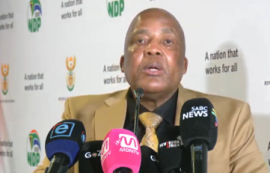
This according to Health Minister, Dr Aaron Motsoaledi, who briefed Parliament’s Portfolio Committee on Health on Wednesday morning.
The Minister’s update followed the confirmation of Hantavirus in a critically ill British national in South Africa, and in a woman who collapsed at OR Tambo International Airport. She later died in South Africa. Her husband, a third patient, passed away in St Helena.
The three were passengers aboard the cruise ship MV Hondius, which was sailing from Argentina to the Canary Islands via Cape Verde.
Motsoaledi explained that contact tracing continues, with 62 people already identified.
“The lady who arrived at OR Tambo flew in from St Helena… we needed to know the people who were there at the airport before she collapsed (sic). The third contact traces are healthcare workers in Kempton Park where the lady went.
“The fourth contact traces relate to the gentleman in a hospital in Sandton (and the ambulance crew). He was airlifted directly and didn’t come by commercial flight.
“The total number of people who were traced and who could have come in contact with them were 62. [Some] 42 of them have already been traced and they are being observed. The work is ongoing,” Motsoaledi said.
The World Health Organisation (WHO) is also conducting contact tracing internationally.
Addressing questions on how one of the patients had been allowed to come into OR Tambo International Airport, the Minister explained that the woman had not presented herself as ill to airline staff in St Helena, making it difficult to flag her in advance.
“On a routine basis, air staff are in touch with countries to report any person who might be sick in the aircraft to warn them…
“In this case, there was no warning coming in because even the staff did not pick up anything. When she arrived at the airport, she came in just like any traveller, not as a sick person. When people arrive, especially from international destinations, we have a temperature measuring [machine] but it does not mean that every human being who is sick [has a high] temperature.
“This lady went through the scan. It did not record anything from temperature (sic). It cannot be said that South Africa’s safety mechanisms were so lax that they just allowed people in without screening,” Motsoaledi said.
The other patient currently in hospital was medically evacuated from Ascension Island to a South African private health facility in Sandton.
Hantavirus
There are 38 strains of Hantavirus. The Andes strain, which is predominant in South America, is the strain which was the cause of the infection detected in the patients who died in South Africa.
“Person-to-person contact is very rare and it has happened under specific conditions, namely: there must be very close person-to-person contact for transmission to occur from one human to another. Not surprising [is] that the first persons who died are husband and wife.
“It happens to be the only strain out of the 38 that is known to cause human-to-human transmission. But… such transmission is very rare and only happens due to very close contact,” Motsoaledi told the committee.
The Minister explained that Hantavirus is a zoonotic disease transmitted from wild animals to humans and is endemic to the Americas.
“Whether South African rats carry this… as far as I know, I have never been told of any presence of Hantavirus on the African continent.
“From the information I have, South African rats do not carry Hantavirus because it’s a virus that is found in the Americas… Europe [and]… India,” he said.
South African response
At the same briefing, infectious diseases expert at the National Institute of Communicable Diseases (NICD), Professor Lucille Blumberg, told the committee that South African authorities had confirmed detection of the virus “within 24 hours of alert” from international colleagues about concerns about the cruise ship.
“On a ship, it’s not unusual for elderly people to travel… and deaths do occur. The first three cases are elder persons, all of whom have comorbidities. [A colleague] alerted me to patient 3, who was admitted to a hospital in Johannesburg as a pneumonia patient… Within 12 hours, we had an international call and we had a number of players discussing this. It is quite a remarkable effort to make that diagnosis of a most unusual pathogen in a most unusual setting in such a short time.
“As a country, we’ve done extremely well. Patients don’t come and say, ‘I’m part of [this]’ and it does take a bit of time to get all the facts. Within 24 hours, we knew what we were dealing with and we had a large amount of information,” Blumberg said.
Furthermore, contacts were identified and contact tracing began.
“All the names of people who were involved – at OR Tambo, those at the hospital close to the airport and all of those who either transported or admitted the patient – were put on a list and contact monitoring was started.
“It was started even before we knew what we were dealing with. That is in progress and is really working quite well. The incubation period is quite long… and they will have to be monitored. We will go back and identify who is a high risk and decide what we are going to do, and maybe intensify monitoring on those people,” Blumberg explained.
Collaboration with experts in other countries is also underway.
“We have had a number of consultations with counterparts in South America, who have a lot experience of Hantavirus. There’s been lab consultations. The international community have come together to support…in an extraordinary way and all of this has been coordinated through the WHO.
“This is quite an extraordinary response to what was an unknown, unusual virus in an unusual setting,” she said. – SAnews.gov.za
taungdailynews@gmail.com

