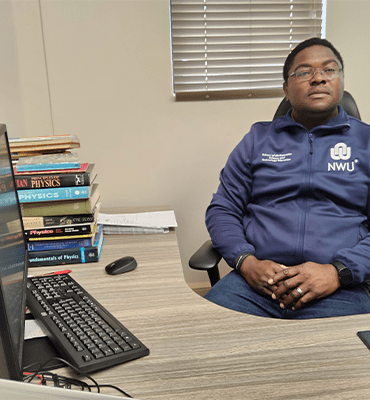
Picture: NWU’s Dr Paul Iwuanyanwu/Supplied
By BAKANG MOKOTO
25 May 2026 – Dr Paul Iwuanyanwu from the School of Mathematics, Science and Technology Education in the North West University (NWU) Faculty of Education believes that STEM education should extend beyond technical training by cultivating engagement with the epistemic and ethical practices of reasoned argument, especially as professionals must justify decisions that carry profound technical, social and moral implications. Iwuanyanwu warns that innovation driven solely by technical efficiency may neglect broader human and societal consequences.
He is the author of the book Empowering STEM Thinkers Through Argumentation: A Framework for Critical Practice. Iwuanyanwu further said in it, he argues that STEM education must move beyond technical knowledge and memorisation to develop critical thinking, ethical reasoning and argumentation skills.
“The book presents a human-centred framework for understanding and advancing responsible STEM education and practice in an age increasingly shaped by artificial intelligence, automation and rapid innovation. Science, technology, engineering and mathematics together are called STEM fields and they drive the systems that power modern civilisation, from healthcare and infrastructure to energy, food security and communication.
“Even our growing dependence on artificial intelligence and other emerging technologies. These fields equip societies to solve complex problems and to innovate. Because of their importance, STEM education must continually evolve; otherwise, it risks producing graduates technically skilled for yesterday’s world rather than intellectually prepared for tomorrow’s,” he said.
According to Iwuanyanwu, his motivation for writing the book came from years of frustration with the narrow ways in which STEM education is often understood. He added that, too often, educational systems equate STEM competence with content mastery, procedural accuracy and examination performance, while neglecting the deeper human capacities that give knowledge meaning and ethical direction.
“For me, this represented a profound philosophical problem. Knowledge without reflection can become dangerous, and innovation without ethical reasoning can become destructive. This concern lies at the heart of the book. The argumentation should not be treated as an optional classroom method, but as the intellectual and ethical foundation of STEM thinking itself.
“Through argumentation, students learn to justify claims with evidence, evaluate competing ideas, respond to counterarguments and revise their thinking when stronger evidence emerges. I believe this is essential because real-world STEM problems are rarely simple. Scientists must defend interpretations, technologists must evaluate competing models and their social consequences, engineers must negotiate trade-offs, and mathematicians must justify generalisations,” said Iwuanyanwu.
He said in each case, responsible innovation depends on disciplined reasoning rather than passive agreement. Iwuanyanwu said traditional STEM education is increasingly inadequate because it was largely designed for industrial societies where success depended on procedural mastery and technical accuracy.
“That model is no longer enough in a world shaped by artificial intelligence, automation, biotechnology and complex socio-technical systems. In such a context, technical knowledge alone is insufficient because intelligent machines can already outperform humans in processing information.
“The deeper challenge is whether human beings can still think critically enough to question assumptions, interpret evidence and ethically govern the systems they create. The risks of failing to do so are significant,” he said.
Iwuanyanwu warns that society may produce professionals capable of building powerful systems without adequately asking whether those systems should exist, whom they benefit, and whom they may harm. He said this is already visible globally in algorithmic bias, unethical uses of artificial intelligence, environmental degradation, misinformation systems and technologies that deepen inequality.
“For me, one of the greatest risks of the contemporary technological age is not artificial intelligence itself, but uncritical human dependence on systems that are no longer deeply questioned. When graduates lose the capacity to interrogate assumptions or evaluate consequences, they risk surrendering human judgement to automated systems.
“That is why I believe universities must move beyond preparing students merely to use technology. They must prepare students to interrogate, justify, govern and humanise technical knowledge responsibly. Technologies are never neutral. Every algorithm or automated system carries assumptions, cultural values and consequences,” said Iwuanyanwu.

