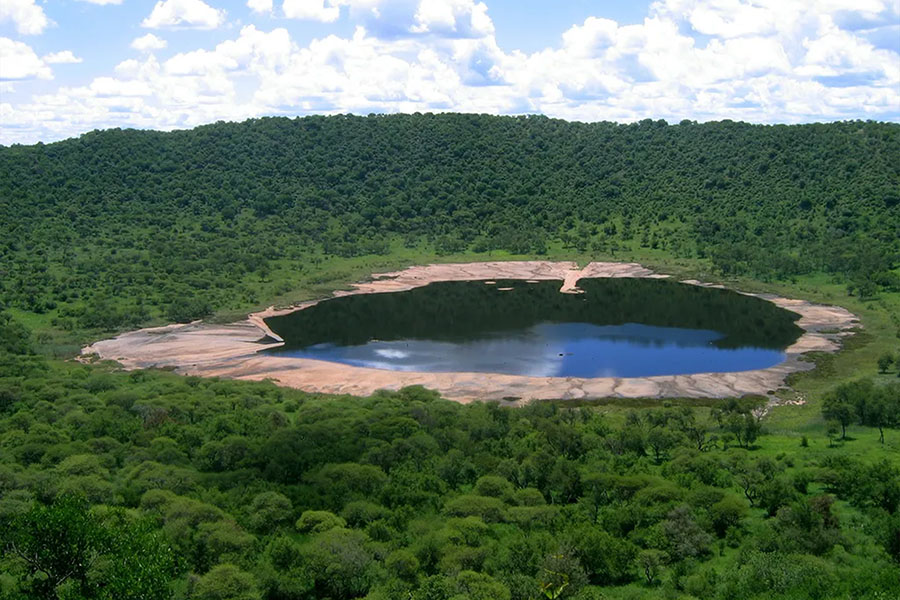
Picture: Tswaing Meteorite Crater
By AGISANANG SCUFF
10 October 2026 – According to ditsong.org.za, some 220 000 years ago a blazing stony meteorite the size of half a football field slammed into the earth’s crust. The impact formed a huge crater, 1.4 km in diameter and 200m deep.
Tswaing Meteorite Crater is one of the best-preserved meteorite impact craters in the world. The name “Tswaing” means place of salt in Setswana and refers to a saline lake that covers the crater floor.
From 1912 to 1950, an industry producing soda ash and salt operated at the crater. Major attractions, besides the crater, are an extensive wetland system, the large variety of plant species of the Sourish-Mixed Bushveld, and 240 species of birds.
From the start, the Tswaing project has invited community participation in its planning and development. Local communities have already benefited from the Museum project through job creation, skills training, environmental education, income-generating projects and tourism.
Annual Heritage Day event involving local dance, song, cuisine
Annual careers week for older school learners and the public with a focus on heritage environment and tourism careers. Education programmes including map work, guided tours that include indigenous knowledge of the local beliefs, plants and area, as well as the history of Tswaing.
Site available for film and photo shoots. Kgotla in traditional style huts situated around a lapa area (accommodates 64 people)
Well-established picnic area with basic camping facilities. The Tswaing Meteorite Crater was formed approximately 220000 years ago when a stony meteorite about half the size of a football field slammed into the Earth’s crust.
An asteroid or chondrite meteorite roughly 30 to 50 meters in diameter struck the Bushveld Igneous Complex granite base. The impact left a bowl-shaped crater measuring roughly 1.13 km to 1.4 km in diameter and 100 to 200 meters deep.
Geologists once debated whether the feature was volcanic, though rock analysis eventually confirmed its meteorite origin. Early humans were drawn to the area 300,000 to 150,000 years ago for the water, salt, and surrounding wildlife.
From 1912 to 1950, a commercial enterprise operated inside the crater to produce salt and soda ash, historically known as the Pretoria Saltpan or Soutpan. Managed by the Ditsong Museums of South Africa, the 1,946 to 2,000-hectare reserve features a 7.2-km hiking trail, a museum, old mining machinery remains, and a wetland supporting over 240 bird species.

