By OBAKENG MAJE
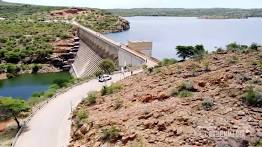
9 October 2026 – Most people believe that Taung Dam can be one of the best heritage sites in Taung. As many people flocked to the area for leisure, especially during festive season, some use it for their spiritual journey.
Residents at large believe that the area holds deep cultural, historical and spiritual significance.
Built in 1993 during the Bophuthatswana government, Taung Dam construction submerged the ancestral graves of the local Kolong and Dikgageng communities without their consent. The site already features a government unveiled memorial stone erected in 2007 to honour those ancestral spirits.
According to Sabinet Gateway Journal, Taung Dam was constructed to boast commercial farming and recreation. The construction of the Taung Dam involved extensive consultation with the local community and held a great potential for development of the region.
“Taung Dam was one of the nominations for the Mmabatho Informal Branch’s Award for Excellence in Civil Engineering. It was built by the Bophuthatswana Department of Water Affairs, after extensive community consultation with a view to deriving the optimum benefit from the resources available to provide maximum economic stimulation for the Taung District.
“The method of construction of the dam, using the relatively new concept of rollcrete combined the economic advantages of the mass concrete gravity configuration most favoured by the topography of the site and those derived from the mass earthworks style placing techniques associated with rollcrete.”
Taung Dam is the tallest of only five rollcrete dams in Southern Africa. It represents the successful combination of state-of-the-art technology with community inspired and sanctioned development.
“Taung Dam was built as a project for the people. A detailed District Development Plan (DDP) was initiated by the Bophuthatswana Department of Water Affairs for the Taung District.
The project chosen by the Mmabatho Informal Branch as its 1993 regional award winner is the Bophuthatswana Rural Water Supply Programme.
“This project has also been nominated for SAlCE’s National Award for Outstanding Civil Engineering Achievement. The DDP was extensively based on community consultation and as a result was fully supported and sanctioned by community leaders in the District,” the article said.
According to the journal, the purpose of the DDP was to ascertain the true economic aspirations of the residents in the District. The site can have major economic activity that can be successfully sustained in the Taung District given its relative remoteness from any substantial industrial resources or infrastructure, is commercial farming.
“The construction of the Taung Dam with its 60 million m3 reservoir, was the only way in which adequate water resources could be harnessed to cater for the irrigation requirements for the successful and prosperous development of the Taung farming community and hence ensure the associated socioeconomic advancement of the District as a whole.
“Construction of the dam commenced at the end of 1990. Shortly after the contract commenced it was decided after consultation with the local community and the Department of Public Works, to construct a road bridge across the top of the dam to improve general access in the area.”
The dam was essentially completed in 1993, at a final cost of approximately R41 million.
A qualified Tourist Guide, Bahedile Dichaba said there was a village in that area called Dikgageng before the establishment of the iconic bridge. Dichaba said the Bophuthatswana government saw it fit to construct a bridge in order to deal with the density of water that was overflowing.
“This resulted in what we call damming, and various households were forced to relocate to areas such as Manthe, Ranstad, Kolong, Cokonyane and other neighbouring areas. The construction of the bridge commenced back in 1983, which I stand to be corrected.
“However, in 1987, the Taung area experienced flooding which was catastrophic. So, under the bridge, there are wrecks of the yellow fleet. There are graveyards submerged and on the brighter note, there is an island on the other side of Taung Dam,” he said.
Dichaba further said Taung Dam can be used as a tourism site for water borne activities, such as kayaking, canoeing, stand-up paddleboarding (SUP), surfing, windsurfing, rafting, kloofing, kitesurfing and parasailing. He added that it can also be used for underwater activities such as snorkeling, scuba diving and freediving, including spearfishing.
“Other than that, it can be used as water parks and play,” concluded Dichaba.

