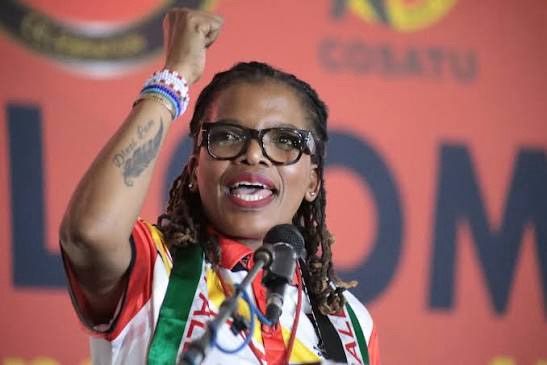
Losi calls for action against unemployment


By OBAKENG MAJE

13 October 2026 – COSATU President Zingiswa Losi has called on the federation’s leadership and affiliates to put aside factional differences, unite behind the interests of workers and intensify the fight against unemployment, poverty, inequality and exploitation. Addressing the opening of the Congress of South African Trade Unions’ (COSATU) 15th National Congress on 12 October 2026, Losi said the federation faced a critical moment following recent divisions that resulted in an adjourned congress.

She urged delegates to use the gathering to rebuild unity and strengthen the labour movement rather than allow internal disputes to weaken the organisation.

“We have been down this road of division, and it does not end well. It weakens the Federation, it demoralises workers, it emboldens our class enemies. It is enough.

“The federation had to place workers’ interests above individual ambitions and factional differences. Continued division could undermine our ability to represent the working class,” said Losi.

She said let this adjourned Congress mark the moment when all of them step back from the precipice, unite and put aside their differences and place the unity of the federation and the interests of the working class ahead of our individual ambitions or factional imaginations. Losi said COSATU’s primary responsibility was to defend workers against unemployment, exploitation, poverty, inequality, racism, sexism, crime, corruption, homophobia and Gender Based Violence (GBV).

“The federation existed to serve workers, including domestic workers, public servants and employees in vulnerable sectors.

“We are here to serve the working class, from the domestic worker in Sandton forced to work for weeks at a time without seeing her children, to the police officer in Kimberley who risks his life to keep us safe. We are not here to serve ourselves,” she said.

Losi highlighted what she described as COSATU’s achievements in protecting labour rights, improving wages and securing social and economic reforms. She said the federation had played a significant role in defending South Africa’s progressive labour laws and preventing proposals that sought to weaken workers’ rights.

“I want to point out agreements we have reached with government following negotiations at the National Economic Development and Labour Council (Nedlac), including measures to double retrenchment payments, protect the National Minimum Wage from deductions and extend labour protections to workers in non-traditional employment arrangements.

“The national minimum wage had helped improve the earnings of millions of vulnerable workers since its introduction,” said Losi.

According to her, minimum wages for domestic workers, farm workers and employees in sectors such as hospitality, construction, cleaning, security and transport had increased substantially. She further highlighted the two-pot retirement system, which came into effect in 2024 after years of engagement and resistance, saying it had enabled millions of workers to access some of their retirement savings while retaining funds for long-term retirement provision.

“Today, more than R80 billion has been released into the pockets of over 4 million highly indebted workers whilst boosting long term savings and doubling the number of workers who will be able to retire in comfort.

“The federation would continue engaging government on tax reforms to reduce the financial pressure on working and middle-class households, added Losi.

She warned that South Africa could not continue to accept high unemployment and sluggish economic growth as normal. Losi called for a comprehensive economic stimulus package, increased public employment programmes and the revival of artisan training to create pathways into permanent employment for young people.

“We cannot continue to normalise the abnormal nor tolerate 43.8% unemployment and a stagnant economy,” she said.

She also urged government to abandon austerity measures and ensure that public institutions received adequate resources to deliver essential services.

Losi welcomed the recruitment of additional personnel in the public sector, including 10 000 police officers, 10 000 labour inspectors and 6 500 South African Revenue Service employees.

She said the country needed more teachers, police officers, nurses, paramedics, doctors and other public servants to meet the needs of communities.

taungdailynews@gmail.com

‘RSA assumes the G20 Presidency at a critical historical juncture’


By OBAKENG MAJE

30 April 2025- The Deputy Minister of International Relations and Cooperation, Alvin Botes said the G20, or Group of Twenty, is an international forum of the world’s major economies—both developed and emerging—that collectively represent approximately 85% of global Gross Domestic Product (GDP), 75% of international trade, and about two-thirds of the world’s population.

Botes said this at the Group of Twenty (G20) High Level African Dialogue of the Think 20 (T20), in Pretoria, South Africa, 29 April 2025. He further said initially formed to promote international financial stability and economic coordination in the wake of the 1999 financial crises, the G20 has evolved into a central forum for addressing a wide range of global challenges, including climate change, poverty, digital transformation, food security and inclusive development.

“In 2023, the African Union (AU) was admitted as a permanent member of the G20 during the Leaders’ Summit in Delhi, India.

“This historic development, following the inclusion of the European Union as a regional bloc, underscores Africa’s growing importance in global governance and provides the continent with a unique opportunity to influence the world’s most powerful economic agenda-setting body,” said Botes.

He further said South Africa, as the sole African G20 member state and now the host of the 2025 G20 Presidency, plays a crucial role in facilitating and amplifying African agency in this forum. Botes added that South Africa’s presidency, themed Solidarity, Equality, Sustainability, is not only a call for cooperative global action but a platform for Africa to reshape its engagement with the global community.

“South Africa assumes the G20 Presidency at a critical historical juncture. The world is navigating what many have termed a ‘polycrisis’—a convergence of overlapping global challenges including inequality, debt distress, climate shocks, geopolitical instability, food insecurity and digital exclusion.

“These are not abstract global threats—they are lived realities for millions across Africa. With less than five years remaining before the 2030 deadline for the Sustainable Development Goals (SDGs), there is growing concern over the backsliding on global commitments,” he said.

Botes said as highlighted by the UN, only 12% of SDG targets are currently on track. He said South Africa’s presidency is particularly important because it offers a platform to re-centre the G20’s focus on development outcomes for the Global South, particularly Africa.

“With the theme Solidarity, Equality, Sustainability, South Africa has pledged to push for collective global responses that reflect the principles of justice, equity, and inclusiveness—values deeply rooted in the African philosophy of Ubuntu.

“The Presidency will promote a people-centred, development oriented G20 that fosters inclusive economic transformation rather than economic dominance by the few,” said Botes.

He said the G20 operates through two primary tracks: the Finance Track and the Sherpa Track. The Finance Track focuses on macroeconomic issues, financial stability, debt sustainability, taxation, and infrastructure financing. Botes said the Sherpa Track, on the other hand, covers broader developmental and sectoral policy discussions on employment, education, digital transformation, climate change, gender equality, health, and more.

“The T20 Africa High-Level Policy Dialogue at a moment when our continent’s voice is not only being amplified in global forums but is helping to alter the global governance architecture.

“South Africa’s G20 Presidency in 2025, captured in our theme: Solidarity, Equality and Sustainability is a unique value proposition to the rest of the world to change the economic and financial architecture of global governance institutions,” he said.

Botes said their deliberations are integral to that effort. He said the T20 brings some of Africa’s finest thinkers to the table, ensuring that ideas forged encapsulates state and non-state policy considerations from the African continent at a substantive level and not merely as a subordinate consideration.

“Our task is clear: transform the African Union’s historic admission as a permanent G20 member from symbolism into substance—through coherent positions, credible analysis and consistent advocacy.

“Engagement groups such as the T20, W20, C20, Y20 and Labour 20 are the heartbeat of the G20. They translate lived experience into evidence-based policy and give legitimacy to global decisions,” said Botes.

He said for Africa, their work is vital in confronting debt vulnerability, accelerating digital transformation, securing fair trade and unlocking climate-resilient development. Botes said as they debate, let them keep sight of the broader struggle for African agency.

“We do not assert ourselves out of resentment, but out of conviction that the world needs Africa’s ideas and resources if it is to overcome inequality, conflict and ecological crisis.

“And as we champion inclusion, let us make it gender-responsive and fair to future generations: women and children still bear the heaviest burdens of poverty and climate stress,” he said.

Botes said South Africa’s foreign policy—rooted in Pan-Africanism, human rights, international law, peaceful resolution of conflict, multilateralism, international solidarity and non-alignment —will use this G20 Presidency to press for a more just financial architecture, equitable access to development finance, food-energy-water security and a value-adding transition in critical minerals.

He said with the above in mind, it is now his privilege to introduce a leader whose commitment to strengthening the African Agency in the G20 is unequivocal.

taungdailynews@gmail.com