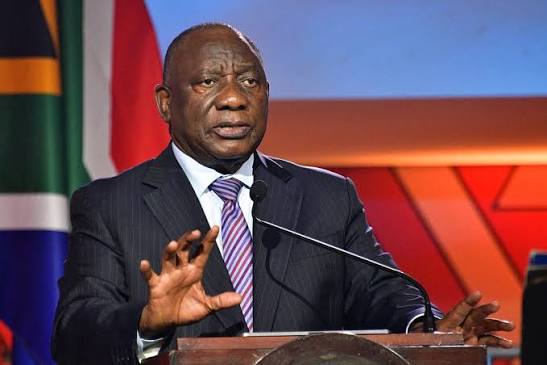
Picture: RSA president, Cyril Ramaphosa
By OBAKENG MAJE
23 November 2026 – The Republic of South Africa (RSA) president, Cyril Ramaphosa said over the course of the last week, they have been part of a South African delegation to Silicon Valley in the United States, where they engaged with representatives from businesses, industry and academia at the forefront of global advances in Artificial Intelligence (AI). Ramaphosa said when planning for this visit, they were adamant that the delegation should include young South African innovators, entrepreneurs and students who will be at the forefront of the next wave of innovation.
He further said for young people pursuing careers in technology, getting exposure to the world’s leading technology companies is an opportunity to witness innovation at work and to draw on the knowledge of others to inform their own ideas. Ramaphosa added that through the generous support of sponsors, they were able to include 30 students from universities and TVET colleges in the delegation.
“We were also able to include a group of tech start-up founders and entrepreneurs developing cutting-edge solutions in the local AI ecosystem. They actively participated in the week-long programme that included events at Sacramento State University and visits to the headquarters of Cisco, Palo Alto Networks, Google and Alphabet.
“During this working visit, these ambitious, focused and determined young South Africans made our country proud. This was a great opportunity for some of our country’s talented young people to learn from their peers and from industry experts, to build their networks and to get international exposure for their ideas,” he said.
Ramaphosa said one young founder who has developed a local AI-powered educational platform had the opportunity to pitch his company to a Google executive face-to-face, making a valuable connection that could potentially help him scale his business in the future. He said an electrical engineering student from a TVET college in the Vaal, had the opportunity to engage with fellow students at Sacramento State University and get advice on his future study trajectory.
“For another student, who is pursuing a Master’s Degree in Information Systems at a university in the Eastern Cape, this visit will form part of her research into the integration of AI in university curricula.
“Another young founder, whose company is building a large language model for African languages, says the visit gave her confidence that there is clear will by government and industry to harness the potential of AI in work and other areas of life,” said Ramaphosa.
He said as a country, they must stake their claim in the next technological frontier so that they can more effectively confront their developmental challenges. Ramaphosa said it is precisely because of the depth of these challenges that the next generation must be exposed to the technologies, ideas and networks that can help them overcome them.
“One of the students on the working visit, for example, is conducting research into how AI can be harnessed in the public healthcare system, both to support how doctors make decisions and how workflows are managed in hospitals.
“In his famous 1906 speech, ‘The Regeneration of Africa’, Pixley Ka Isaka Seme spoke of an Africa that “has refused to camp forever on the borders of the industrial world”. He spoke of knowledge being power and of Africa’s children, once educated, “returning to their country like arrows, to drive darkness from the land,” he said.
Ramaphosa said the visit to Silicon Valley has been both encouraging and challenging. He said although the adoption of AI in South Africa by both businesses and individuals continues to grow, a successful shift to AI will require more than just access to the tools.
“For a country with high levels of poverty, unemployment, inequality and uneven access to services, AI offers an extraordinary opportunity to accelerate development. Following this visit, we will therefore be developing an AI Action Plan that outlines a set of immediate priorities that will guide South Africa’s participation in the rapidly evolving AI ecosystem.
“The plan will translate the lessons learned on the visit into practical outcomes. In doing so, we have to manage both opportunity and risk. We must ensure that the development of advanced AI systems is accompanied by effective safeguards, independent evaluation and appropriate governance,” said Ramaphosa.
He said they need to strengthen their own cybersecurity capabilities and protect their critical national infrastructure. Ramaphosa said this means that they must develop legal and regulatory frameworks that encourage innovation while protecting privacy, intellectual property, human rights and the public interest.
“We have to prepare our workers, institutions and education system for the workplaces of the future. In doing all this, we will continue to seek out opportunities to learn from those who have already moved beyond theory to practical adoption of these technologies.
“As we draw on their experiences, learn from their successes and setbacks and adapt our own approach accordingly, we will build a future in which the extraordinary power of technology is placed at the service of all our people,” he concluded.

