
Mothers need more support to breastfeed


By BAKANG MOKOTO

7 July 2026 – Associate Professor at the North West University’s (NWU) Centre of Excellence for Nutrition with an interest in public health nutrition, Prof Christine Taljaard-Krugell said breastfeeding is a public good – so why are mothers carrying the cost alone?

Taljaard-Krugell said South Africa has the policies, but has the country counted the cost for mothers to breastfeed? She further said breastfeeding should not be a choice between feeding a baby and feeding a family.

“We tell mothers to breastfeed, but do we make it possible? South Africa has among the most progressive infant feeding policies in the world. The Tshwane Declaration of 2011, signed by Ministers, MECs, traditional leaders, and representatives from the World Health Organisation and UNICEF, committed the country to protecting exclusive breastfeeding (EBF) for the first six months of life.

“The R991 Regulations of 2012 imposed strict marketing restrictions on formula. South African law binds companies and citizens to R991 itself. It does not bind them to the subsequent WHO guidance, much of which has evolved since 2012. The country meets the letter of a decade-old law without necessarily meeting the spirit of where the evidence has since travelled,” said Taljaard-Krugell.

She added that exclusive breastfeeding rates tell a different story. Taljaard-Krugell said the most recent national figure puts exclusive breastfeeding at six months at 22%.

“A decade and a half of political commitment has not changed this trajectory in any sustained way. The standard response has been to strengthen the clinical chain: more lactation counsellors, better-trained community health workers, and expanded breastfeeding support at facility level.

“These interventions matter, and they address barriers that are very real. But evidence suggests that information and clinical support, while necessary, are not sufficient for many South African mothers. What is often missing is something more basic: time and income,” she said.

Taljaard-Krugell said the benefits of breastfeeding for both mother and child are well established. She said for infants, breastfeeding reduces the risk of infectious diseases and lowers the likelihood of stunting.

“For mothers, lactation itself lowers the risk of postpartum haemorrhage, type 2 diabetes and certain cancers. These benefits belong first and foremost to the mother-infant pair, regardless of whether the milk reaches the baby directly at the breast or through other means.

“However, some of the benefits of breastfeeding extend far beyond the household. Healthier infant places less strain on public clinics and hospitals. Reduced childhood illness means fewer missed school days and, later in life, improved opportunities for the child and lower costs for the state,” said Taljaard-Krugell.
taungdailynews@gmail.com

Over R90 million allocated for the refurbishment of traditional council offices


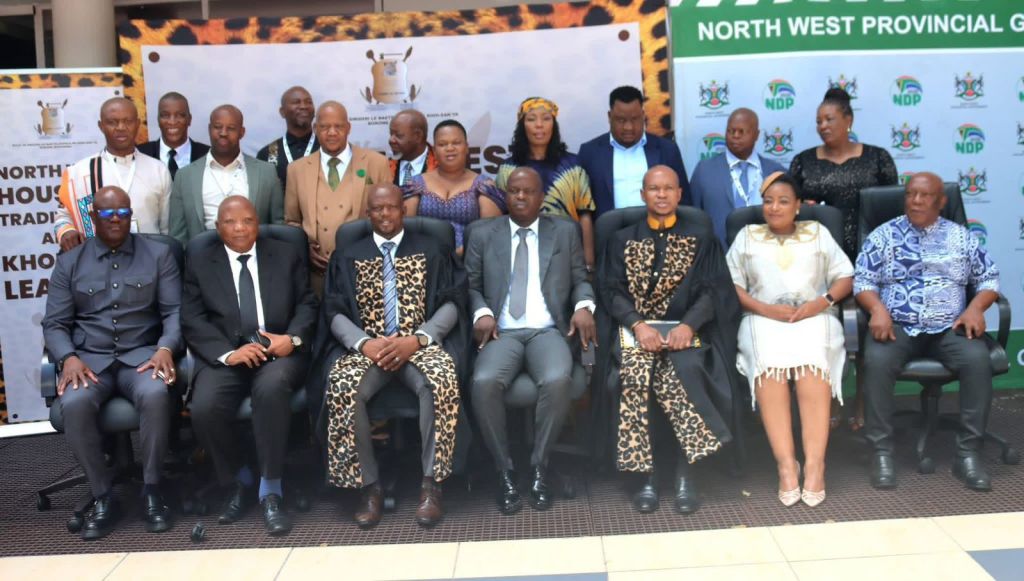
Picture: The Provincial House of Traditional and Khoi-San Leaders/Supplied

By STAFF REPORTER

30 March 2026 – The North West Provincial Government (NWPG) has reiterated its dedication to bolstering traditional leadership’s position and recognising this role as a central pillar of governance, land stewardship and socio-economic development. This follows pronouncements made by the North West Premier, Lazarus Mokgosi during the official opening of the Provincial House of Traditional and Khoi-San Leaders for the 2026/2027 term, held at the Lowe Chambers in Mahikeng.

The prestigious ceremony, presided over by Chairperson Kgosi Thari Maotwe, brought together Members of the Executive Council (MECs), Traditional Leaders, Mayors, and other key stakeholders, marking a significant moment in the province’s governance calendar.

Delivering the keynote address, Mokgosi emphasised the importance of traditional leadership in shaping the province’s developmental agenda. He further said they are deliberately repositioning traditional institutions from being peripheral stakeholders to becoming primary partners in economic transformation, investment facilitation, and sustainable development.

“Our traditional leaders remain enablers of our socio-economic trajectory, particularly as custodians of our land. We have announced bold interventions aimed at unlocking the economic potential of land under traditional authorities.

“They include the transfer of qualifying properties from the North West Development Corporation (NWDC) to traditional leaders. For a prolonged period, NWDC has held assets located on land under the jurisdiction of traditional leaders, without these assets generating meaningful economic returns for the rightful landowners,” he added.

Mokgosi said this intervention is aimed at restoring control, ownership and economic dignity to traditional communities. He said they will also ensure that these properties are not merely transferred, but are actively revitalized through structured investment facilitation.

Mokgosi also announced initiatives to ensure that communities directly benefit from provincial resources. He said these include the commercialisation of provincial parks, where traditional authorities and communities will participate as equity partners.

“This approach represents a shift from exclusionary conservation models to one that recognises communities as co-owners and beneficiaries.

“Over R90 million has been allocated for the refurbishment of traditional council offices and chambers, while additional investments will go towards tools of trade, including vehicles, laptops and mobile devices,” said Mokgosi.

He said the Traditional Councils were encouraged to utilise their monthly allocation of R100 000 effectively to strengthen administrative capacity and service delivery. Mokgosi said addressing key challenges affecting rural communities, the government’s focus on improving road infrastructure, water provision, housing and agricultural development.

“We believe the upgraded road network will enhance access to essential services such as clinics, schools and community facilities, while also creating over 3000 job opportunities through labour-intensive methods,” he said.

taungdailynews@gmail.com