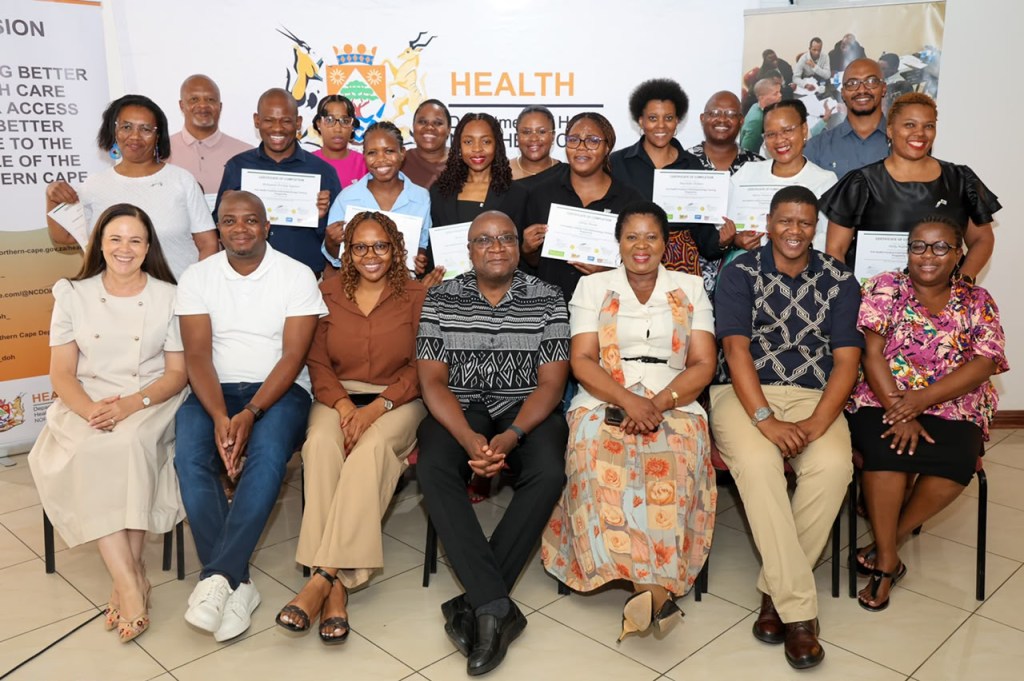
Picture: Northern Cape Health professionals complete FETP/Supplied
By BAKANG MOKOTO
17 November 2026 – The Northern Cape Department of Health celebrated a significant milestone in strengthening public health capacity through the successful implementation and completion of the Field Epidemiology Training Programme (FETP) Frontline tier on 12 November 2026. This very first FETP-Frontline training in the Northern Cape province was launched in August 2026, in collaboration with the South African Field Epidemiology Training Program (SAFETP) of the National Institute for Communicable Diseases (NICD).
The Northern Cape MEC for Health, Nontobeko Vilakazi said FETP-Frontline is a 3-months training that aims to strengthen the use and quality of surveillance data, and outbreak preparedness and response capacity at local level of the public health system. Vilakazi said as part of the training, participants learn epidemiological concepts during classroom sessions, and conduct surveillance data analysis, problem analysis, and case or outbreak investigations during the field intervals.
“Subsequently, participants present reports of their field activities during scientific seminars at the end of the training period. The cohort comprised 14 professionals, including Environmental Health Practitioners, Health Promoters, EPI Programme Managers, and Monitoring and Evaluation personnel from the Department, who have now graduated across all districts in the province.
“The Northern Cape Cohort 1 Scientific Seminar was successfully held on 11-12 November 2026 in Kimberley, bringing together the trainees in the province, facilitators and public health professionals to showcase field epidemiology work conducted during the training programme,” she said.
Vilakazi further said the seminar provided participants with an opportunity to present the findings of their surveillance analyses, outbreak investigations and case investigations conducted across the districts of the Northern Cape Province. She added that participants demonstrated the practical application of epidemiological methods through presentations on a wide range of public health topics, including measles, congenital syphilis, Group A Streptococcus infection, Streptococcus pneumonia, cryptococcal meningitis, salmonella, hepatitis B, healthcare risk waste surveillance, and food safety monitoring.
“These presentations highlighted the importance of disease surveillance, timely case investigation, outbreak detection, and evidence-based public health action in protecting the health of communities across the province. The seminar serves as an important platform for knowledge sharing, peer learning, and constructive scientific discussion.
“Participants demonstrated their growing competencies in data analysis, interpretation of findings, and communication of public health evidence. The presentations reflected the commitment of the trainees to strengthening disease surveillance and response systems within the Northern Cape. The seminar culminated in a certificate award ceremony to formally recognise the participants’ successful completion of the FETP Frontline Epidemiology Training Programme,” said Vilakazi.
She said the training programme forms part of the department’s broader strategy to, among others, increase capacity at district level to implement effective disease surveillance as an early warning system and ensure evidence-based planning. Vilakazi said to improve response to suspected or confirmed disease outbreaks and put preventative measures in place to mitigate spread at community level, strengthen collaboration between Department of Health and Municipality Environmental Health Services in the province.

