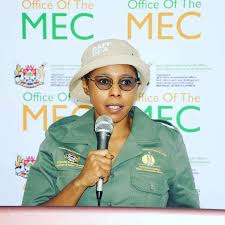
Picture: The Northern Cape MEC for Transport, Safety and Liaison, Limakatso Koloi
By BAKANG MOKOTO
2 September 2026 – The Northern Cape MEC for Transport, Safety and Liaison, Limakatso Koloi, together with the Northern Cape MEC for Women, Children, Youth and Persons with Disabilities, Mirriam Kibi, will be joining the Northern Cape Police Commissioner, Lieutenant General Koliswa Otola for the presentation and release of the crime statistics for the Northern Cape for the first Quarter of the 2026/2027 financial year.
The event will be held at the Northern Cape Office of the Premier, T&I Building, 69 Memorial Road, Kimberley on Friday at 8am.
Picture: The Northern Cape MEC for Social Development, Women, Youth and Persons with Disabilities, Mase Manopole
By BAKANG MOKOTO
8 June 2026 – The Northern Cape MEC for Social Development, Women, Youth and Persons with Disabilities, Mase Manopole led the provincial Child Protection Week programme in Victoria West, Ubuntu Local Municipality, under the theme: “Working Together in Ending Violence Against Children.” The event, supported by Ubuntu Local Municipality mayor, Sheryl Jantjies and local councillors, brought together government departments, SAPS, community leaders, faith-based organisations, civil society organisations, parents, caregivers and children to strengthen efforts to protect children from abuse, neglect, exploitation and violence.
Manopole said key stakeholders delivered messages of support, highlighting the importance of collaboration in safeguarding children. She further said SAPS underscored the role of law enforcement in combating child abuse, Legal Aid South Africa outlined available legal support services, while Child Ambassador Olothando Brys encouraged young people to make informed choices and remain focused on their education and future aspirations.
“Child protection is a shared responsibility. Children are the heart of our nation. Protecting them requires families, communities and the government to work together to create safe homes, schools and communities.
“We also raised concern over child abuse, sexual violence and teenage pregnancy in the province, noting that 396 child abuse cases were reported in the Northern Cape during the 2025/26 financial year, highlighting the need for stronger prevention and early intervention programmes,” added Manopole.
She said the Child Protection Week programme forms part of the department’s ongoing efforts to strengthen child protection services, family preservation programmes and community-based interventions addressing challenges such as Gender-Based Violence (GBV), substance abuse, family violence and teenage pregnancy.
She said the department also promoted awareness of reporting mechanisms and support services available to children and families, while encouraging communities to speak out against abuse and support child safety. Manopole called on parents, caregivers and community members to remain vigilant and to take children seriously when they report abuse or unsafe situations.
“Together, we can end violence against children and build a safer future for every child in the Northern Cape. In support of vulnerable families, we handed over 100 fleece blankets to parents and caregivers and distributed dignity packs to children during the programme.
“The initiative forms part of the department’s ongoing commitment to improving the wellbeing of children and families, while ensuring that vulnerable members of the community receive much-needed support and care during the winter season,” she said.
Manopole said the department extends its appreciation to all stakeholders, including SAPS, the Departments of Health, Education and Justice, municipalities, NGOs, faith-based organisations and community structures for their continued commitment to protecting children’s rights and wellbeing. She said as Child Protection Week continues, communities across the Northern Cape are encouraged to participate in awareness programmes, report abuse and help create safe, nurturing environments where every child can thrive.
Picture: The Chairperson of Portfolio Committee Women, Youth and Persons with Disabilities, Liezl van der Merwe
By BAKANG MOKOTO
3 February 2026- The Portfolio Committee on Women, Youth and Persons with Disabilities will this week conduct interviews for the appointment to serve on the National Council for Gender-Based Violence and Femicide (NCGBVF). Last year, the committee met and shortlisted 18 candidates to be interviewed to serve on the National Council.
The Chairperson of Portfolio Committee Women, Youth and Persons with Disabilities, Liezl van der Merwe said the committee received 403 applications submitted through various channels – online (322), email (80) and in person (1). Van der Merwe said furthermore, the committee noted that eight applications were submitted late and 48 were identified as duplications.
“The names of the shortlisted candidates along with CVs (in compliance with POPI Act) have been published on Parliament’s website. This has provided civil society and the public at large with an opportunity to comment on and engage with the shortlist, ensuring transparency and inclusivity throughout the selection process.
“Meanwhile, on 6 February 2026, the committee will conduct an oversight at Sibonile School For the Blind and Ekurhuleni School For the Deaf. The committee will visit schools for children with disabilities to understand how children with special needs are excluded from the education system,” she said.
Van Merwe added that as continuation of the work on the statutory rape enquiry, the committee seeks to understand the severity of the problem with special schools to be visited. She said the interviews will be conducted on 3, 4 and 5 February 2026 at Protea Hotel, OR Tambo from 8:30am until 4:30pm.
Picture: The Minister in the Presidency for Women, Youth and Persons with Disabilities, Sindisiwe Chikunga
By KEDIBONE MOLAETSI
5 Aug 2025- The Minister in the Presidency for Women, Youth and Persons with Disabilities, Sindisiwe Chikunga has launched 2025 Women’s Month. Chikunga said Women’s Month in South Africa stands as one of the most powerful illustrations of how a heritage of resistance has evolved into sustained advocacy for systemic change.
She further said their celebration is deeply rooted in what may be called embodied resistance—the physical act of 20,000 women marching to the Union Buildings on 9 August 1956 to eliminate laws that fundamentally restricted their autonomy, citizenship, and right to self-determination.
Chikunga added that the pass laws were not mere administrative inconveniences, but were tools of control that relegated African women to a subordinate status within both racial and patriarchal hierarchies.
“In marching, these women were resisting what Professor Kimberlé Crenshaw would later conceptualize as intersectionality—the overlapping systems of oppression based on race, gender, and class that created uniquely compounded forms of discrimination for African women.
“What makes Women’s Month particularly significant is how our struggle has evolved from resistance to reconstruction, from wanting mere inclusion to demanding a fundamental restructuring of power relations,” she said.
Chikunga said building on the legacy of 1956, their transformation agenda is much more daring to the patriarchal script. She said their agenda is rooted in centuries of systemic exclusion that relegated women to subordinate positions across virtually every sphere of human activity.
“At its core, our movement for gender equality seeks to uproot entrenched patriarchal structures that have historically denied women equal participation in economic, political, social and scientific spheres of life.
“Our President has led from the front in giving teeth and enforcement powers to the struggle for gender equality and women’s empowerment. The significance of appointing Justice Mandisa Maya as the first South African woman to occupy the position of Chief Justice and Head of the Constitutional Court, cannot be overstated,” said Chikunga.
She said today, South African women hold 43.5% of the seats in Parliament, occupying 171 out of 400 seats—an increase from 28% representation in 1994. Chikunga said the signing of the Public Procurement Bill and the Land Expropriation Act are clear signs of their commitment to gender-responsive land redistribution and related productive assets.
“The establishment of the R20 Billion a year Transformation Fund and its emphasis on supporting emerging women industrialists and SMMEs affirms our bold commitment to transformation. The National Council on Gender-Based Violence and Femicide (NCGBVF) Act has now been passed, and the process of establishing the National Council is underway.
“Another major achievement has been the ongoing success of our G20 Activities. More recently, under the leadership of South Africa’s G20 Presidency, our Chairship of the Empowerment of Women Working Group has elevated three overarching priorities such as policy perspectives on the care economy, financial inclusion and the elimination of Gender-Based Violence,” she said.
Chikunga said their working group is rallying the government to not only recognize, but value the care economy, which encompasses both unpaid and underpaid labour that sustains families, communities and economies worldwide. She said today, women perform approximately 75% of the world’s unpaid care work, valued at trillions of dollars globally, yet they remain systematically excluded from economic calculations and policy considerations.