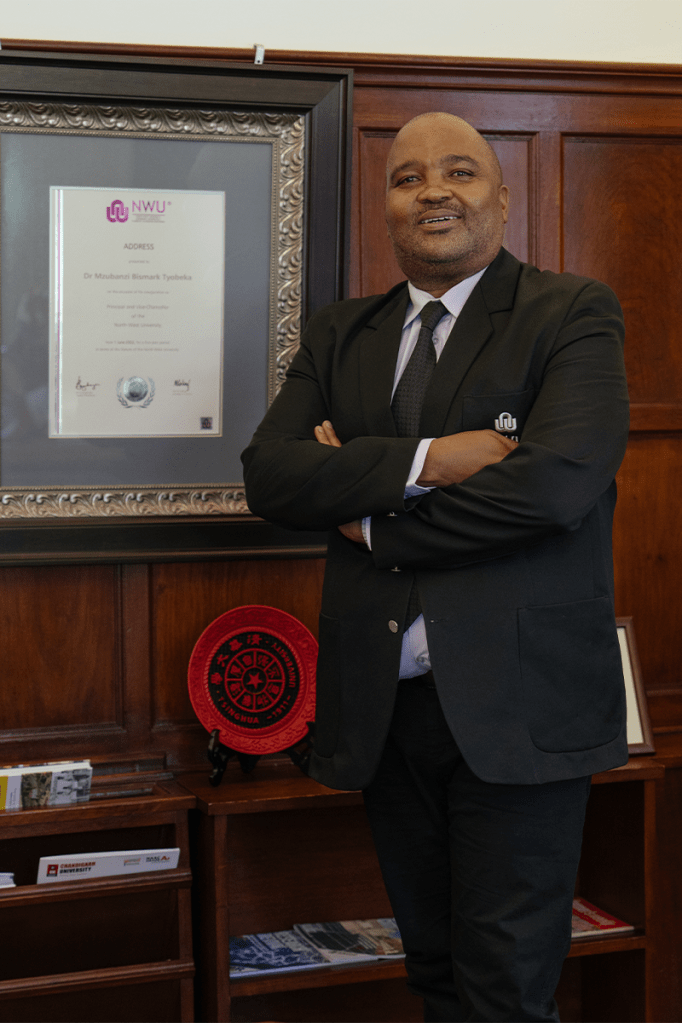
Picture: The North West University (NWU) principal and vice-chancellor Prof Bismark Tyobeka/Supplied
By REGINALD KANYANE
29 June 2026 – The North West University (NWU) principal and vice-chancellor Prof Bismark Tyobeka said twice, he was there when South Africa was the centre of the universe. Tyobeka said the last decade of the 20th century heralded the arrival of a nation poised to lead through moral example, as they pledged never again to repeat their tainted history.
“Today, many citizens threaten violence against foreigners, and once again we face becoming one of the world’s pariahs. On 11 February 1990, I was glued to the television in my sister’s home in the township of Selosesha in Thaba Nchu, where I had just started Standard 8 (Grade 10) at Moroka High School.
“I had taken a weekend off from the school hostel and together with a global audience, watched as Nelson Mandela walked free from Victor Verster Prison. Four years later, on 27 April 1994, I was in my village of Nonceba, where I cast my vote at Nonceba Primary School. South Africa opened its arms to all who live in it and in turn, the world opened its arms to us,” he said.
Tyobeka further said now, 32 years and two months later, as principal and vice-chancellor of the North West University (NWU), he is aghast at the danger of large-scale violence and disruptions aimed at illegal immigrants. He added that first, he wants them to be honest.
“There is no place for illegal immigration. We have limited resources and it is our obligation to look after and safeguard our citizens. After the recent spate of xenophobic attacks and the promise of more to come, South Africans are once again being asked to choose between two false extremes.
“Either they must tolerate xenophobia or they must ignore illegal immigration. Collectively, we should choose neither. We have to acknowledge that when governments fail to manage immigration properly, ordinary migrants often become scapegoats for failures that belong to the state,” said Tyobeka.
He said this is just as great an injustice as immigrants crossing the borders illegally. Tyobeka said violence, however, is never the answer.
“I want to bring the argument closer to home. My home. The North West University. The word university stems from the Latin universitas, which translates as “a community united as a whole”. At the NWU, we have lecturers, researchers and students from across our continent because we know that major scientific breakthroughs cross borders, that we have as much to teach others as we have to learn from them and that ideas have passports far more powerful than those carried by people.
“Students become better graduates because they encounter people who think differently, and a university that isolates itself quickly becomes intellectually poorer,” he said.
Tyobeka said in the public’s eye, the distinction between lawful migrants, refugees, international students and skilled professionals and those who deliberately circumvent immigration law, is disappearing. He said when that happens, they arrive at the toxic situation they face today.
“As public universities, I believe it is our duty to demonstrate that openness and order are not opposing ideals, but complementary ones. We thrive because we combine openness to people and ideas with accountability, merit and respect for the rule of law.
“International students do not simply arrive; they obtain the necessary visas. International academics are appointed through rigorous processes and are expected to comply with the same regulations and standards as everyone else,” said Tyobeka.
He said openness works precisely because it is underpinned by clear rules that are applied fairly and consistently. Tyobeka said a recent article in the respected British publication The Economist states that there is ample evidence to challenge many common assumptions about migration.
“Foreign-born residents make up only about 5% of South Africa’s population, and research by the World Bank and the Organisation for Economic Co-operation and Development suggests that migrants are often net job creators who establish businesses and stimulate economic activity.
“Studies have also found that foreign nationals are, on average, less likely to commit crime than South African citizens. These are hard truths, but are they widely known? The word universitas reminds us that humanity advances not by turning away from one another, but by learning together,” he said.
Tyobeka said yet communities also endure because they respect rules. He said South Africa does not have to choose between openness and order.
“We need both. We must reject xenophobia without reservation, enforce immigration law without apology and continue building universities that welcome ideas from every corner of the world while remaining firmly rooted in the rule of law.
“The colours of our Rainbow Nation are fading. The dreams of our founders are being deferred. The blood spilled in the pursuit of freedom has been forgotten and their beliefs are being neglected and misused. More than 11 750 days after I cast my first democratic vote, the legacy of reconciliation over revenge and hope over hatred remains ours to protect,” said Tyobeka.
He said let them take up a new canvas and use this opportunity to paint it brightly once again, so that the world may see that South Africa is more than a place on a map. Tyobeka said it is an idea to aspire to.

