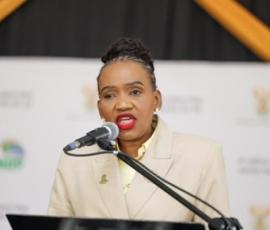
Picture: The Deputy Minister of Human Settlements, Tandi Mahambehlala
By BAKANG MOKOTO
21 September 2026 – The government has committed to accelerating interventions to address persistent service delivery challenges in the Phokwane Local Municipality in the Northern Cape. The municipality faces challenges including unreliable water supply, ageing infrastructure, housing backlogs, unemployment and electricity interruptions.
The Deputy Minister of Human Settlements, Tandi Mahambehlala made the commitment during an Integrated Service Delivery Outreach Visit to Phokwane in the Frances Baard District on Friday.
Leading the outreach on behalf of Deputy President Paul Mashatile, Mahambehlala said the outreach forms part of the work of the Inter-Ministerial Committee on Service Delivery, chaired by Mashatile.
Mahambehlala said the visit aimed to ensure that government leaders engage directly with co mmunities and understand their challenges first-hand.
“Today is therefore not merely an exercise in listening. It is part of holding all spheres of government accountable for delivery. The delegation visited the Vaalharts/Taung Irrigation Scheme, the Vala Zonke Project and the Pecan Nut Processing Plant to assess both the municipality’s development potential and obstacles holding back economic growth.
“Residents have clearly identified a range of pressing service delivery failures, including unreliable water supply, ageing infrastructure, potholes, sewer spillages, and electricity interruptions among others,” she said.
Mahambehlala further said these concerns are legitimate. She added that they are the daily measure of dignity.
“We acknowledge that the government’s response has not kept pace with the needs of communities and that while progress has been made in some areas, implementation has not happened at the speed communities deserve. We would like to emphasise that the government will have to move beyond engagements and ensure that identified interventions are implemented.
“The water and sanitation challenges in Pampierstad, including asbestos pipelines, recurring pipe bursts, sewer blockages and sanitation problems, were among the issues raised. This as the government implements projects to upgrade bulk water and sanitation infrastructure,” said Mahambehlala.
She said as a government, they do not claim to have all the answers. Mahambehlala said but they listened.
“We have taken note. We have seen your challenges. We also acknowledge long-standing frustrations over housing backlogs, including shortage of serviced sites and delays associated with bulk infrastructure.
“We have identified projects in Ganspan, Bonita Park, Kingston, Masakeng, Andalusia and Nkandla, but acknowledged that the pace of delivery remains far from satisfactory. The outreach must help ensure that blockages delaying these projects are addressed through greater coordination between government institutions,” she said.
Mahambehlala said unemployment was another major concern, with the municipality’s rate estimated at approximately 43%. She said communities should not be treated as beneficiaries of development, but that investment in communities translates into jobs, skills and enterprise opportunities.
“We call on the municipality, major employers, agricultural enterprises, businesses and investors to strengthen local recruitment and procurement, while expanding internships, apprenticeships and learnerships.
“Every infrastructure project, every agricultural investment, every housing development must become a vehicle for local job creation, skills development and enterprise opportunities,” said Mahambehlala.
She also supported calls for a Technical and Vocational Education and Training (TVET) college in the area to expand access to post-school education and training. Mahambehlala noted that young people should not have to leave their communities to access opportunities.
“The government’s response to infrastructure challenges will also have to include roads, electricity networks and protection of infrastructure from vandalism and theft. The Kolong Road Project and Vala Zonke Programme are among interventions being implemented, but acknowledged that the infrastructure backlog remains significant.
“Investment in electrification and network upgrades must be accompanied by stronger measures to address vandalism and electricity theft. The District Development Model (DDM) provides a framework for ensuring that the government does not work in silos,” she said.
Mahambehlala said the national, provincial and local government must plan together, budget together and deliver together. She said the people of Phokwane do not care which sphere is responsible.
“They simply want services, dignity and opportunity. While noting Phokwane’s agricultural assets, where local businesses and young people provide a foundation for economic development, we want to stress that this potential can only be realised through coordinated government action and effective implementation.
“We would like to assure residents that their concerns and the observations made during the visit will be reported directly to the Deputy President,” concluded Mahambehlala .

