Booysen case ‘thoroughly investigated’


CrimeTapeSmall

CAPE TOWN – The investigating officer working on the rape and murder case of Bredasdorp teenager Anene Booysen has defended the police probe.
Johannes Kana is standing trial for the rape, mutilation and murder of the 17-year-old in February.

The trial resumed in the Swellendam Circuit Court on Wednesday.

Kana confessed to raping Booysen but denied killing her.
Warrant officer Edmund Abels told the court Booysen’s rape and murder case was thoroughly investigated.

He said all tip-offs and leads were followed up.

Abels said even though the teenager mentioned the name “Zwai” when questioned about the suspects, no concrete forensic evidence could link him to the crime.

The court also heard a bra, which belonged to Booysen, had blood on it.

But again, no forensic evidence could be decisively linked to Kana.
The case resumes on Monday.
For more http://www.ewn.co.za

S&P reacts to budget speech


GetImage
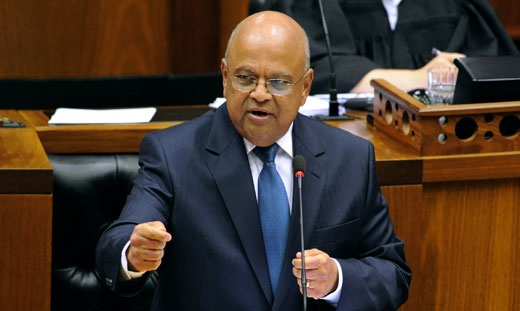
JOHANNESBURG – The medium-term budget policy statement has given South Africa some breathing room, ratings agency Standard and Poor’s (S&P) said on Wednesday. Finance Minister Pravin Gordhan delivered his speech in Parliament, Cape Town. Speaking to Talk Radio 702/567 Cape Talk’s Bruce Whitfield this evening, the minister defended his optimistic view of the economy as a whole. – See more at: http://ewn.co.za/2013/10/23/SP-reacts-to-budget-speech-1#sthash.NzloeDCK.dpuf

Robbery colonel hands self in


SAPS
Johannesburg – A military colonel who committed an armed robbery at an Eastern Cape police station 18 years ago, has handed himself over to the military police, the defence department said on Wednesday.

Brigadier General Xolani Mabanga said Colonel Nceba Patrick Bobelo reported to the joint operations headquarters in Pretoria on Tuesday afternoon.

“Arrangements were made for him to be taken by the military police. The military police then consulted with the correctional services department and the police for him to be handed over,” Mabanga said.

“The correctional services officials from Pretoria indicated that he [Bobelo] had to serve his sentence in the Eastern Cape. They were discussing the modalities of having him transferred.”

Disappeared from Mbombela home

Mabanga said there were no indications that Bobelo was trying to evade arrest or that he was trying to run away because he handed himself over.

On Tuesday, Eastern Cape police spokesperson Colonel Sibongile Soci said a warrant of arrest has been issued and police are looking for Bobelo.

Beeld reported on Tuesday that Bobelo disappeared from his Mbombela home in Mpumalanga before police could arrest him.

According to the report, indications were that Bobelo was trying to evade arrest. Soci told the newspaper Bobelo was not considered a fugitive.

Bobelo’s appeal against his prison sentence failed in 2001, but neither the army nor the justice department were able to explain why Bobelo, commander of the military’s joint tactical headquarters in Mpumalanga, had avoided jail.

Advanced rank

In 1995, he was one of four defendants convicted of robbing the Ntabethemba police station in the Eastern Cape. Two policemen were attacked and several firearms were stolen.

The four were sentenced to 12 years in prison each, of which three years were conditionally suspended.

One of the four appealed successfully in 2001, but Bobelo and the other two were ordered to start serving their jail terms immediately.

Bobelo, however, spent the next 12 years being advanced to the rank of colonel.

Following a Beeld report two months ago on Bobelo’s involvement in the robbery, the National Prosecuting Authority in the Eastern Cape received a query from the SA National Defence Force to determine why Bobelo had not served his sentence. The warrant for his arrest was then issued.

– SAPA

Robber shot during store robbery


CrimeTapeSmall
Johannesburg – Police shot and injured a man they caught stealing from a furniture shop in Johannesburg on Wednesday morning, metro police said.

He and three accomplices were robbing a Joshua Doore furniture shop on the corner of Fox and Delvers streets at around 08:00, Chief Superintendent Wayne Minnaar said.

A JMPD officer caught them red-handed as they were loading TVs and radios onto a van.

“One was shot in the leg during the scuffle as they were trying to flee,” he said.

He and another man were arrested. The other two ran away.

The arrested men would be charged with armed robbery at the Johannesburg Central police station.

Police were searching for the other two.

– SAPA

Free State farmer dies in tractor accident


cc66ba4996c94032bdbdfcce2b524e63
Bloemfontein – A man was killed when a tractor he was working on fell on top of him on a farm in Bethlehem, Free State, paramedics said on Wednesday.

The man, in his late 40s, had been working on the tractor late on Tuesday and when his wife woke up on Wednesday, found he had not come home, said ER24 spokesperson Vanessa Jackson.

“The farmer’s son went to look for him and was devastated to find his father trapped under the tractor,” she said.

Paramedics declared him dead on the scene.

– SAPA

Farlam concerned about Marikana murders


234be664fabe4265b0969192781fd352
Pretoria – Retired judge Ian Farlam expressed concern on Wednesday about murders linked to the Marikana Commission of Inquiry.

Farlam sent the commission’s condolences following the murder of National Union of Mineworkers (NUM) branch chairperson William Setelele.

He was gunned down near the Marikana koppie, close to Lonmin’s platinum mine in the North West, last Thursday.

“It is a matter of concern because a number of people connected to this commission have been assassinated. It is a matter which I am sure is receiving attention from the authorities,” he said.

“My colleagues and I wish to extend our condolences to the family, friends and colleagues of our former witness (Setelele). I hope the perpetrators will be brought to book in due course.”

Shot eight times

Karel Tip, for the NUM at the commission, also expressed his condolences. Setelele testified at the commission in January and February.

North West police said the Setelele was shot eight times.

“The man was gunned down on Thursday night between 19:00 and 20:00. He was on his way to visit his girlfriend when four men came out of the bushes and shot at his car,” said Brigadier Thulani Ngubane.

He was hit once when he was driving. When he stopped and got out of the car the men fired another seven bullets at him. He died on the scene.

Another NUM official, Daluvuyo Bongo, was killed in October last year.

At the time, Tip said NUM believed Bongo’s murder was a “target killing”.

Key evidence

The NUM branch secretary was shot six times at his home at the Wonderkop hostel complex in Marikana on 5 October. He was scheduled to testify at the commission’s public hearings.

At the time of Bongo’s death, NUM said he was set to present key information to the commission.

The inquiry, chaired by Farlam, is investigating the deaths of 44 people during strike-related unrest at Lonmin platinum’s operations at Marikana, near Rustenburg, last year.

Evidence leader Matthew Chaskalson SC was cross-examining Lieutenant Colonel Duncan Scott on Wednesday.

Scott helped draft the police plan which was to be used to try and disperse and disarm the striking mineworkers. The plan was referred to as the “Scott plan”.

– SAPA

Accountability linked to failures: Madonsela


76eafb5b30314896985bd05b7319bd8d
Johannesburg – Lack of accountability and lapses in leadership are some of the causes of governance failure, Public Protector Thuli Madonsela said on Wednesday.

“Whether we are talking about an organisation, or the state, it is a situation where the majority hand over power to the few, with the understanding that they are better off with a few managing their affairs,” Madonsela told delegates at the Black Management Forum conference in Midrand.

“It is a relationship of trust and it can only succeed if those, who are entrusted with power and resources, understand that they are stewards -that resources do not belong to them.”

She said it often did not work that way.

“At the level of government… we are getting a mentality [from communities] that says if we start a fire they will come,” Madonsela said.

“With a trust deficit [with regard to government], some communities are increasingly resorting to violence and are literally starting fires with the view to draw attention to themselves.”

She said this was happening in many disadvantaged areas.

“If those who exercise public power don’t… [follow the democratic values in the Constitution], the criminal elements have an easier task of promoting a [violent] reaction.”

Madonsela said her office was increasingly finding that leaders had problems understanding what it meant to do the right thing.

“Increasingly there is an issue of conflict of interest, where people place themselves in situations where really they have two masters,” she said.

“When you find yourself in a situation with two masters, something has to give and often it is your organisation that has to give, and other interests take [precedence].”

Failure of governance

Madonsela said a “loss of institutional memory” also led to the failure of governance.

“Even if you get highly competent people, it is difficult for them to know volumes and volumes of internal policies,” she said.

“Institutional memory loss leads to governance failures because increasingly people take action without going through the policies – because there are so many of them.”

She said the life cycle of directors general was too short, and a significant number did not finish their three-year terms.

“It is musical chairs. The same applies to municipal managers, but increasingly it’s applying to ministers, premiers, MECs, mayors and councillors,” Madonsela said.

“Increasingly that continuity is lost.”

Other causes of governance failure were a lack of skills, inconsistent enforcement, and power struggles, among others.

“Is it possible that good governance is the key that we lost in the transition from the society we inherited to the one we wanted to become when we signed the Constitution?” Madonsela asked.

– SAPA

R6.5m drug bust at Durban airport


SAPS
Johannesburg – Two people were arrested in Durban after being found in possession of drugs with an estimated street value of R6.5m, KwaZulu-Natal police said on Wednesday.

The couple aged between 28 and 29 were caught on Tuesday night at the King Shaka International Airport after they landed from India, said police spokesperson Jay Naicker.

Police confiscated 36kg of crystal methamphetamine in their luggage.

A 36-year-old woman was later arrested in the Point area in Durban waiting for the delivery of drugs from the couple, said Naicker.

The three would appear in court soon for dealing in drugs.

The arrests followed an instruction by provincial police commissioner, Lieutenant General Mmamonnye Ngobeni, to identify people supplying drugs to dealers in the province.

– SAPA

Shop owner held for unlicenced gun


Federal-Firearms-Law
Johannesburg – A foreign shop owner was arrested in Bekkersdal, near Westonaria, on Wednesday for possession of an unlicensed firearm and ammunition, Gauteng police said.

Police spokesperson Elsie Tshonte said residents informed police that the man had a gun and had used it to shoot another man.

“Police officers searched the shop and found the gun,” said Tshonte.

“But we have not received any details surrounding the shooting.”

Tshonte said no case had been opened and “the shop owner has not been charged for that”.

Police continued to monitor the area following violent service delivery protests.

Protesters had earlier gathered near the local taxi rank and burnt tyres.

Last week, 35 protesters were arrested and charged with public violence after a petrol bomb and stones were thrown into the police station.

Three police vehicles and a disaster management vehicle were damaged.

Tshonte said no protesters had been arrested on Wednesday.

– SAPA

Marikana cop communications in spotlight


a49c0d71d9b244b08cd6e79a35f78a8a
Pretoria – A senior police officer was questioned on Wednesday about the SA Police Service’s (SAPS)communication difficulties during the intervention to end the violent Marikana protest in Rustenburg last year.

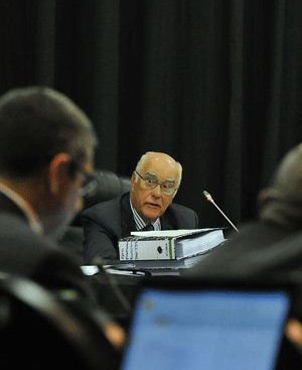
Evidence leader Advocate Matthew Chaskalson was cross-examining Lieutenant Colonel Duncan Scott at the Marikana commission’s public hearings in Pretoria.

Chaskalson sought answers on the communication difficulties between senior officers at the security joint operations committee (JOC) and officers deployed on the ground.

“We know from the video evidence that the first deaths [of mineworkers] at scene two happened 10 minutes into the video. We can work out that between the report of ‘bodies down’ and the first death at scene two, there would have to be 14 minutes,” said Chaskalson.

“At the very least, between that [bodies down] communication and the first deaths there are quite possibly more than 14 minutes. Is that sufficient time for control to have been exercised from the JOC, to take stock and pause the operation?”

Scott said police procedure dictated that in such a scenario, confirmation would need to be sought first, regarding the information on the dead bodies.

“You still need to consult with your commanders on the ground because to simply tell them to stop, pause where they were would be nave of the JOC.

“Police lives and other lives would be in danger,” he said.

“That time period would be sufficient [for the consultations].”

Changing channels

The commission also heard on Wednesday that a civilian was communicating on a stolen police handset radio.

Chaskalson asked Scott why officers did not change to another channel, different from the protester.

“From the 14th [of August] the SAPS was aware that a radio had been stolen. Once a radio has been stolen, there is a risk of interference or interception with communication which is foreseeable.

“Was anything done to set up a protocol for shifting to a back-up channel if there was interference [from the stolen radio]?”

Scott said there was a back-up channel “which was supposed to be utilised if one channel went down”.

Chaskalson then asked why officers did not shift to that back-up channel when their communication went down for some minutes during the operation.

“It wasn’t briefed [to officers] that we were expecting an interception of that kind. I can’t recall it being pertinently briefed, I don’t think we expected them [protesters] to use the police radio to jam the frequency,” said Scott.

Back-up channel

The senior policeman faced several questions on why the officers did not migrate to a back-up channel, when their communication by police radios failed on 16 August.

The inquiry, chaired by retired Judge Ian Farlam, is investigating the deaths of 44 people during strike-related unrest at Lonmin platinum’s operations at Marikana, near Rustenburg, last year.

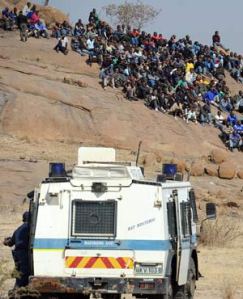
The police shot dead 34 people, mostly striking mineworkers, wounded 70, and arrested 250 on 16 August 2012. In the preceding week, 10 people including two policemen and two security guards were killed.

The hacked police officers were stripped of their handguns and radios.

Scott helped draft the police plan which was to be used to try and disperse and disarm the striking mineworkers.

The plan was referred to as the “Scott plan”.

– SAPA