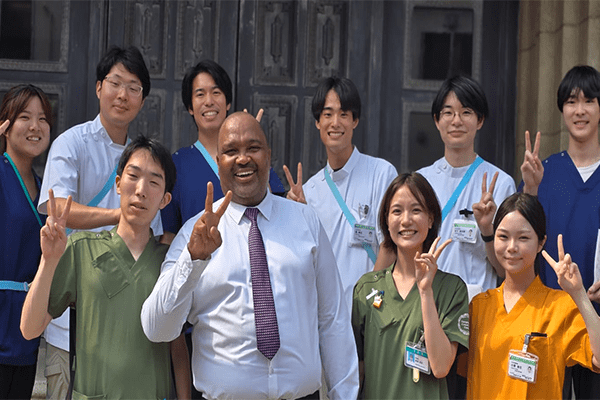
Picture: NWU principal and vice-chancellor, Prof Bismark Tyobeka during his visit/Supplied
By BAKANG MOKOTO
29 July 2026 – North West University (NWU) principal and vice-chancellor, Prof Bismark Tyobeka said Mount Fuji’s famous peak is hidden behind a blanket of clouds today. Tyobeka said it is a wondrous sight, and there is a serenity to it.
He further said it feels as though Japan and specifically Tokyo, where he was, has been transported from the future to the present. Tyobeka added that the country is a technological marvel of automation and innovation, yet he also finds himself carried into the past to terrible moments more than 80 years ago.
“Between 9 and 10 March 1945, flames licked the night sky red as squadrons of American B-29 Superfortresses dropped a devastating combination of high-explosive and incendiary bombs on Tokyo. Between 80 000 and 100 000 people died amid the rubble of Japan’s political and administrative heart.
“On 6 August, an atomic bomb was used in warfare for the first time when it was detonated over Hiroshima. Three days later, another followed over Nagasaki. By the end of 1945, more than 200 000 people had died as a result of the two bombings,” he said.
Tyobeka said on 15 August, Japan’s emperor, Hirohito, delivered his famous Jewel Voice Broadcast. He said it was the first time the Japanese people had heard his voice, but his message was one of tragedy rather than the triumph for which they had hoped.
‘We have resolved to endure the unendurable and suffer what is insufferable,’ he said, signalling Japan’s surrender.
“By then, Japan had suffered catastrophic human, military and economic losses. More than two million Japanese military personnel had been killed, alongside hundreds of thousands of civilians. Around 66 major cities had been heavily bombed, much of the country’s industrial capacity had been destroyed, its merchant fleet had been decimated and its navy effectively eliminated.
“Food was scarce, inflation soared, transport networks were crippled and millions faced hunger. Japan had also lost its overseas empire. Yet here I stand, in the Land of the Rising Sun, in what is now the fourth-largest economy in the world: a global leader in automobiles, electronics, robotics, machinery and advanced manufacturing, whose people enjoy among the highest life expectancies on Earth,” said Tyobeka.
He said then, he thinks about the continent he calls home, more than 13 000km away. Tyobeka said he thinks of the Rwenzori Mountains, with their mist-filled valleys stretching across Uganda and the Democratic Republic of the Congo, and of majestic Mount Kilimanjaro rising above Tanzania.
“I think of my country’s own Drakensberg and of Mount Kenya, whose snow-capped summit stands sentinel over the continent. Yet in the shadows of these giants, our continent has still not built industrial capacity, technological sophistication or health security on the scale achieved by this island nation of some 123 million people, occupying a landmass only slightly larger than Germany.
“Why is that? Perhaps part of the answer lies in where we choose to direct our gaze. Africa has every right to remember its past. Colonialism, slavery, apartheid, exploitation and conflict left wounds that did not disappear when flags changed and constitutions were signed. History matters because its consequences endure,” he said.
Tyobeka said but history should explain their circumstances and it should not determine the limits of our ambition.

