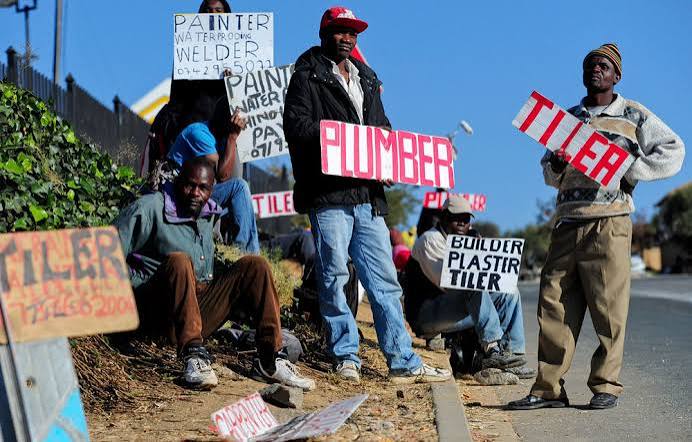
Picture: Some of residents sitting at traffic lights looking for emmployment/Generic
By KEDIBONE MOLAETSI
11 August 2026 – South Africans continue to grapple with unemployment. This comes after Statistics South Africa showed that a narrow definition of unemployment has risen by 0.9% to 33.6% with the number of unemployed persons rising by 345 000.
The statistics showed that the expanded definition of unemployment rose overall by 0.1% to 43.8% with a total decrease in the number of employed persons by 16 000. Particularly concerning losses were seen in community and social services (57 000), mining (26 000), and agriculture and manufacturing (15 000 each).
According to the statistics, the job losses in provinces included the Western Cape (48 000), Gauteng (22 000), and North West (15 000). However, the positive gains were recorded in trade (70 000), construction (39 000), finance (11 000), Mpumalanga (41 000), Eastern Cape (13 000) and Free State (9 000).
The Congress of South African Trade Unions (COSATU) Parliamentary Coordinator, Matthew Parks said they demand bold and decisive action to tackle the unemployment crisis. Parks said the latest jobs report released by Statistics South Africa for the 2nd Quarter of 2026, is beyond depressing.
He further said the job losses for the 2nd Quarter of 2026 are extremely worrying. Parks added that the outlook for the 3rd Quarter is likely to be similarly bleak due to the unprovoked war in the Middle East and the devastating impact it has had on international oil and fuel prices.
“This has seen economic growth projections for South Africa for 2026, slashed from an already meagre 1.4% to 1.1%. Inflation for transport has spiked with food and other essential goods likely to soon follow suit, with inflation having reached 5% in June 2026. This will likely cause the Reserve Bank to raise the repo rate again, inflicting even further pain upon highly indebted workers and an embattled economy.
“We cannot continue to normalise 1% economic growth and dangerously high levels of unemployment, poverty and inequality. The extent of this crisis requires a bold and aggressive stimulus package to kickstart the economy, rebuild public and municipal services, make capital affordable and accessible for SMMEs and industrial sectors and extend relief for the unemployed by expanding public employment programmes,” he said.
Parks said similarly, efforts to reduce the price of electricity, restore rail and ports to full capacity and invest in economic infrastructure and tackle crime and corruption must be accelerated. He said they will be requesting urgent engagements at Nedlac with government and business on a stimulus package mobilising every possible public and private financial resource to spur economic growth.
“Unemployment is the single greatest threat to the nation. It requires the same decisive and progressive response as was mobilised and led by President Cyril Ramaphosa during COVID-19. This is a ticking time bomb we cannot continue to blue tick.
The Democratic Alliance (DA) leader, Geordin Hill-Lewis said: “Following the latest Quarterly Labour Force Survey released today, it is clear that South Africa’s jobs crisis is worsening, not improving. Economic reform is happening far too slowly to spur growth at the pace required to create jobs. South Africa does not lack economic potential. It lacks urgency.
“The DA will continue to push for much greater urgency and ambition in the economic reform agenda of the Government of National Unity (GNU). South Africa cannot afford to lose another quarter to slow reform. We need urgency, clear priorities and a relentless focus on growth and jobs.”
He said businesses and investors are still held back by red tape, unreliable basic services, failing ports and rail, and crime that makes it harder and more expensive to build, invest and employ people. Hill-Lewis said South Africa’s central national mission must be to get the economy growing at a significantly faster pace to get people into work.
“Reform cannot continue at a pace completely disconnected from the scale of the unemployment crisis. Growth cannot be one priority among many. It must be the priority.
“The number of unemployed South Africans increased by 345 000 to 8.5 million in the second quarter of 2026, while employment declined by a further 16 000. Official unemployment increased from 32.7% to 33.6%, while the broader measure of unemployment and the potential labour force rose to 43.8%,” said Hill-Lewis.
He said this is the highest unemployment rate in 4 years.

