Zuma loses popularity among ANC supporters


Johannesburg – As former president Nelson Mandela was being laid to rest on Sunday, an opinion poll showed President Jacob Zuma losing support over claims of self-enrichment.

A survey conducted for the Sunday Times newspaper showed 51% of registered voters of the ruling ANC want Zuma to resign as he seemingly battles to fill the deceased statesman’s shoes.

The results of the survey conducted by the Ipsos market research company comes in the same week that Zuma was booed at a memorial service for Mandela in Soweto.

Of the 1 000 ANC voters polled in a representative survey, 33% said they were less likely to vote for the ANC over allegations that Zuma used public money to upgrade his luxury private residence to the tune of some $20m.

Forty-two percent said they believed he had abused taxpayer funds.

On Tuesday, South Africans booed their president at a memorial service attended by tens of thousands of people for Mandela, whose legacy is one of selflessness and sacrifice.

Many of those who jeered later spoke of their disillusionment and anger at Zuma’s lifestyle at a time that many South Africans remain poor, unemployed, and without formal housing in a society that is among the world’s most unequal.

Public challenge

Zuma’s predecessor Thabo Mbeki, though unpopular at the time of his party ouster by Zuma in 2008, received a warm welcome at the memorial.

Mbeki, who succeeded Mandela as president in 1999, on Sunday challenged South Africa’s leadership to ask if they were living up to Mandela’s standards, in a pointed public challenge to his ANC comrades.

“I think to celebrate his life properly we need to ask ourselves a question about the quality of leadership,” Mbeki told a prayer gathering in Johannesburg.

The ANC under Zuma has come under increasing fire over claims of nepotism and corruption.

The party is preparing for national elections next year.

Despite growing disgruntlement, the party retains a firm grip on power on the back of its historic status as the liberator of a long-oppressed people, and will likely retain a large majority.

The ANC had claimed the booing was orchestrated by other political parties.
AFP

Your grief is Tanzania’s, says Kikwete


718f82c1e49a4704805e28ae3fdbb528
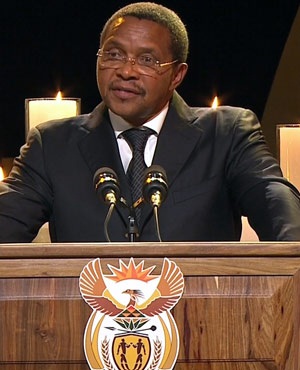
Qunu – South Africa’s grief following the death of former president Nelson Mandela was shared by Tanzania, President Jakaya Kikwete said on Sunday.

Speaking at Mandela’s funeral in Qunu in the Eastern Cape, Kikwete said Mandela and Tanzania’s first president Julius Nyerere built the foundation upon which the two countries’ close relationship was based.

“That is why your sadness, grief and sorrow are ours as well. That is why we also join you in celebrating the life of this great man,” Kikwete said.

“He has left behind a vibrant democracy. A nation where nobody is denied their basic rights because of the colour of their skin. A nation where blacks can also prosper, where in the past they were condemned to live in squalor… and [as] second class citizens in their own country.”

When Mandela visited Dar es Salaam after his release from prison, he was greeted by the biggest crowds ever to meet a foreign dignitary, even though it was raining at the time.

“This record has not been broken,” said Kikwete.

He recited the close historical links between Tanzania and the ANC, which the apartheid government had banned at the time, severely restricting the movement of members in and beyond South Africa.

Nyerere, after meeting Mandela when he first visited the country in 1962 as he was gathering support for the ANC’s armed struggle against apartheid, allowed Umkhonto we Sizwe (MK) cadres to stay and train in the country.

“Beyond availing places to live and train, he [Nyerere] offered Tanzania’s own moral and material support,” said Kikwete.

Mandela’s charisma

“Beside that, Tanzania was generous enough to give cadres of the liberation movement travel documents, passports… and when necessary, some of them assumed Tanzanian names.”

When Mandela came to Tanzania, he had no passport and intended going to first Accra in Ghana, then Lagos in Nigeria, and then Addis Abba in Ethiopia.

“He was given a Tanzanian travel document. It facilitated his movement and I know a number of you [here] used Tanzanian travel documents. I don’t know if Thabo [Mbeki] returned his,” Kikwete said, which induced laughter.

“The ANC found a new home in Tanzania from where it operated, organised, spearheaded, and prosecuted the struggle.”

When Madiba left for Accra, he left behind his boots in the home of the family where he stayed in the hope he could pick them up on the way back.

Shortly after arriving back in South Africa he was imprisoned.

“In 1995, when Mandela was president, the pair of boots was handed back to him.”

Kikwete said Mandela’s charisma was unmatched in modern times and it was no accident that South Africa and Tanzania enjoyed excellent bilateral relations, given the common history uniting the two countries.

Mandela died at his Houghton home in Johannesburg on 5 December. He was 95.

A memorial service was held at FNB Stadium in Johannesburg on Tuesday.

Friends, colleagues, comrades and family of Nelson Mandela are invited to share their memories and tributes, and to light a candle for him, on his profile at Remembered.co.za.

Nelson Mandela will be laid to rest in Qunu.
– SAPA

Zuma: Mandela children suffered


9caa6506cd0e47a48777818f5154978b
Qunu – President Jacob Zuma acknowledged on Sunday that the children of former president Nelson Mandela had suffered because of their father’s absence.

Speaking at Mandela’s state funeral in Qunu, in the Eastern Cape, Zuma thanked them for sharing him with the world.

“We acknowledge the suffering of your own children, who had an absent father,” said Zuma.

He said it must have been difficult for them to have a father who the apartheid regime had labelled as a “dangerous man who was a terrorist”.

“They must be proud to be brought onto this earth by a man so great and humble,” Zuma said of Mandela’s children.

Mandela had six children, three of whom have died.

Wives

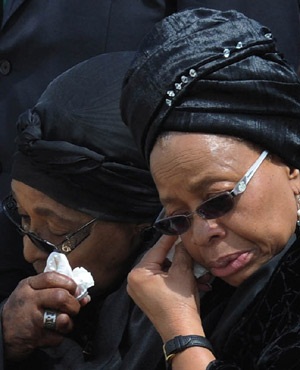
Zuma thanked Mandela’s late wife Evelyn Mase, his ex-wife Winnie Madikizela-Mandela and his widow Graca Machel.

“We acknowledge comrade Winnie Madikizela-Mandela, who kept your name alive… through your imprisonment,” said Zuma.

He said that even when the African National Congress was banned, Madikizela-Mandela refused to be silent.

“We are proud of the contribution she has made to the freedom of the country,” said Zuma.

He thanked Graca Machel for being at Mandela’s side.

“The past year has not been easy for her,” said Zuma, adding that Machel had ensured Mandela was comfortable and always well-cared for.

He said Mandela and Machel both had a passion for children.

“The two of you made a formidable pair for the benefit of children,” said Zuma.

He said that in Mandela’s memory, South Africa’s children should grow up in a country that is not only politically free, but free of violence, crime, disease, and indignity.

“You said: ‘I hate race discrimination most intensely and in all its manifestations’. You forgave those who took you away for most of your adult life and dehumanised the majority of your compatriots…

“Tata, as your triumphant journey comes to an end, we sincerely thank you for dedicating your life to building… a free South Africa,” said Zuma.
– SAPA

Tata taught humility – grandchild


6f55a7c51aed474b9ad20f55ec80e994
Qunu – Former president Nelson Mandela taught his grandchildren humility and accountability, his granddaughter Nandi Mandela said at his state funeral in Qunu, in the Eastern Cape, on Sunday.

“I stand here today, humbled to be the one representing all of the children and grandchildren of Tatamkhulu,” she said.

“Tatamkhulu means grandfather and, like all South Africans and people around the world, we are proud of his achievements and he makes us want to make him proud.”

Mandela commanded respect and when former SA Communist Party general secretary Chris Hani was assassinated in April 1993, the country was on a knife’s edge and could easily have slid into war, she said.

“He [Mandela] persuaded people to calm down and the people listened. When Louis Luyt took him to court, he did not have to appear but he always remained humble and accountable and taught us to do the same.”

Luyt was the president of the SA Rugby Union and refused to appear before a presidential commission of inquiry into allegations of racism in 1998. His refusal forced Mandela to have to testify in court. The court eventually found against Luyt.

Nandi said Mandela was a true leader and servant of the people and his mission had been to make life better for the underprivileged.

“He truly cared for his children and grandchildren. He shared his life with them and provided for them, including his extended family,” she said.

Stories of his childhood

“He took it upon himself to make sure we all had a good education. During his presidency and after he stepped down, he made sure the children of Qunu always had a beautiful Christmas. They came in their thousands and he made sure each one received a gift and a meal.”

After a while, it became impossible for Mandela to fund the festivities from his own pocket, and the business people in Qunu contributed, she said.

“His gesture made others want to do good and that is the lesson he taught us.”

Mandela was always fun to be around and Nandi Mandela said she missed hearing his voice over the past year.

“At dinner he always told us stories and poked fun at himself as he recounted stories of his childhood.”

Friends, colleagues, comrades and family of Nelson Mandela are invited to share their memories and tributes, and to light a candle for him, on his profile at Remembered.co.za.

– SAPA

Kaunda takes dig at apartheid regime


aed460807ce542d0bb8d2532367f3ad7
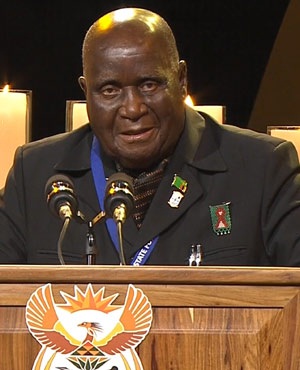
Qunu – Many guests at the state funeral of former president Nelson Mandela enjoyed the animated vote of thanks given by former Zambian president Kenneth Kaunda in Qunu, in the Eastern Cape, on Sunday.

Loud laughter was heard when Kaunda referred to the apartheid-era National Party, led by FW De Klerk, as the “boer” party.

As his address ran over time, African National Congress deputy president Cyril Ramaphosa walked up to the podium to signal to him to wrap up.

Kaunda got the audience giggling when he protested, saying people were “trying to control an old man who fought the boers”. Ramaphosa shrugged and smiled.

Kaunda took the opportunity to remind the apartheid government of its shameful treatment of Mandela and his fellow men.

“I had a chance to meet a number of friends of the boer company. I spent three nights with [former prime minister John] Vorster on a train [stationed on the railway bridge over Victoria Falls, which separates Zambia and Zimbabwe],” Kaunda said.

“I asked the prime minister to please release Nelson Mandela and his colleagues and come together in discussions. It came to nothing.

“Then came another boer leader – I think he was called [PW] Botha – to discuss the future of South Africa together. I didn’t succeed and it also came to nothing. “Then came my meeting with FW de Klerk… and, after a few hours, I called a press conference where I said: ‘I think I can do business with this man’. Thank goodness he released this great man.”

Kaunda also referred to some quotes from the Bible and ended his speech by saying “Amen”.

Friends, colleagues, comrades and family of Nelson Mandela are invited to share their memories and tributes, and to light a candle for him, on his profile at Remembered.co.za.

Mandela’s grandson Ndaba Mandela left the funeral service venue shortly after in preparation for the burial ceremony.

Friends, colleagues, comrades and family of Nelson Mandela are invited to share their memories and tributes, and to light a candle for him, on his profile at Remembered.co.za.

– SAPA

Helicopters, planes honour Mandela


c7f009cfabac4ca6b9bccc01eadeb93a
Qunu – Helicopters bearing the South African flag and a formation flight by several jets took to the skies over Qunu, in the Eastern Cape, on Sunday for the burial of former president Nelson Mandela.

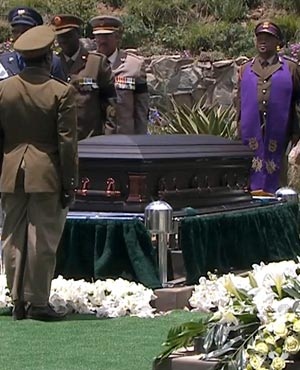
Mandela’s coffin was placed over his grave and soldiers folded the South African flag which had rested on the casket. A prayer was said at his grave side.

Earlier, a slow-marching military procession had escorted the coffin on a gun carriage from the venue where Mandela’s funeral service was held.

When it came to a halt, straps securing the coffin were removed; soldiers tilted the coffin and gently eased it off of the gun carriage.

Eight military pallbearers then pushed the coffin on a trolley toward the gravesite. Muffled drums played in the background.

Banks of white flowers flanked the coffin at the burial site.

The lowering of the coffin was not televised.

SA National Defence Force chaplain Reverend Monwabisi Jamangile said at the burial that Mandela had truly achieved ultimate freedom.

“We will remember Nelson Rolihlahla Mandela,” he said while praying for him before his coffin was lowered into the grave.

“Rest in peace. Yours was truly a long walk to freedom and now you have achieved the ultimate freedom in the bosom of your leader, God Almighty.”

Jamangile asked that God soothe the family in this time of grief, when their longing for Mandela became unbearable.

A 21-gun salute also fired.
– SAPA

‘We will take Mandela’s legacy forward’, says Zuma


nelson-mandela
Qunu – President Jacob Zuma undertook on Sunday to take forward former president Nelson Mandela’s legacy at his state funeral in Qunu, in the Eastern Cape.

Zuma said Mandela had made tremendous strides in gender equality, giving it prominence and seriousness under his presidency.

“[This led] to an increase in the number of women in public office, especially Parliament and Cabinet,” Zuma said.

“We dare not reverse your achievements in this regard.

“As your journey ends today, ours must continue in earnest. One thing we can assure you of today Tata is, as you take your final steps, is that South Africa will continue to rise.”

Mandela’s abiding revolutionary spirit would prevail on the country not to rest until the poor and working class had truly benefited from the material fruits of freedom and democracy for which he had fought.

Education

“Therefore, today we undertake to take forward the [promise] of an improved quality of life for all,” the president said.

“We commit to work more intensely to deal a decisive blow against persisting poverty, unemployment, and inequality.

“We pledge to take your vision forward for good schools, hospitals, quality housing, utilities, decent jobs and working conditions as well as efficient and accountable public service.”

Learning from Mandela, education would continue to be used as a weapon to improve the quality of life and bring about change through investing in the development of children and the youth.

“You love children dearly,” Zuma said.

Mandela died at his home in Houghton, Johannesburg, on 5 December. He was 95.

A memorial service was held at FNB Stadium in Johannesburg on Tuesday.

His body was flown to the Eastern Cape on Saturday.
– SAPA

Tributes, tears at Mandela’s funeral


0dcf15eca5554c06b54eac59bbc0922d
Qunu – Former president Nelson Mandela was returned to his home village of Qunu on Sunday in a state funeral that saw political tributes and tears flow.

The farewell by the country and fellow African leaders was a reluctant one.

“We did not want to confront the reality of your mortality,” President Jacob Zuma said in a eulogy that tried to address doubts about the country’s current leadership voiced in the wake of Mandela’s death.

“Thank you. Thank you for being everything we needed and wanted in a leader during a difficult period in our lives… for building a free South Africa,” Zuma told 4500 mourners in Qunu.

Zuma said an outpouring of grief across South Africa in the past 10 days was the nation’s natural response to the goodness Mandela had radiated.

“As your journey ends today, ours must continue in earnest. One thing we can assure you of today, Tata, as you take your final steps, is that South Africa will continue to rise,” he said.

“We plan to take your vision forward.”

The mourners gathered early for the funeral in a marquee on Mandela’s family farm, awaiting Mandela’s casket that was carried through green countryside in a military procession and placed on cowhides.

“My life is in a void”

European dignitaries included Britain’s Prince Charles, Monaco’s Prince Albert and former French prime minister Lionel Jospin.

African leaders included Tanzanian president Jakaya Kikwete, Malawian President Joyce Banda and Zambia’s first post-colonial president Kenneth Kaunda – all of whom delivered eulogies.

Former president Thabo Mbeki was brought to tears as Kikwete recalled anecdotes of ANC leaders’ days in exile in Dar-es-Salaam, including how Mandela left behind boots that languished in the capital for three decades after he was jailed by the apartheid regime.

Banda saluted the quiet dignity of Mandela’s widow Graca Machel.

“Women across South Africa have told me these past 10 days that they are very proud of you and what you have taught us as African women.”

After she spoke, there was laughter when ANC deputy president Cyril Ramaphosa teasingly said she was from “Malawi. Yes, Malawi” – a reference to a recent faux pas by Zuma when he lamented the poor state of roads in that country.

Mandela’s ex-wife Winnie Madikizela-Mandela smiled and playfully poked Zuma, who chuckled.

Members of Mandela’s family spoke at the service, but the most heart-rending tribute came from his close friend and fellow Robben Island prisoner Ahmed Kathrada, who spoke of being bereft after losing the man he considered a brother.

“My life is in a void and I do not know who to turn to.

“He was my elder brother,” Kathrada said, adding that Mandela had shown love and tolerance in abundance, and that the outpouring of grief over his death had shown how connected South Africans felt to him.

Family graveyard

“Today, mingled with our grief is the enormous pride that one of us has, during his lifetime and now, in your death, united the people of South Africa and the entire world on a scale never seen in history.”

Mandela’s casket was carried from the funeral tent just past noon to be buried in the family gravesite – in keeping with Xhosa custom that dictates that the dead are laid to rest when the sun is at its highest.

Zuma, Mbeki and past and present Cabinet ministers followed on foot.

Mandela was to be buried beside his parents and his son in the family graveyard at a ceremony that would gather only 450 mourners and be presided over by Methodist church general secretary Vuyani Nyobole.

Anglican Archbishop Emeritus Desmond Tutu attended in a last-minute change of heart after saying on Saturday he had cancelled plans to go to Qunu after finding he had not been invited.

Faced with the wrath of one of Mandela’s close friends and allies, the ANC dismissed the imbroglio as a misunderstanding and insisted that he was welcome.

It had caused speculation that Tutu had been sidelined because of his caustic criticism of the current government.

All indications were that grudges had been firmly set aside for Mandela’s funeral, as senior ANC members who have fallen foul of Zuma attended – among them former Cabinet minister Tokyo Sexwale.

Friends, colleagues, comrades and family of Nelson Mandela are invited to share their memories and tributes, and to light a candle for him, on his profile at Remembered.co.za.
-AFP

Nelson Mandela: RIP 1918 – 2013


94d34f0c8fab4d858c5235478a46c6ec
Qunu – Nelson Mandela, South Africa’s first black president, was laid to rest Sunday after a state funeral filled with tearful eulogies and strident vows to pursue his ideals of equality and justice.

Mandela’s casket was buried at his family plot in his rural boyhood home of Qunu, watched by his widow Graca Machel, ex-wife Winnie Madikizela-Mandela, other family members and around 450 selected guests.

The interment followed a ceremonial state funeral that ran well over its allotted two hours, as speaker after speaker paid emotional tribute to the man who led South Africa out of the apartheid era.

“The person who lies here is South Africa’s greatest son,” said ANC deputy president Cyril Ramaphosa in an opening address.

A 21-gun salute and full military honour guard had escorted Mandela’s coffin to the marquee where 4 500 mourners said their final goodbyes.

His flag-draped casket was placed on cow skins, surrounded by 95 candles – each signifying a year of his extraordinary life.

The frail and ageing leaders of South Africa’s anti-apartheid struggle also attended: George Bizos, Desmond Tutu and Ahmed Kathrada, whose voice broke with as he delivered a eulogy for his old friend.

“I first met him 67 years ago,” said Kathrada, who along with Mandela was sentenced to life in prison in 1963.

He recalled his fellow inmate as a powerful amateur boxer who could cope far better than others with the physical challenge of hard labour.

“What I saw in hospital was a man helpless and reduced to a shadow of himself,” he said struggling not to break down.

“We can salute you as a fighter for freedom. Farewell my dear brother, my mentor, my leader.

“Now I’ve lost a brother my life is in a void and I don’t know who turn to.”

A towering public figure

His words left many in tears among the invited guests, whose ranks included foreign dignitaries and celebrities ranging from Britain’s Prince Charles to US talk show queen Oprah Winfrey.

The funeral closed the final chapter on a towering public figure whose courage and moral fortitude turned him into a global symbol of freedom and hope.

During 10 days of mourning, hundreds of thousands of South Africans had turned out across the country to bid the founding father of their “Rainbow Nation” farewell.

They braved a rain-sodden memorial in Soweto and queued for three days to see his remains as they lay in state at Pretoria’s Union Buildings.

For 50 million compatriots, Mandela was not just a president, but a moral guide who led them away from internecine racial conflict.

“Ever since he passed away, I wanted to walk the journey with him,” said Pascal Moloi, 52, who made the trip from Johannesburg to Qunu.

For the rest of the world he was a charismatic leader of the anti-apartheid struggle.

While Mandela had been critically ill for months, the announcement of his death on December 5 still sent a spasm through a country struggling to carry forward his vision of a harmonious multi-racial democracy of shared prosperity.

‘South Africa will continue to rise’

During the funeral, South African President Jacob Zuma told the country to carry on his legacy.

“One thing we can assure you of today Tata (father), as you take your final steps, is that South Africa will continue to rise.

“South Africa will continue to rise because we dare not fail you,” Zuma said.

After the ceremony, Mandela’s coffin was transported to a graveyard sitting on the sprawling family estate Mandela built in Qunu after his release from prison in 1990.

“It was in that village that I spent some of the happiest years of my boyhood and whence I trace my earliest memories,” he wrote in his autobiography.

As the coffin was lowered into the ground, a formation of military aircraft – six jets with one spot left vacant in a symbol of a missing man – flew overhead.

After a life spent in the public spotlight, Mandela’s final rites were a private affair.

A family deprived of their husband and father during his 27 years in apartheid prisons and many more years in public service seized it as an intimate last goodbye to a man who meant much to millions.

A live television broadcast followed the coffin to the graveside but was cut after several minutes in line with the family’s wishes.

Overseen by male members of his clan in line with traditional Xhosa rites, the burial included the slaughter of an ox – a ritual marking of a life’s milestones.

Mandela was referred to throughout as Dalibhunga, the name given to him at the age of 16 after undergoing the initiation to adulthood.

Friends, colleagues, comrades and family of Nelson Mandela are invited to share their memories and tributes, and to light a candle for him, on his profile at Remembered.co.za.

– AFP
Qunu says farewell to Tata Madiba


ac6618af0faf42b4a4390a2e1ba85048
Qunu – Perched above the pomp and ceremony of Nelson Mandela’s state funeral, villagers and visitors to his rural home said a final goodbye among the open spaces and grasslands of his boyhood.

A few hundred people watched a live broadcast on a big screen, framed by sweeping views overlooking Mandela’s home in Qunu village.

“I felt that I was a part of it,” said local Samora Makasi, 35, sitting in an open-walled tent as presidents, foreign dignitaries and celebrities gathered below.

“I could have watched it at home but I wanted to be around people,” Makasi said.

Qunu has, in the 10 days since his death was announced on December 5, been a hive of round-the-clock activity as funeral organisers rushed to construct a venue for the 4 500 people who wanted to attend the event.

The usual rural tranquility was interrupted by the constant thumping whir of military helicopters and convoys bringing in troops as the village was placed under a security clampdown.

“I’m sad. It’s unbelievable that Mr Mandela today is no longer with us,” said Qunu resident, photographer Monde Sikweza, 48, as the sound of a 21-gun salute echoed over the village.

“This long walk to freedom is gone now,” he said, holding a framed photograph of Mandela and fellow comrades in 1991.

Traditionally, funerals are open to anybody, but the South African government had limited the number of guests, citing security concerns and space constraints.

“I am happy watching this on television. My eyes are bad. I can see it better this way,” said villager Dickson Gangatele, 73.

Many watching in the viewing area had come from out of town.

“Ever since he passed away, I wanted to walk the journey with him,” said Pascal Moloi, 52, who came from Johannesburg to watch with Mandela’s fellow villagers.

Watching in the village, with a wide view of the valley below, made him “feel much more connected” to Mandela, he said, saying afterwards he thought the ceremony, which was over two hours long, was “brilliant”.

But local Nonkuleleko Mfoboza, 45, felt differently.

“We want to be there as residents, but now there is no space for us,” she said.

Several of the speeches drew standing ovations, but Mfoboza gave her stamp of approval to only a handful.

“Otherwise it was boring… too long,” she said.

While the formal section of the state funeral was broadcast live to the world, the burial rituals were closed to the public on the wishes of the Mandela family.

“We really don’t know whether there will be access to the grave. We are watching this from a distance,” said Milisa Manxiwa, 34, sitting on a chair next to the main road near the funeral, draped in a South African flag.

As Mandela’s final gun salutes rolled over the valley and an air force flypass thundered overhead, a group of men in traditional Zulu dress, carrying sticks and shields, cried out in succession.

“He was an old man, he deserves his rest, and I think it’s been overdue,” said Ntsika Madyibi, 35, who came from a neighbouring village to watch.

Friends, colleagues, comrades and family of Nelson Mandela are invited to share their memories and tributes, and to light a candle for him, on his profile at Remembered.co.za.

Nelson Mandela will be laid to rest in Qunu. Say your final farewell and be published on News24 by e-mailing or uploading.
– AFP