‘Let’s work together to ensure no person goes hungry’


By KEDIBONE MOLAETSI

22 October 2025- The Republic of South Africa (RSA) president, Cyril Ramaphosa said last week, the 7th Social Justice Summit, organised by the Centre for Social Justice at Stellenbosch University, reflected on the country’s progress towards achieving food security as a key component of social justice. Ramaphosa said government, policy makers, academia and civil society organisations, discussed what they must do to ensure that no South African goes hungry and to chart a new course as countries of the world strive to achieve the 2030 Sustainable Development Goals (SDGs).

He further said the centre has developed the Musa Plan, which aims to use data-driven research and collaborative resource mobilisation to end poverty. Ramaphosa added that overcoming poverty and tackling the cost of living for South Africans is one of the strategic priorities of the Government of National Unity (GNU).

“Access to nutritious food directly affects the physical health and development of individuals and societies. Around 15 to 16 million people in South Africa have inadequate or severely inadequate access to food.

“South Africa is amongst 29 countries where the right to food and water is enshrined in the Constitution, and where citizens have resources in the legal system to ensure that this right is enforced. Our Constitution imposes a duty on the state to take reasonable legislative and other measures, within its available resources, to progressively realise this right,” he said.

Ramaphosa said since the advent of democracy in 1994, successive administrations have adopted a multifaceted approach to tackling hunger and food security. He said this has included legislative and policy reform, nutrition at primary healthcare level, and programmes that deliver nutrition directly to communities and institutions, such as the school feeding scheme.

“To further bolster food security, the provision of social grants, free basic services, free basic and tertiary education, and free primary healthcare have freed up money in households to buy food.

“In South Africa, the social wage accounts for approximately 60% of spending by the Government before interest payments. This is amongst the highest of upper-middle income countries. A 2021 World Bank report noted that South Africa’s system of programmes were effective, well-targeted and provided sizable benefits to the poorest households,” said Ramaphosa.

He said their social assistance system “effectively reduces poverty and inequality rates”. Ramaphosa said the School Nutrition Programme has been one of the most far-reaching and transformative policies implemented under democracy to address poverty.

“This programme provides nutrition to more than 9 million learners from poor households on a daily basis. The provision of meals at schools, with nutritious ingredients sourced from school and community food gardens, has had a positive impact on learner attendance, concentration and overall academic performance.

“The long-term impact of this programme is evident. Last year, learners from the poorest schools, 60% of schools, accounted for 67% of all bachelor passes achieved. Supporting communities to grow their own food has been an integral feature of the Government’s food security strategy,” he said.

Ramaphosa said provincial agricultural departments run programmes across the country to support school, household and community food gardens, and provide implements like seedlings, tools and training. He said despite a range of interventions by national and provincial governments, a large portion of South African households are food insecure.

“In a context of high unemployment and poverty and limited economic growth, many households across the country are finding it difficult to afford nutritious food. It is, therefore, necessary that together with measures to eradicate extreme food poverty, we have to also look at market factors that are making the cost of nutritious food increasingly out of reach.

“According to Statistics South Africa data, annual inflation for food and non-alcoholic beverages continues to rise. Last month, headline consumer inflation hit a 10-month high. Meat and vegetables are more expensive, putting household food budgets under pressure,” said Ramaphosa.

taungdailynews@gmail.com

EU investment supports inclusive and sustainable growth in SA


By AGISANANG SCUFF

14 October 2025- The Republic of South Africa (RSA) president, Cyril Ramaphosa said last week, they had the opportunity to attend the Global Gateway Forum in Brussels at the invitation of European Union (EU) Commission President Ursula von der Leyen. Ramaphosa said the forum showcases the EU’s investment initiatives in other regions of the world and is meant to advance its global relationships.

He further said South Africa’s attendance at the forum follows the South Africa-European Union Summit that was held in Cape Town in March to further advance political and economic ties between our country and EU member countries. Ramaphosa added that at the Summit in Cape Town, the EU announced an investment package of 4.7 billion Euros to support strategic projects in South Africa.

“Last week, the EU announced a further investment package that will bring the total investment value to 11.5 billion Euros, which is over R230 billion. This innovative partnership focuses on priorities that South Africa has set for itself as it strives to improve the lives of its people.

“These priorities include investment, the clean energy transition, skills and technology, connectivity and developing strategic industries. Importantly, the partnership will contribute to the work being done to create jobs,” he said.

Ramaphosa said the investment package covers areas such as critical minerals, e-battery development, green hydrogen, renewable energy and vaccines. He said this will lead to the creation of a number of jobs, skills development and transfer of technology.

“As we said in Brussels, these investments will support our effort to build the economy of the future in the South Africa of the present. They will help to accelerate South Africa’s ambitious transition to a low-carbon economy that is just and inclusive.

“The package aims to mobilise financing to invest in local processing and refining of minerals that are critical to the energy transition. It includes investments in projects to produce green hydrogen and derivatives that will set South Africa up as a world-leading producer for the local economy and for export,” said Ramaphosa.

He said the investments are also expected to accelerate large-scale solar and wind power projects, while boosting energy efficiency in industry, housing and public services. Ramaphosa said these measures will reduce reliance on coal, lower costs and improve energy security for households and businesses.

“As a country, we have always insisted that our energy transition must be just and inclusive, and that we must take deliberate measures to protect workers, communities and businesses that would be affected.

“That is why part of the investment package is dedicated to re-skill, train and provide entrepreneurship opportunities. It will also be used to expand access to clean water, waste management and energy efficient public services,” he said.

Ramaphosa said the investment package will also support the work that South Africa is undertaking to develop their rail, road and ports infrastructure, logistics and digital connectivity. He said these investments will also support the local manufacturing of pharmaceuticals through partnerships with regulatory authorities, as well as innovative research projects, training and capacity building on biotechnology and pharmaceutical infrastructure.

“This investment package is being announced against the backdrop of the progress we are making in addressing some of the critical impediments to inclusive economic growth.

“As our country, we have made immense progress in overcoming our energy supply constraints through the improved performance by Eskom and a massive investment in renewable energy generation,” said Ramaphosa.

He said they are improving efficiencies at their ports and opening their freight rail lines to private operators. Ramaphosa said they are undertaking a massive investment in infrastructure and streamlining regulations to improve the environment for investors.

“The progress we are making with our reforms is recognised and it’s making our country an investment destination. We are seen as the gateway into the African continent. The EU investment takes place in the context of a more volatile global environment.

“There is a significant realignment of trade and investment between countries. In addition, rapid advances in technology and the escalating climate crisis are contributing to greater uncertainty,” he said.

Ramaphosa said that is why South Africa is forging ahead with the work of building a resilient and sustainable economy that addresses the needs of the present, while positioning itself for the needs and challenges of the future.

taungdailynews@gmail.com

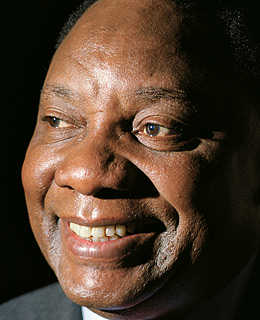
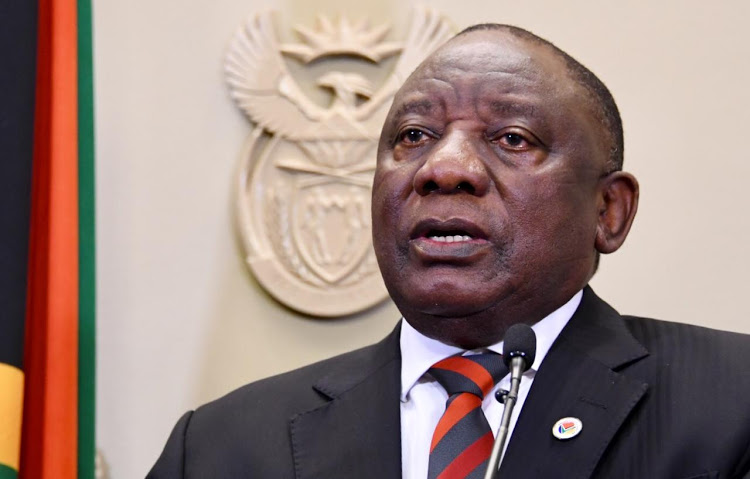
Picture: RSA president, Cyril Ramaphosa

‘Business ties with the United States are strong and expanding’


By AGISANANG SCUFF

29 September 2025- The Republic of South Africa (RSA) president, Cyril Ramaphosa said last week, he addressed a Trade and Investment Dialogue between South African and US businesses on the sidelines of the United Nations General Assembly in New York. Ramaphosa said this was one of a number of engagements they had with US companies, while in the city.

He further said some of these companies already have business operations in South Africa, while others are interested in investing. Ramaphosa added that all of the companies commended the reforms being undertaken by the government and the prospects for growth in the economy.

“As part of strengthening ties with the United States, we also used the opportunity to meet with members of the US Congress and Senate. Some of our ministers and officials also held meetings with representatives of the US administration.

“The Trade and Investment Dialogue was convened by the US Chamber of Commerce, the world’s largest business advocacy organisation with representation in more than 120 countries, including South Africa. A number of government officials and representatives from business and industry from both countries were present,” he said.

Ramaphosa said the optimistic, future-focused tone of this important engagement underscored how, beyond the headlines and debates around trade policy and political frictions, US and South African businesses are forging ahead. 

Addressing the dialogue, the President of the US-Africa Business Center of the US Chamber of Commerce Kendra Gaither said that there was “no economic relationship more foundational than the ties that the US and South Africa have”. She said it was a vital relationship that merits dedicated attention. 

Ramaphosa said as further testimony to the strength of this relationship, later this year, the US Chamber of Commerce will be sending a high-powered delegation, led by its CEO, to the B20 Summit, the official dialogue forum of the G20 for the global business community. He said commercial ties between South Africa and the US have proven to be both durable and resilient.

“There are more than 600 US companies in South Africa. Our country is the second-largest African destination for US exports. Both South African and US businesses can see the clear opportunities and commercial gains of investing in the other’s respective markets. 

“South Africa is positioning itself as an investment destination for critical minerals, with the digital transition and the global move towards net zero driving global demand. We also had the opportunity to engage with US industry around investment opportunities in agriculture, pharmaceuticals, healthcare, advanced manufacturing, technology and other key sectors,” said Ramaphosa.

He said they announced the establishment of the South Africa-United States Trade and Investment Forum, which will be inaugurated at next year’s South Africa Investment Conference as a vital bridge between the two countries. Ramaphosa said these engagements with business take place alongside discussions with the US administration around a reciprocal trade agreement.

“Our Department of Trade, Industry and Competition has been meeting with the US Trade Representative to finalise an agreement that benefits both our countries. We are also encouraged that the US Chamber of Commerce supports the reauthorisation of the African Growth and Opportunity Act (AGOA), describing it as “the cornerstone of US-Africa commerce”.

“Predictable, preferential access to the US market isn’t just vital to South Africa’s own exports, but also to US companies that depend on reliable imports. We are also prioritising the African Continental Free Trade Area as a vital tool for strengthening US-South Africa trade and investment,” he said.

Ramaphosa said as a country, they will continue to advocate for the principle of reciprocity in investment and trade relations with the US. He said as the presence of US companies on South African soil continues to grow, they want to expand the number of South African companies operating in the US market, thereby creating more jobs for Americans. 

“As the official talks around trade tariffs continue, we take to heart the words of the US Chamber of Commerce representative at the recent dialogue, that expanding commercial partnerships “happens one deal, one investment at time”. 

“Our engagements in the US show that South African and US businesses remain deeply connected and are committed to mutually beneficial partnerships well into the future,” said Ramaphosa. 

taungdailynews@gmail.com

A foreign policy that always faces forward


By REGINALD KANYANE  

25 August 2025- The Republic of South Africa (RSA) president, Cyril Ramaphosa said last week, the country participated in the 9th Tokyo International Conference on African Development (TICAD) in Japan. Ramaphosa said this is an important forum for strengthening bilateral trade and investment between Japan and African countries.

He further said Japan is an important trading partner for South Africa in sectors such as construction, manufacturing, technology and agriculture. Ramaphosa added that at the business forum held on the sidelines of TICAD9 business representatives from South Africa and Japan discussed potential areas of collaboration in clean and renewable energy, automotive components and hydrogen production.

“One of the promising discussions was around the continental expansion plans by the Japanese automaker Isuzu Motors. Isuzu’s South African plant has trialled the manufacture of commercial trucks and truck bodies locally, and is engaging with Isuzu Motors Japan on its plans to become a manufacturing hub for the African market.

“At a time of global trade disruptions and mounting tariff pressures, participating in forums like TICAD is key to our economic diplomacy efforts. Economic diplomacy is an important part of our country’s foreign policy, and has become all the more critical at a time of economic headwinds and global power shifts,” he said.

Ramaphosa said South Africa’s National Interest Framework Policy Document, published in 2022, is clear that it is in the country’s national interest to forge strategic alliances that support economic partnerships and trading arrangements that favour, advance and safeguard our national interest. He said in the spirit of Kwame Nkrumah’s famous words “We face neither East nor West, we face forward”, South Africa will continue to engage with partners in both the Global North and Global South.

“Our approach is neither partisan nor beholden, but strategic.

Our economic diplomacy is centred on securing market access, attracting investment and promoting sustainable development.  At a time when our country faces potentially high tariffs imposed by the US administration, we are continuing to put in place measures that reduce our dependence on historical markets.

“South Africa continues to advocate for an international trade regime that is fair, equitable and rules-based. We are seeking a trade regime that does not render developing economies vulnerable to unilateral measures or protectionist pressures,” said Ramaphosa.

He said likewise, their foreign policy is anchored in multilateralism, respect for sovereignty and the pursuit of alliances that advance peace, justice and our national interest. Ramaphosa said South Africa’s foreign policy outlook is not determined by pressure exerted by outside forces, but by principle.

“It is on principle that we continue to stand with the Palestinian people in their quest for statehood, recognising as we do the pain of dispossession, land theft and state-sanctioned brutality. Even when a number of countries criticised us for doing so, and before the full extent of the brutality in Gaza was laid bare, our commitment to peace, justice and the rule of law informed our decision to take Israel to the International Court of Justice.

“We continue to stand in principled solidarity with the peoples of Western Sahara in their struggle for self-determination, even when this has found us at odds with other countries, including on the African continent,” he said.

taungdailynews@gmail.com

Debt sustainability is the key to development


By OBAKENG MAJE

8 July 2025- The Republic of South Africa (RSA) president, Cyril Ramaphosa said last week, the world came together at the 4th Financing for Development Conference in Sevilla, Spain, to agree on a set of actions to advance development over the next decade. Ramaphosa said this year’s conference took place at a moment of great consequence for humanity.

He further said they face more daunting challenges than at any other time, from the growing devastation caused by climate change to persistent levels of poverty in many parts of the world. Ramaphosa added that, to confront these challenges, they need to mobilise funding to tackle climate change, reduce poverty and build infrastructure that enables sustainable and inclusive economic growth.

“It is estimated that the world needs an extra $4 trillion dollars a year to meet the UN Sustainable Development Goals by 2030, a gap which can only be closed through more affordable, long-term sustainable financing. A major contributor to this financing gap is the growing debt burden faced by many developing economies, particularly those in Africa. Around 3.4 billion people now live in countries that are spending more on interest payments to creditors than on health and education.

“As the Jubilee Commission appointed by the late Pope Francis notes, while few countries have defaulted on their debt, they are defaulting on their people, their environment and their future. Debt can be a tool for development, if it is affordable and spent efficiently on infrastructure and other investments that support growth. However, a succession of external shocks – including the COVID-19 pandemic, the destabilising effect of various conflicts around the world and tightening financing conditions – has caused the cost of debt to rise rapidly for many developing economies,” he said.

Ramaphosa said at the inception of our G20 Presidency, they appointed an Africa Expert Panel led by Trevor Manuel, their former Minister of Finance, to develop recommendations that the G20 can take forward. He said they did so because they are convinced that Africa’s development must remain front and centre this year and into the future.

“We have since been focusing on practical solutions to achieve debt sustainability, such as improving the G20 Common Framework for debt treatments to enable timely and adequate debt restructuring. We are also working to expand the use of innovative mechanisms to alleviate the debt burden in times of crisis, such as climate resilient debt clauses, which automatically paused debt payments when a country faces a climate disaster.

“Going forward, a key priority is to ensure that more support is available to countries facing financial liquidity challenges, with interventions taking place early enough and providing enough relief to avoid a crisis. We have shown that this is possible through previous efforts spearheaded by the G20, such as the Debt Service Suspension Initiative, which created fiscal space for low-income countries during the COVID-19 pandemic,” said Ramaphosa.

He said there is no shortage of solutions to address the debt burden. What we need is the political will to translate proposals into action and to do so at a scale that matches the size of the challenge. Ramaphosa said countries committed in Sevilla to “take concrete actions to enhance fiscal space, address debt challenges of developing countries and lower the cost of capital”.

“This commitment was reinforced by the Rio de Janeiro Declaration adopted at the BRICS Leaders’ Summit in recent days, which recognised the need to “address in an effective, comprehensive and systematic manner the debt vulnerabilities of both low and middle income countries. The world cannot stand by and watch as rising debt service costs crowd out development for a generation or more.

“For this reason, South Africa is committed to working together with all countries to confront the debt challenge in a manner that is effective, sustainable and just,” he said.

taungdailynews@gmail.com

‘We need to stand up for the human rights of all people’


By BAKANG MOKOTO

24 March 2025- The Republic of South Africa (RSA) president, Cyril Ramaphosa said last week, they observed Human Rights Day, a day that honours the 69 unarmed protestors who were killed by the apartheid police in Sharpeville on 21 March 1960. Ramaphosa said since the advent of democracy, they have strived to build a society that recognises the injustices of the past, while advancing reconciliation and national unity.

He further said that is why as a country, they have chosen 21 March as an occasion to recommit themselves to the advancement of human rights for all. Ramaphosa added that, at the dawn of democracy, they chose the path of reconciliation and nation-building.

“The people of this country supported the adoption of a Constitution and a Bill of Rights that guarantees the human dignity of all regardless of their race, gender, culture, religion ethnic or social origin, age, disability, language or birth.

“South Africans should be proud of the fact that the majority of them continue to believe in democracy, human rights and the rule of law as universal values. Since the dawn of democracy, South Africans have been able to exercise their rights freely and many know that they can approach our independent courts and the institutions supporting democracy if their rights are infringed or violated,” he said.

Ramaphosa said they can be proud that South Africans are confident they have a voice and a say in how their country is run, demonstrated by the fact that they have held successive free and fair elections since 1994. He said in South Africa today, all citizens, African, white, Indian and coloured, male and female, enjoy equal rights and freedoms that the state is obliged to uphold, protect and advance.

“In South Africa today, there are constitutional protections guaranteed to all racial, cultural and linguistic groups, including their right to enjoy their culture and to use their language. As South Africans, we should therefore reject the politics of divisiveness that is emerging in many parts of the world.

“In particular, we should challenge the completely false narrative that our country is a place in which people of a certain race or culture are being targeted for persecution. We should not allow events beyond our shores to divide us or turn us against each other,” said Ramaphosa.

He said since the end of apartheid, the country has been recognised globally for upholding human rights. Ramaphosa said the free flow of ideas and opinions are vital to democracy and to having a vibrant society.

“Even those with the most offensive views should know that in democratic South Africa, and unlike many other parts of the world, our Constitution guarantees the right to freedom of expression, as long as it does not include incitement to violence or advocacy of racial and other hatred.

“Reflecting on the perilous state of human rights in many parts of the world today, including the resurgence of racism, South Africa’s path of reconciliation and nation-building becomes all the more important,” he said.  

Ramaphosa said as the United Nations Secretary-General António Guterres has observed, “a toxic legacy of historic enslavement, colonialism and discrimination” continues to infect many parts of the world. He said since they attained our freedom, South Africans have been steadfast in their solidarity with people everywhere who are facing persecution, discrimination and the violation of their rights.

“Human rights are universal and indivisible. As South Africa we stand in solidarity with all those whose right to lead lives of dignity are being undermined by conflict and war. The UN human rights system must be strengthened so that the enjoyment of human rights is no longer the preserve of some.

“As a country we will continue to repeat our call for a renewed global human rights movement so that the rights and dignity of all people should be upheld. As we reflect on the state of human rights in South Africa during this month, let us be proud of our achievements as a country,” said Ramaphosa.

He said at the same time, he said they should recommit themselves to working together to ensure the human rights culture is upheld and strengthened.

taungdailynews@gmail.com

Picture: RSA president, Cyril Ramaphosa