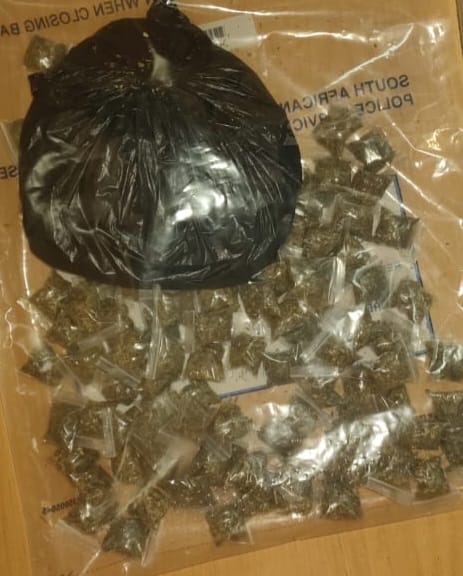
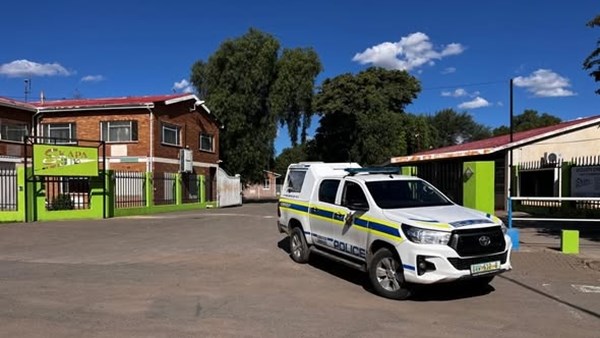
9 March 2026- The multi-disciplinary teams executing Operation Vala Umgodi disruptive operations in Postmasburg resulted in the arrest of five suspects between the ages of 21 and 42 on 8 March 2026. This comes after a tip-off was received regarding suspects allegedly in possession of suspected drugs in Postdene, Boitshoko, Greenfield, Newtown, Marantheng, White City and Mountain View.
The Northern Cape police spokesperson, Warrant Officer Molefi Shemane said the police operationalised the information and raided the identified locations, where drugs with an estimated value of R34 650 was discovered. Shemane said in addition, the police confiscated a digital scale machine and money believed to be used in the commission of a crime.
“The operation led to the arrest of a foreign national suspect (34) after the police established that he does not have valid documentation permitting him to be in South Africa.
“All arrested suspects are expected to appear in court soon on charges of dealing in drugs, possession of drugs and contravention of the Immigration Act. The police will continue undoubtedly with disruptive actions in the fight against illicit mining and related crimes,” he said.
9 March 2026- A body of a trapped miner was recovered at Ekapa Mine in Kimberley, Northern Cape during an ongoing search operation. Five miners were trapped in a shaft following a mud-rush incident.
The Northern Cape police spokesperson, Colonel Cherelle Ehlers said the Kimberley Detectives are investigating an inquest after the recovery of the body. Ehlers said the body was recovered on Monday approximately at 3pm.
“This follows a mud rush that occurred on 17 February 2026. The investigation continues,” she said.
9 March 2026 – The acting North West Police Commissioner, Major General (Dr) Ryno Naidoo, has welcomed the recent sentences handed down in four separate cases, including three involving rape and one related to tampering with and/or damaging of essential infrastructure. Naidoo said in the first incident, a suspect was arrested on 10 December 2021, after DNA evidence linked him to two rape cases that were reported in Wolmaransstad.
He further said in the first case reported on Sunday evening, 4 June 2017, the court heard evidence that a woman (27) was walking back from Extension 15 to Extension 10, when she was overpowered by two men. Naidoo added that the suspects robbed her of money, forced her to a nearby house and raped her.
“In the second case, reported on Sunday evening, 7 November 2018, a woman (21) went to a nearby shop when she was overpowered by two men who threatened her with a knife. She was taken to a nearby toilet, where she was raped.
“The accused, Letlhogonolo Luckyboy Modisapodi (30) was found guilty by the Wolmaransstad Regional Court and sentenced to two life imprisonments. He was also declared unfit to possess a firearm in terms of Section 103 of the Firearms Control Act 60 of 2000,” he said.
Naidoo further said in a separate case, Buru Mopalami (29) was found guilty by the Schweizer Reneke Regional Court and sentenced to 20 years imprisonment for the rape of a woman (27). He added that the court heard evidence that the victim was visiting a local tavern in Ipelegeng Township, near Schweizer Reneke, when the convict threatened her with a knife and forcibly took her to his house, where he raped her.
“Buru was also declared unfit to possess a firearm in terms of the Firearm Control Act. In a third, unrelated incident reported in Phokeng during February 2025, George William Nkedi (54), a former employee of the Rustenburg Municipality’s infrastructure department, was found guilty and sentenced to five years imprisonment in terms of Section 271(1)(i) of the Criminal Procedure Act 51 of 1977 by the Bafokeng Magistrate’s Court.
“This sentence follows after he was found in possession of suspected stolen copper cables belonging to the Rustenburg Local Municipality. He was also declared unfit to possess a firearm in terms of Section 103 of the Firearms Control Act 60 of 2000,” said Naidoo.
He commended the investigating officers, prosecutors and all other role players for their collaborative efforts in securing these convictions and sentences.
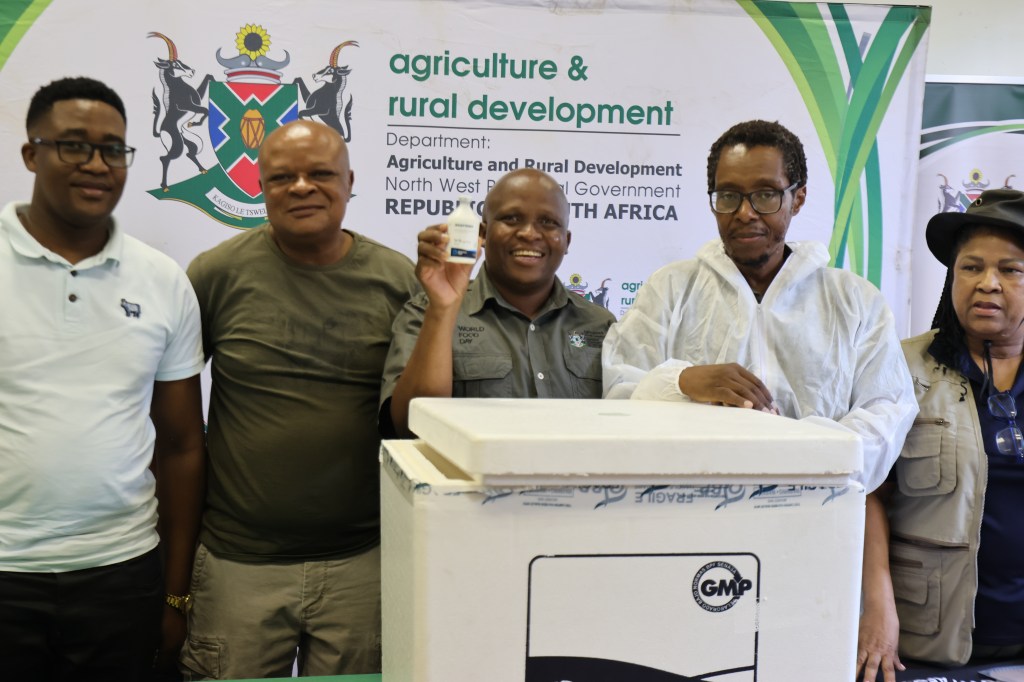
Picture: North West MEC for DARD, Madoda Sambatha, joined by senior management from the Department and municipal officials, unveiled 100000 doses of Biogenesis Bago FMD Virus Vaccines during a press conference at Potchefstroom College of Agriculture/Supplied
By REGINALD KANYANE
9 March 2026 – The rollout of Foot and Mouth Disease (FMD) vaccines in the North West has officially begun, with the first batch of cattle receiving injections as part of an intensified campaign to stop the outbreak. The department said this marks a decisive step in the province’s response, with the vaccination drive now in full swing across affected districts to protect livestock, farmers, and rural communities.
The North West MEC for Agriculture and Rural Development, Madoda Sambatha said the FMD has already spread to 16 of the province’s 18 municipalities, with a combined total of 158 confirmed cases across all four districts. Sambatha said to curb the spread, his department has secured 100 000 doses of Biogenesis Bago FMD Virus Vaccines.
“Vaccines will be distributed across all districts to ensure fairness and equal access. While priority will be given to the most affected areas, no farmer or village will be left behind. Communal villages, where livestock movement and limited biosecurity measures increase risk, will be a critical focus to build herd immunity and cut off transmission pathways.
“Alongside vaccination, veterinary teams are conducting daily outreach, information sessions, and biosecurity awareness campaigns across the province. Priority is also being given to precautionary quarantine farms and areas near buffalo populations, which are known carriers of the virus,” he said.
Sambatha appealed directly to farmers, stressing the importance of early reporting. He said farmers must not keep quiet when they see signs of Foot and Mouth Disease.
“Do not hide cases and be the first to report them to your nearest veterinary clinic or extension officer. If you report early, it will help the province stop the disease from spreading. This sickness does not move on its own; it is moved by us when we move animals without care. That means we also have the power to stop it. By reporting quickly and working together, we can protect our cattle, our villages, and our livelihoods,” said Sambatha.
He said farmers are strongly encouraged to report any suspicious signs immediately to the nearest veterinary facility or inform extension officers. Sambatha said by acting quickly and responsibly, communities can help contain the outbreak and protect the agricultural economy, food security, and rural livelihoods.
9 March 2026- The Republic of South Africa (RSA) president, Cyril Ramaphosa said the progress being made by the eThekwini metro towards stabilisation demonstrates how effective leadership, coordinated action and strong societal partnerships can support struggling municipalities to regain their footing.
Ramaphosa said, last week, he met with the Presidential eThekwini Working Group stakeholders, which include national government, provincial government, local government, business, community-based organisations and organised labour.
He further said they established the working group in 2024, in response to concerns from business and residents about the city’s decline. Ramaphosa added that at the time, the metro was beset by service delivery failures, deteriorating infrastructure and sliding business and investor confidence.
“Two years later, the interventions undertaken to tackle poor service delivery and failing infrastructure are driving an effective sustained recovery in the metro. The Durban Business Confidence Index is at its highest level since it was established.
“In the manufacturing sector, confidence has risen by nearly 16% quarter-on-quarter, a significant development for a city with a major port and a strong industrial base. Tourism has also rebounded strongly, with more than 1.2 million visitors to the metro during the recent festive season,” said Ramaphosa.
He said in addition, the key infrastructure projects are underway and they are seeing improvements in safety and security coordination across the metro. Ramaphosa said while stabilisation is not the same as a complete turnaround and the metro still faces significant challenges, the experience of eThekwini offers a viable model for coordination and partnership that can be replicated in other metros and municipalities to enable them to recover.
“The working group approach is based on the District Development Model (DDM), which we launched in 2019 to improve service delivery by fostering collaboration across all three spheres of government.
“The model has proven effective in addressing challenges in government, but more importantly has encouraged various stakeholders to work together. It is designed to bring together government, business, labour and civil society to accelerate turnaround strategies,” he said.
Ramaphosa said, last year, the eThekwini metro approved a Partnerships Framework as a mechanism for public-private cooperation, particularly on infrastructure and catalytic projects. He said for business, supporting local government turnaround has a direct economic benefit because improved service delivery strengthens the economic environment in which companies operate.
“Drawing on lessons learned from the eThekwini Working Group, last year we established the Presidential Johannesburg Working Group, which is focused on governance, service delivery, infrastructure, urban renewal and safety.
“While working groups can contribute to stabilising municipalities, sustained progress depends on strengthening institutional capacity across the entire local government system. Municipalities must be able to deliver on their constitutional mandates without the need for national intervention,” said Ramaphosa.
He said the review of the White Paper on Local Government currently underway will result in a far-reaching overhaul of the entire local government system. Ramaphosa said among the reforms under consideration are a differentiated approach to municipal powers and responsibilities, improving appointment processes for senior municipal officials and stronger cooperation between municipalities and traditional leadership institutions.
“A number of municipalities are characterised by poor revenue management and rising municipal debt. Audit outcomes show that around two-thirds of municipalities are in financial distress. Without stronger revenue management and financial discipline, service delivery challenges will persist and backlogs will only worsen.
“The revenues collected from service provision are meant to be reinvested into maintaining and upgrading infrastructure to improve service delivery. However, in far too many instances these resources are redirected to cover other costs,” he said.
Ramaphosa said to address this problem, R27.7 billion has been allocated over the next three years to encourage metros to reform their water, sanitation, solid waste and electricity services. He said the government is reforming the municipal infrastructure grant to address persistent underspending, misuse of funds and capacity constraints.
“The progress being made in eThekwini and other municipalities is part of a broader programme of reforms that are contributing to better economic growth and improved business confidence. The reforms we are undertaking in the energy, water, telecommunications and logistics sectors are already making an impact on the efficiency and competitiveness of our economy.
“The progress being made in eThekwini to rebuild capacity and restore accountability shows how municipalities can achieve a turnaround with political will and the involvement of stakeholders and residents,” said Ramaphosa.
He said when local government fails, the impact is felt by communities, businesses and households. Ramaphosa said when local government works well, villages, towns and cities become engines of opportunity and growth.
“With local government elections on the horizon, this is an opportunity for all stakeholders to work together – not to campaign for the ballot box, but to renew the promise of local government to uphold the dignity and improve the life of every citizen,” he said.
Picture: Deputy Minister of Water and Sanitation, Sello Seitlholo
By BAKANG MOKOTO
9 March 2026- The deputy minister of Water and Sanitation, Sello Seitlholo will engage with Rustenburg and Moses Kotane Local Municipalities and the Magalies Water on the ongoing water supply challenges facing communities within the municipalities. Seitlholo, together with the municipalities and Magalies Water will deliberate on strategies to strengthen coordination, ensure accountability, and to develop a clear turnaround plan to restore full operational capacity across the following systems, Kortbegrip Reservoir, Phatsima Pump station, Bospoort reservoir, Bospoort Water Treatment Works 3, Monakato pump line and Tlhabane Reservoir under Pilanesberg Phase 2 Project.
The meeting will be held at Rustenburg Civic Centre on 9 March 2026.
9 March 2026- The Speaker of the North West Provincial Legislature (NWPL), Dr Desbo Mohono will preside over a Legislature House Sitting, where the North West Premier Lazarus Mokgosi will respond to the 2026 State of the Province Address (SOPA) debate in the Legislature Chamber on 10 March 2026 at 9am.
The debate where Members of Political Parties represented in the Legislature participated was held on 3 March 2026, in the Chamber. The proceedings of the House Sitting will be streamed live on the Legislature Facebook page.
Picture: North West MEC for Social Development, Sussan Dantjie
By REGINALD KANYANE
9 March 2026- The North West MEC for Social Development, Sussana Dantjie said women should be given recognition and claim equal participation in the creation of a non-sexist, non-racist democratic society. Dantjie echoes her sentiments as the United Nations celebrate International Women’s Day on 8 March 2026, under the theme: ‘Rights. Justice. Action. For All Women and Girls.
She further said the observance of this day is a clarion call to action for accelerating gender equality, dismantling harmful practices and social norms that erode the rights of women and girls. Dantjie added that her department has recorded great milestones in hiring women in senior management positions.
“Currently the ratio of women in the top echelon of management is higher than men in her department – a move she described as meaningful in addressing historic subordination and women oppression.
“Without basking in the glories at our disposal, we are doing sterling work in empowering women. On a yearly basis we provide funding to qualifying NPOs which include old age homes, residential facilities, treatment centres and many other facilities that provide social services to our communities,” she said.
Dantjie said most of these NPOs are largely owned by women. She said that through her departmental policy on women empowerment they have provided a basket of interventions in the form of equipment and stock to women owned entities and small businesses in rural areas.
“In an effort to promote and restore the dignity of the victims of Gender-Based Violence (GBV), our department has established White Doors as immediate contact centres that give victims access to counselling, a temporary safe haven from an abuser.
“The centres make provision for rooms with beds, chairs, food as well as a dignity packs for women who have experienced abuse. The centres are directly linked to the local police station and serve as referral points for victims and survivors of GBV,” said Dantjie.
She said they also have shelters that provide psycho-social services such as referrals, trauma counselling, skills development, court preparation, long term accommodation including prevention and aftercare services for the victims of GBV.
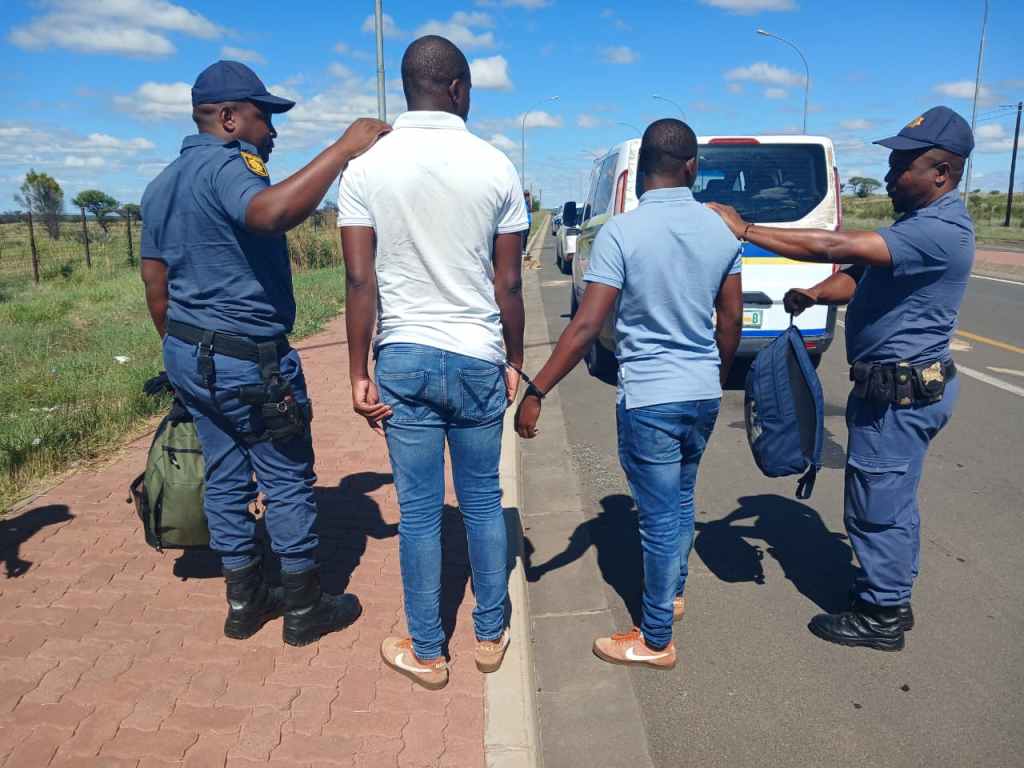
Picture: Two suspects nabbed during raids/Supplied
By OBAKENG MAE
9 March 2026 – The Frances Baard District Illicit Mining Task Team executed high visibility patrols at identified hotspot areas in Kimberley and Galeshewe Township, which led to the arrest of eight suspects. On 5 March 2026, during foot and vehicle patrols in the De Beers area, a suspect (28) was arrested for possession of drugs after police found mandrax tablets in his possession.
The Northern Cape police spokesperson, Warrant Officer Molefi Shemane said additionally, another two suspects aged 38 and 46 were arrested for being illegally in the country after they failed to produce permits that secures their legality in the country. Shemane said on 6 March 2026, as members were executing foot patrols in the Kimberley Central Business District, they arrested a man (25) for possession of drugs.
“On 7 March 2026, two identified premises in Galeshewe were raided after police acted on intelligence information regarding drugs allegedly sold at the two locations. Simultaneously, police acted swiftly and raided the two houses, where suspects aged 34 and 50 were arrested.
“Mandrax tablets, tik, dagga and money were found and confiscated by the police. Furthermore, on 8 March 2026, during vehicle patrols conducted on the R357, members arrested two suspects aged 34 and 38 for dealing in drugs after they were found at a hiking spot on the Douglas Road with bags containing dagga and money,” he said.
Shemane further said dagga with an estimated value of R 41 985 was confiscated by the police. He added that police remain resolute in its quest to remove drugs from the streets of the Frances Baard District and surrounding areas.
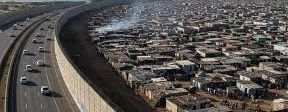
9 March 2026- Build One South Africa (BOSA) said the acting Minister of Police, Prof Firoz Cachalia does not believe that the proposed wall along the N2 highway in Cape Town will stop crime. BOSA said Cachalia has directly contradicted the City of Cape Town’s justification for spending R120 million on a wall along the N2 corridor.
BOSA leader, Mmusi Maimane said in a written reply to BOSA’s parliamentary question, Cachalia makes it clear that the South African Police Service (SAPS) has not determined that the N2 safety project is an effective substitute for sustained visible policing or enhanced investigative capacity, emphasising that infrastructure interventions “cannot replace core policing functions.” Maimane said Cachalia further confirms that a wall will not address organised criminal activity, firearm-related offences, gang violence, or broader public order challenges affecting surrounding communities.
“This stands in stark contrast to repeated public commitments by the Mayor of Cape Town that the N2 wall will help stop crime along the corridor. The Minister has effectively punctured the City of Cape Town’s justification for spending R120 million on a wall along the N2.
“This contradiction exposes the fundamental problem with the project. BOSA has long held that this wall is more a cosmetic intervention than a crime-fighting strategy. If the country’s own Police Minister acknowledges that a wall will not stop the most
serious forms of crime affecting nearby communities, then the City must explain why it continues to present this project as a meaningful safety solution,” he said.
Maimane added that a R120m barrier along the highway used by thousands of people travelling between the airport and the city each day risks echoing the spatial logic of the past. He said symbolically, it will use infrastructure to divide communities and keep poverty out of sight.
“For many residents, the project mirrors the thinking of apartheid spatial planning. Separate communities and shield inequality from those passing by. Crime cannot be walled away, and South Africa cannot build barriers high enough to hide the reality of poverty and inequality.
“Real safety will come from effective policing, intelligence-led operations, proper investigative capacity, and meaningful investment in communities. BOSA believes that concrete walls act as a temporary measure to obscure deeper problems,” said Maimane.
He said BOSA will continue to oppose the building of this wall, and instead advocate for the R100 million plus budget to be directed towards real crime fighting measures in areas which need it the most.

 The Guardian