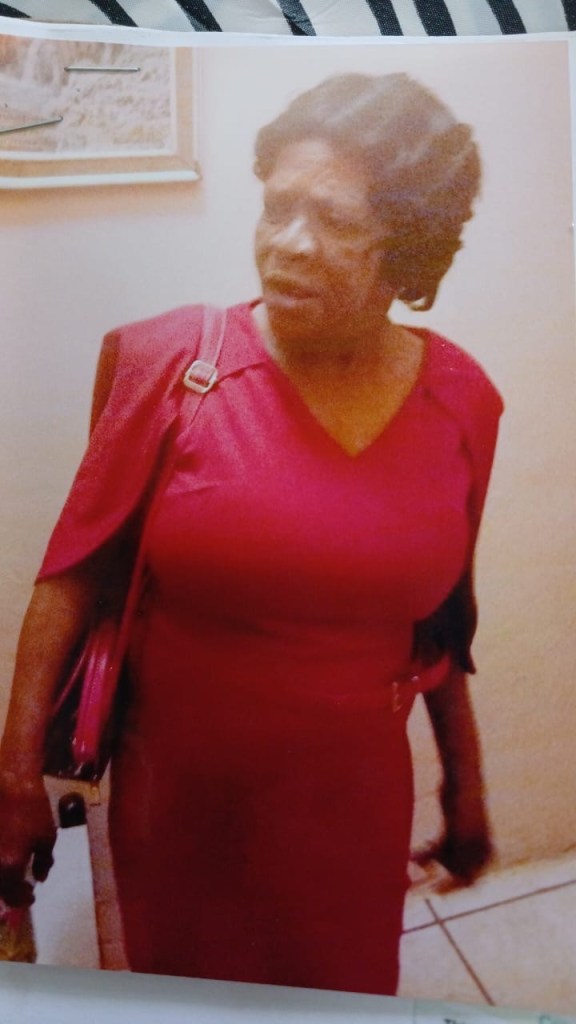
Picture: The missing Fransiena Dede Tommy/Supplied
By OBAKENG MAJE
The police in Upington are requesting the assistance of the public in locating a missing woman, Fransiena Dede Tommy. Tommy (63) was last seen on 3 May 2024 at Capitec Bank, near Shoprite in the Upington Central Business District (CBD) with two women.
The ZF Mgcawu District police spokesperson, Omphile Masegela said they were seen doing a bank transaction together. Masegela said thereafter, Tommy allegedly left with them and she has not returned home since.
“Tommy was wearing a red blouse, blue denim jeans with blue sneakers. Anyone with information can contact the Investigating Officer, Sergeant Bahedile Nkwadipo on 082 495 4615 or 054 337 3400.
“The public is reminded that there is no waiting period to report a person missing,” she said.
Picture: The firearm and ammunition confiscated by the police/Supplied
By OBAKENG MAJE
A man has been arrested for possession of unlicensed firearm, ammunition during Operation Vala Umgodi in Pampierstad on Tuesday. The intelligence-driven operation further led the police to the arrest of two men aged 33 and 42 after they were found in possession of suspected drugs.
The Northern Cape police spokesperson, Sergeant Molefi Shemane said a firearm, ammunition and drugs estimated to the street value of R14 485 were confiscated.
“The suspects will briefly appear in the Pampierstad Magistrate’s Court soon,” he said.
Meanwhile, the Northern Cape Police Commissioner, Lieutenant General Koliswa Otola, applauded the police for their swift response and commended the community involvement in assisting the police to address illicit mining and related crimes.
The Northern Cape police said the policing of Gender-Based Violence and Femicide (GBV&F) and contact crimes remains their priority. The Northern Cape police spokesperson, Lieutenant Col Sergio Kock said, however, adherence to the essential safety tips can help the public to stay safe.
Kock said this will prevent them from becoming the victim of crime. He further said those who might plan to meet strangers, should choose reputable venues with positive reviews and a good reputation for safety and security.
“Adopt a buddy system and always go out with a group of friends and stay together throughout the night. Look out for one another and agree on a plan to leave the club together.
“Plan transportation in advance and arrange reliable transportation to and from the club, tavern or social gathering beforehand, ensuring that you have a safe way to return home,” said Kock.
He added that individuals should also watch their drinks. Kock said they should never leave their drinks unattended, as it could be tampered with.
“This will leave you as a victim of date rape. Do not accept drinks from strangers and drink responsibly. Pace yourself and be aware of your alcohol consumption. Know your limits and avoid excessive drinking to stay in control of your surroundings.
“Be aware of your surroundings and stay vigilant. Also, be alert against the people around you. Never walk home alone or take short-cuts through dark and secluded areas. Report suspicious behaviour, whether it is someone pestering an individual or group, or following someone to the bathroom or their car. Report it to staff or security immediately,” he said.
Kock urges people to never go to the toilet alone. He advised individuals to use a buddy system for bathroom breaks. He said they should also keep their personal belongings secure.
“Carry only essential items, such as your ID and some cash, in a secure bag or pocket. Avoid flashing expensive items that may attract unwanted attention from criminals. That may lead to robbery and sexual assault.
“Never accept a ride home from strangers and learn self-defence techniques. Consider taking self-defence classes to empower yourself with basic skills that could potentially save you in a dangerous situation,” said Kock.
He said by following these essential tips, individuals can mitigate risks and enjoy a safe night out. Kock said they should always have an emergency contact on speed dial.
“Call your nearest police station or 10111 when you find yourself in a dangerous situation. Call Stop Gender Violence Helpline: 0800 150 150 or report GBVF crime to the MySAPS app.
Some residents in Pudimoe said they hope that the newly-appointed Station Commander in Pudimoe Police Station will bring drastic changes. The residents said Pudimoe has been turned into a “crime haven” by criminals, who continue with a “reign of terror”.
One of the residents who refused to be named for fear of reprisal said: “We have a high rate of crime in our area and the police turn a blind eye. Just recently, young men lost their lives after being stabbed to death. We urge the police to combat crime and ensure there is high visibility.
“We understand that some police officers are conniving with criminals, especially drug lords. Our community is living in fear due to these criminals who continue to terrorise us. We hope the newly-appointed station commander will crack the whip against incompetent police officers,” he said.
The North West Police Commissioner, Lieutenant General Sello Kwena accompanied by the Deputy Provincial Commissioners and District Commissioners, conferred ranks to 13 newly appointed station commanders. The conferment took place on 10 May 2024, at the South African Police Service (SAPS) Provincial Office in Potchefstroom.
Lieutenant Col TR Magile was appointed as the Station Commander of Pudimoe Police Station. According to Kwena, Magile has 20 years of service and a Diploma in Policing.
“We have also appointed Lt Col DA Serebolo as the Station Commander of Bloemhof Police Station. Serebolo has 20 years of service and a Diploma in Management. Lt Col MS Modisakeng was appointed as the Station Commander of Lehurutshe Police Station with 29 years of service. He has a Bachelor Degree in Public Administration. Lt Col CSO Letsatsi was appointed as the Station Commander of Swartruggens Police Station and 33 years of service, with a Diploma in Policing.
“Lt Col TV Semeno was appointed as the Station Commander of Ventersdorp and served for the past 32 years. He has a diploma in Policing. Capt MR Molelekoa was appointed as the Station Commander of Boons. Molelekoa has 19 years of service and a Bachelor Degree in Policing,” he said.
Kwena further said he also appointed Capt J Badenhorst as the Station Commander of Boshoek. He added that Badenhorst has 33 years of service and a Diploma in Policing.
“Capt MP Mahube was appointed as the Station Commander of Mareetsane. She has been serving for the past 22 years and has a Diploma in Policing. Capt OM Kegakilwe was appointed as the Station Commander of Morokweng. He has 19 years’ service and a Diploma in Policing,” said Kwena.
He said Capt KM Meleke was appointed as the Station Commander of Ottosdal and has been serving for the past 19 years. Kwena said Meleke has Bachelor Degree in Police Science.
“Capt PB Mogwera was appointed as the Station Commander of Reivilo. He has 19 years’ service and a Diploma in Policing. Capt Plaaitjie was appointed as the Station Commander of Vorstershoop. He has 19 years’ service and a Bachelor Degree in Commerce.
“Capt TC Ngobeni was appointed as the Station Commander of Dwarsberg. He has served for the past 19 years. We would like to congratulate all the appointees. We would also like to remind them that being a station commander is a mammoth task and they are responsible for their jurisdictions,” he said.
Kwena said the station commanders must always be available on their cell phones.
“Station Commanders, you are the extension of the Provincial Commissioner. You are the extension of the District Commissioner. You must be there. In addition, we urge you to take care of both human and physical resources.
“Kindly discourage the tendency of dumping of vehicles involved in accidents at garages without paperwork. Critically, for being the station commander, is giving the people service that they request from you. Ensure that your Community Service Centre is running like a clock,” said Kwena.
As of today, the country will have had no load shedding for over a month and a half. This welcome development shows that the Energy Action Plan we announced in 2022 is working.
It is too early to say that load shedding has been brought to an end. However, the sustained improvement in the performance of Eskom’s power stations – as well as the new generation capacity we have added to our energy system – gives us hope that the end of load shedding is in sight.
A renewed focus by Eskom on maintenance and the return to service of several units is now showing results. Losses due to unplanned outages have reduced by 9% between April 2023 and March 2024, adding the equivalent of 4,400MW of capacity to our national grid.
Better maintained and more reliable power stations have increased the country’s Energy Availability Factor (EAF), which is the amount of electricity available from our power stations at any given time. The EAF has been above 60% since April, compared to 53% over the same period last year.
Through dedicated support from our law enforcement agencies and the National Prosecuting Authority, great strides are being made in rooting out corruption at Eskom. Work is continuing in disrupting criminal syndicates and protecting our power stations from sabotage.
The leadership, management and staff of Eskom, particularly the power station general managers and their teams, are to be commended for their efforts. The work of the National Energy Crisis Committee, which coordinates the response across government, has also been vital. The strong partnership with business and the support of other social partners has enabled the deployment of valuable resources and expertise.
The stabilisation in the availability of electricity and reduction in breakdowns signal a real trend in improved plant performance.
Yet, against all the available evidence, some people have claimed that the reduced load shedding is a political ploy ahead of the elections. Some have speculated that there is less load shedding because Eskom is using the diesel-fuelled peaking plants to ‘keep the lights on’ in the run-up to the elections.
This is not borne out by the facts. Eskom is actually using these peaking plants at a much lower rate than the last two years. For example, last month Eskom spent more than half as much on diesel as it did in April 2023.
Another key factor driving the reduction in load shedding is our success in adding new generation capacity, mostly from renewable energy sources.
Removing the licensing threshold for new power generation projects has led to significant private investment in the energy sector. There is now a pipeline of more than 130 private energy projects, representing over 22,500 MW of new capacity, some of which are already starting to connect to the grid.
As a result of the tax incentives and financing options we introduced for businesses and households, by November last year the capacity of rooftop solar had reached over 5,000MW, more than doubling in just twelve months. This has helped to alleviate pressure on the national grid.
More bid windows have been released for new capacity from solar, wind, gas and battery storage, with more than 10,000 MW currently in procurement through public programmes.
Load shedding has been reduced due to a combination of all of these measures: fixing Eskom, unlocking private investment in energy generation, accelerating the procurement of new capacity and supporting rooftop solar.
While we have made progress in addressing the current crisis, we have also put our country on a clear path towards a reliable, affordable and sustainable supply of energy. We have embarked on fundamental reforms to the energy sector that will ensure we don’t experience load shedding in the future.
The Electricity Regulation Amendment Bill, which we tabled in Parliament last year, will establish a competitive energy market in South Africa for the first time. This will encourage investment and bring down electricity prices. We are also expanding our transmission network to accommodate renewable energy in provinces like the Northern Cape, with a plan to build over 14,000 km of new transmission lines across the country.
Just as we note this progress, we must be clear that we are not out of the woods yet. The risk of load shedding remains. We must therefore all continue to play our part by using electricity sparingly and paying for the electricity that we use.
What we can say for sure is that our plan is working. We are determined to stay the course and to continue this work until the energy crisis is brought to an end once and for all.
Picture: The retired ConCourt Judge, the late Yvonne Mokgoro/Google
By OBAKENG MAJE
The National Prosecuting Authority (NPA) in the Northern Cape said the partner of the retired ConCourt Judge, the late Yvonne Mokgoro (73), could face charges of culpable homicide. Mokgoro was horribly injured in a car accident near Warrenton in Northern Cape last year.
This forced her to withdraw from any public engagement to focus on her recovery. However, she passed away recently and her partner, David Mmelesi, who was allegedly the driver during a car crash, was charged for reckless and negligent driving.
Mmelesi is currently out on warning.
The NPA spokesperson in Northern Cape, Mojalefa Senokoatsane said: “He is criminally charged and facing one count of reckless and negligent driving. There is a possibility of amending his charges to culpable homicide following the death of the judge.
“The accused will be back in the Barkley West Magistrate’s Court on 30 May 2024. Mmelesi briefly appeared on a J175 and is currently on warning.”
Meanwhile, heartfelt condolences continue to pour into Mokgoro’s family. The Republic of South Africa (RSA) president, Cyril Ramaphosa said he is saddened by the passing of Mokgoro.
“On behalf of the government, we offer our deepest condolences to Prof Job Mokgoro and the late Justice’s immediate and extended family, as well as her many associates in the legal fraternity in South Africa and abroad.
“Mokgoro was a judge of the Constitutional Court of South Africa from its inception in 1994 until the end of her 15-year term in 2009. She obtained a Bachelor of Jurisprudence (B Juris) degree at the then University of Bophuthatswana (now North West University) in 1982, a Bachelor of Laws (LLB) two years later, and a Master of Laws (LLM) degree in 1987,” he said.
Ramaphosa said she also studied at the University of Pennsylvania in the United States of America, where she obtained a second LLM degree in 1990. He further said throughout her legal career, she taught a number of courses, including Constitutional Law, Human Rights Law Jurisprudence, History of Law, Comparative Law, Criminal Law, Private Law and Customary Law at a number of universities in South Africa, the United Kingdom, the USA and the Netherlands.
“Mokgoro wrote and presented papers, and participated in a myriad national and international conferences, seminars and workshops in South Africa and internationally, mainly in sociological jurisprudence and particularly on human rights, customary law, focusing on the impact of law on society generally, and on women and children specifically.
“In 2015, she was inducted as a Member of the Order of the Baobab in Bronze for her excellent contribution in the field of law and administration of justice in a democratic South Africa,” said Ramaphosa.
He added that Mokgoro’s passing deprives the nation of a formidable intellect and impeccable jurist, who served our democracy at its very inception and through the years that followed.
“As we recall the inauguration of our Founding President, Nelson Mandela 30 years ago on this day, 10 May, we count his appointment of Mokgoro to the Constitutional Court as one of the critical, transformative decisions he exercised in those early days of our liberation.
“As a black female judge, she was a pioneering embodiment of and contributor to the transformation of our country and the legal system and new jurisprudence that enabled this transformation,” said Ramphosa.
At MyNorthernCape TV, we pride ourselves on being the fearless voice of our beloved province, and we feel compelled to address the recent Carte Blanche reportage (on Sunday, 12 May 2024) that has stirred significant controversy. Their segment, framed under the campaign titled ‘Broken Promises,’ painted a grim picture of our province, overshadowing the tangible strides made by the people of this beloved Northern Cape province we call home.
Premier Zamani Saul’s impassioned response highlights the need for a more nuanced narrative that acknowledges both challenges and achievements. Dr Zamani Saul has been inaugurated as Premier of the Sixth Administration of the Northern Cape Provincial Government (NCPG) after the African National Congress (ANC) achieved success in the 2019 General Elections.
The Misleading Media Narrative
Carte Blanche’s portrayal of the Northern Cape as a ‘forgotten province’ riddled with infrastructural decay is emblematic of a broader media trend that prioritizes sensationalism over substance. By focusing exclusively on negatives, such as sewer spillages and water bursts, and tying these issues specifically to a democratically elected black-led government, the report perpetuates harmful stereotypes. This type of coverage does a disservice to all the people of this province who are working tirelessly to improve their communities and to leaders like Premier Saul who are spearheading these developmental initiatives.
Premier Saul’s Stance: A Call for Context
Premier Zamani Saul’s frustration is palpable and justified. His accusation that Carte Blanche manipulated interview snippets to push a sensationalist agenda underscores a critical flaw in contemporary media practices. Saul’s challenge to Carte Blanche to release the full interview speaks to a demand for transparency and fairness. It is essential for media outlets to provide context and balance, especially when discussing systemic issues. The Premier’s emphasis on the unacceptable nature of suggesting that infrastructural failures are expected in black communities is a powerful condemnation of implicit racial biases that still permeate media narratives.
Progress Amidst Challenges
While it is undeniable that the Northern Cape faces significant infrastructural challenges, it is equally important to recognize the progress being made. Under Premier Saul’s leadership, there have been concerted efforts to upgrade infrastructure, albeit at a pace constrained by economic and logistical realities. The narrative of a ‘forgotten province’ overlooks the strides being made in areas such as renewable energy, economic development, and social programs aimed at uplifting disadvantaged communities.
A Call for Balanced Reporting
Carte Blanche’s current campaign, with its bleak portrayal of the Northern Cape, risks undermining the confidence and morale of its residents. Media outlets have a responsibility to provide balanced reporting that not only highlights problems but also showcases solutions and progress. By focusing solely on the negatives, they contribute to a skewed public perception that can hinder further development and investment in the region.
Conclusion: A Plea for Fair Representation
The Northern Cape is far from a doomed province. It is a region with its share of challenges but also one with immense potential and ongoing progress. Media narratives should reflect this dual reality. Premier Zamani Saul’s call for a more accurate representation is not just a personal grievance but a plea for fairness and balance in journalism.
It is time for media outlets like Carte Blanche to rise to the occasion and provide a more comprehensive view that does justice to the resilience and efforts of the people of the Northern Cape.
At MyNorthernCape TV, we are committed to showcasing the true spirit of our province. We will continue to provide fearless and balanced reporting that highlights both the challenges and the achievements of the Northern Cape. Let’s work together to foster a more informed and constructive public discourse.
(NB: The remarks raised in this article are the views of the author and Taung DailyNews nor its associates do not agree nor disagree with the content. The views remain of the author, My Northern Cape TV representative Motheo Seleke)
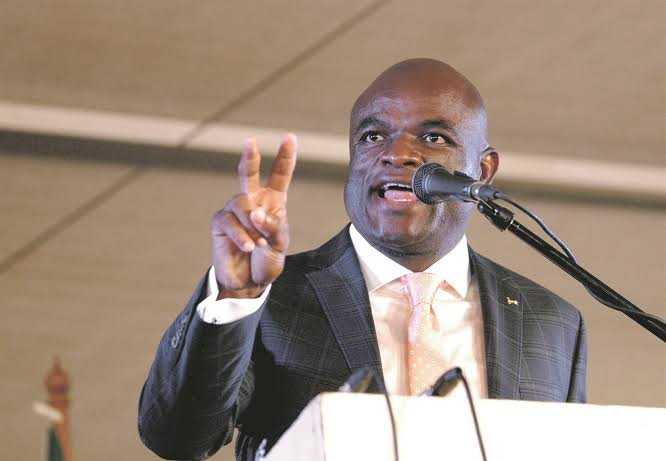
The South African National Civic Organization (SANCO) in the North West said it is deeply disappointed by yet another revelation of corruption within the Matlosana Local Municipality. SANCO provincial spokesperson, Mzukisi Jam said it is really disturbing to witness the level of corruption within both the administrative and political offices of this municipality.
Jam further said nonetheless, they commend the media and law enforcement agencies for their unwavering commitment to uncovering corruption and urge them to persist in their efforts. He added that a recent report by Sunday Independent online news has exposed yet another corruption scandal involving the Whip of the Council, Khaya Ndincede and again the Chief Financial Officer (CFO) of the Matlosana Municipality, Mercy Phetla.
“The two stand accused of misusing a municipal vehicle and credit card/petrol card for personal gain at the expense of taxpayers. It is unspeakable to see how they shamelessly abused state resources while holding higher positions and being well compensated.
“At least all the evidence on the misuse of the vehicle and petrol card is detailed in the letter written by the Municipal Fleet Maintenance Unit Superintendent, Raymond Holele to his superiors, dated
15 November 2023.
“Sunday Independent has also published parts of the evidence from the municipal fleet records, WhatsApp messages, and images showing the car at some point being damaged and the extent to which it was misused with the petrol card. With all this evidence, we envisage seeing these corrupt officials being convicted, thereby sending a strong message that corruption will never be tolerated in government,” said Jam.
He said SANCO also calls for all the officials with evidence to come forward and testify to strengthen the state case against these corrupt individuals. Jam said the municipality’s reaction to this issue and towards accountability is also deeply concerning.
“It is unacceptable that taxpayer funds intended for service delivery are being squandered for personal gain, with no accountability to the public as no one in the municipality has responded to these allegations.
“According to the Sunday Independent, despite repeated attempts to seek clarification, neither Ndincede nor Phetla has provided any explanation for their actions. Apparently, even the Matlosana Local Municipality spokesperson, Ntswaki Makgetha, did not respond to questions despite promises to do so,” he said.
Jam said as SANCO, they are profoundly disturbed by the level of corruption within the municipality. He said it appears that those entrusted with serving the community have abandoned their responsibilities and focusing their efforts on their personal enrichment.
“We remain steadfast in our commitment to monitoring and condemning corruption. We call for an extensive SIU investigation into the Matlosana Local Municipality and for the removal of all corrupt individuals from government institutions.
“These corrupt individuals are continuing to tarnish the name and integrity of the ANC, and we urge for decisive action to be taken to restore trust in our government. The fight against corruption must be intensified and we stand ready as SANCO to collaborate with the ANC and other stakeholders to rid our provincial government of corruption for the betterment of our communities,” he said.
The Republic of South Africa (RSA) President Cyril Ramaphosa will on Wednesday, publicly sign into law the controversial National Health Insurance Bill (NHI), which directs the transformation of South Africa’s health care system to achieve universal coverage for health services.
The national Department of Health said, through this, the system will overcome critical socio-economic imbalances and inequities of the past. The signing ceremony will take place at the Union Buildings, Pretoria, at 2pm.
According to the department’s website, https://www.health.gov.za/nhi/, since the dawn of democracy, the health sector has undergone many reforms to try and create a more equitable, accessible and affordable healthcare system that can service all South Africans. It says, however, these past reforms have been too little and too slow.
“Everyone deserves equal access to quality and affordable healthcare. Fundamental changes need to occur to create a strengthened healthcare system. The problem is that South Africa’s health system is very complicated and expensive.
“The health outcomes do not match the resources invested in the system. Both the public and private sector have challenges that make the healthcare delivery system unsustainable to service all South Africans,”
The department says it plans to strengthen the health system. It says South Africa is a member of the United Nations community and has committed to implement universal health coverage for all.
“The desired outcome is that all people have access to the full range of quality health services they need, when and where they need them, without financial hardship. The NHI is South Africa’s strategy to achieve universal health coverage.
“The NHI is a fund from which the government will buy healthcare services for South Africans from healthcare providers both in the public and private sector. The NHI will make healthcare more affordable, by reducing the cost of healthcare for all,” the website says.
The department says NHI acts like a medical aid for everyone, and all of them will contribute to this fund through taxes and special contributions in line with what we can afford. It says the insurance will ensure that everyone is entitled to free healthcare when they need it.
“There will be no fees charged at the facility because the fund will cover the costs of care. The NHI is a journey to transform South Africa’s health sector. It will take many years to be fully realised and requires input from all sectors to ensure no one is left behind.
“For the NHI Fund to be effective, the entire health system will undergo reform for many years to come. These reforms include partnerships between the private and public sectors, making both sectors more effective and more efficient, and implementing robust governance structures,” says the website.
The department says the passing of the NHI Bill in June 2023 by the National Assembly was a key milestone that paves the way for ensuring better collaboration between our private and public health systems, guaranteeing universal and comprehensive quality health coverage for all.
Meanwhile, the Democratic Alliance (DA) Western Cape Spokesperson on Health and Wellness, Gerrit Pretorius said: “The DA rejects the destructive National Health Insurance Bill. The residents express pressing concerns on the financial and social implications of the Bill’s passage into law.
“Proposed by the ANC at the national level, the NHI Bill would allow the state to take control over virtually all healthcare in South Africa. Under NHI, private healthcare would be all, but outlawed, and medical procedures would be funded by a massive, central, tax-funded pool of money.”
Pretorius further said the National Treasury has thus far not disclosed how this system of state-funded healthcare will be funded with any degree of viability. He added that, while the goal of universal health coverage is a noble one, this particular Bill will have dire economic consequences for South Africa.
“With a mounting debt crisis, a stagnant economy and an energy crisis that makes real the threat of total economic collapse. South Africa already cannot meet its financial obligations.
“The passage of NHI would not only catastrophically exacerbate this, but would also bring millions of patients into an already-overstretched public healthcare system, while simultaneously demanding hundreds of billions of rand more from an overstretched and shrinking tax base,” said Pretorius.
He said these concerns were echoed by hundreds of residents, who made written and oral submissions on the Bill. Pretorius said in addition to economic reasons, many residents felt that NHI would worsen the flight of medical professionals from South Africa to wealthier countries.
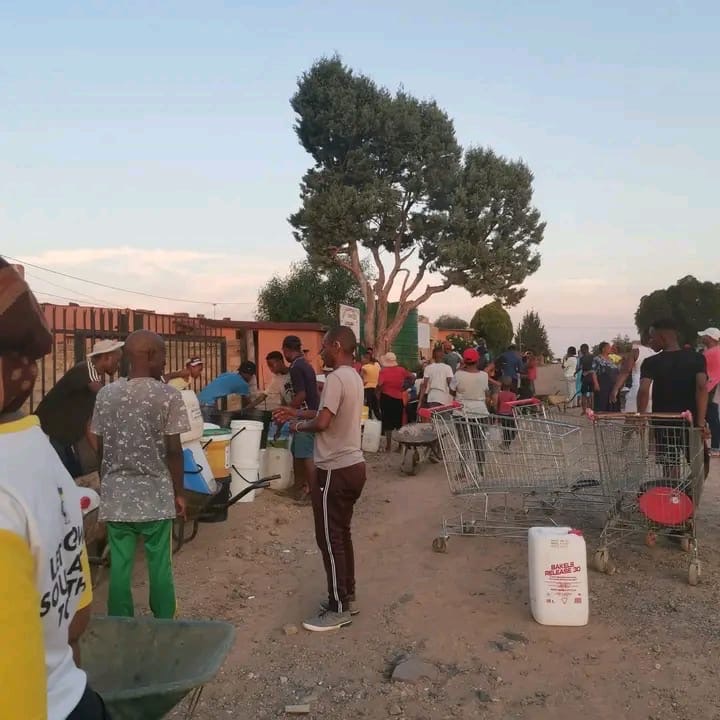
The Department of Water and Sanitation said as the custodian and leader in the water and sanitation sector, it will continue to have a constant engagement with the communities in the North West, through its toll free number.
The Department of Water and Sanitation spokesperson, Wisane Mavasa said this will assist them in improving service delivery of water and sanitation in the province. Mavasa said this follows Minister of Water and Sanitation, Senzo Mchunu’s pronouncement in January this year to resuscitate the Departmental Call Centres in all provinces.
“This initiative is a greater collaboration of government, departments, entities, and water service authorities. The agencies within the water sector have inspired teamwork towards a shared goal of ensuring continuous water and sanitation service delivery in the North West.
“The department’s Call Centre aims to ensure effective monitoring of service delivery in the province, as well as to ensure speedy response to the complaints of members of the community,” he said.
He further said this is in line with the department’s goals underpinned by the National Development Plan (NDP), which dictates that the state should put people first (Batho Pele) and effectively respond to the needs of the country and its people. Mavasa added that the department encourages communities and the country at large to report water and sanitation challenges to hotline 0800 200 200.
“They should report dry public boreholes, burst pipes or leaking taps, water use registrations and licensing, pollution and dumping of waste in or near water resources, vandalism and theft of infrastructure, leaking sewerage systems and sewer spillages. This includes poor water quality, water reservoir problems and illegal water connections.
“No water supply and water supply interruptions. The department will continue to decisively intervene and resolve water and sanitation related service challenges as it is mandated by the constitution through the National Water Act 36 of 1998 to promote equitable access to water,” said Mavasa.
He said they are also re-dressing the results of past racial and gender discrimination, promoting the efficient, and to maintain sustainable and beneficial use of water in the public interest.



 The Guardian