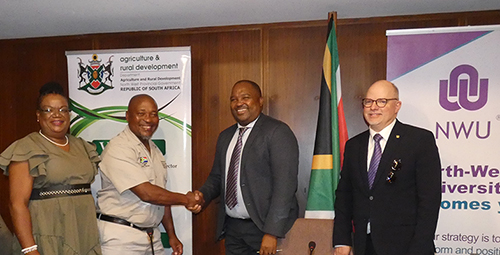
Picture: Dr Karabo Mabe, acting Chief Director for Agricultural Support Services at DARD, Thupi Mokhatla, Head of Agriculture and Rural Development for the North West DARD, Prof Bismark Tyobeka, NWU Principal and Vice-Chancellor and Prof Robert Balfour, Deputy Vice-Chancellor for Teaching and Learning at the NWU
By OBAKENG MAJE
The North West University (NWU) principal and vice-chancellor, Prof Bismark Tyobeka said the Memorandum of Understanding (MoU) they signed with the Department of Agriculture and Rural Development (DARD) will be beneficiary.
Tyobeka said the DARD was) representing the Potchefstroom College of Agriculture and the Taung Agricultural College. He said the objective of the MoU that was signed at the NWU’s Potchefstroom Campus, was to offer a framework for cooperation between the parties in pursuit of their respective statutory tasks and on a variety of mutually beneficial topics.
“The parties agreed to collaborate on matters ranging from research and capacity building to economic development and any other areas that the parties may identify and agree on from time to time, including faculty and student exchanges.
“The start of the year is a critical period in the lives of our young people, as they prepare to enter a new chapter of their life, relating to gaining access to universities. However, the unfortunate aspect is that most individuals do not meet the criteria for university admission,” he said.
According to Tyobeka, there is a failure to recognise the relevance of colleges and Technical Vocational Education and Training (TVET) colleges, notably agricultural colleges. He further said, it was their obligation to ensure that these alternative tertiary education options stay viable to the youth and are not viewed as a last resort for furthering their education.
“The signing of this MoU would focus on this option of postsecondary education for young people, as agricultural institutions held the key to unlocking self-sufficiency skills, with an emphasis on food security.
“Without functional and competent agricultural colleges throughout South Africa and in our province, we risk abandoning our subsistence farmers,” he warned. In my inaugural address on 26 August 2022, I highlighted one of my visions was to form a strong collaboration with the provincial government, and I am pleased that this collaboration has come to fruition,” said Tyobeka.
He added that, an important aspect of this agreement, was that, it would address the immediate needs of the NWU and its students, particularly those on the Potchefstroom Campus. Tyobeka said capacity building within the DARD in the sense of emerging with much-needed research collaboration to advance knowledge, will also be part of the agreement.

The DARD’s Head of Department (HoD) in North West, Thupi Mokhatla shared the same sentiments. Mokhatla said, he was pleased to be embarking on this partnership as there were many areas, where the university would offer much-needed assistance.
“Climate change increased natural disasters, so addressing the impact as soon as possible with the necessary resources would be extremely beneficial to the department, as the community invariably sought support and solutions from the department.
“We would like to empower our farmers to be proactive in taking measures that will enable them to avert the impact of natural catastrophes or to be minimally impacted by these. Also, there is a need for system technologies that would serve as warning systems, alerting farmers to impending disasters and allowing them to take preventative steps,” he said.
Mokhatla said the North West farming industry fails to contribute to the country’s GDP, despite the department’s support over the years. He said perhaps the university can aid them by reviewing their strategy and guiding them, as the province is rural and may require tailor-made interventions.
“The need for a management development programme for the department’s managers was also a crucial need. This will help them to execute their responsibilities more efficiently.
“There is also a concern regarding food security. The province was ranked ninth out of all the provinces. Through several interventions, we have now advanced to the eighth position, but more needs to be done. We are looking forward to this collaboration bringing about the necessary changes,” said Mokhata.
 The Guardian