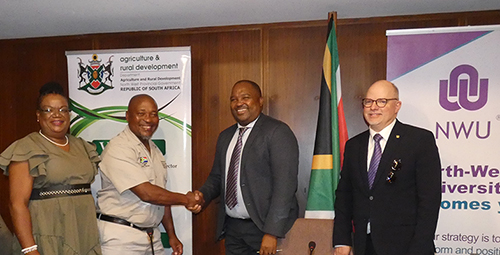
NWU and DARD sign MoU to address food security


Picture: Dr Karabo Mabe, acting Chief Director for Agricultural Support Services at DARD, Thupi Mokhatla, Head of Agriculture and Rural Development for the North West DARD, Prof Bismark Tyobeka, NWU Principal and Vice-Chancellor and Prof Robert Balfour, Deputy Vice-Chancellor for Teaching and Learning at the NWU

By OBAKENG MAJE

The North West University (NWU) principal and vice-chancellor, Prof Bismark Tyobeka said the Memorandum of Understanding (MoU) they signed with the Department of Agriculture and Rural Development (DARD) will be beneficiary.

Tyobeka said the DARD was) representing the Potchefstroom College of Agriculture and the Taung Agricultural College. He said the objective of the MoU that was signed at the NWU’s Potchefstroom Campus, was to offer a framework for cooperation between the parties in pursuit of their respective statutory tasks and on a variety of mutually beneficial topics.

“The parties agreed to collaborate on matters ranging from research and capacity building to economic development and any other areas that the parties may identify and agree on from time to time, including faculty and student exchanges.

“The start of the year is a critical period in the lives of our young people, as they prepare to enter a new chapter of their life, relating to gaining access to universities. However, the unfortunate aspect is that most individuals do not meet the criteria for university admission,” he said.

According to Tyobeka, there is a failure to recognise the relevance of colleges and Technical Vocational Education and Training (TVET) colleges, notably agricultural colleges. He further said, it was their obligation to ensure that these alternative tertiary education options stay viable to the youth and are not viewed as a last resort for furthering their education.

“The signing of this MoU would focus on this option of postsecondary education for young people, as agricultural institutions held the key to unlocking self-sufficiency skills, with an emphasis on food security.

“Without functional and competent agricultural colleges throughout South Africa and in our province, we risk abandoning our subsistence farmers,” he warned. In my inaugural address on 26 August 2022, I highlighted one of my visions was to form a strong collaboration with the provincial government, and I am pleased that this collaboration has come to fruition,” said Tyobeka.

He added that, an important aspect of this agreement, was that, it would address the immediate needs of the NWU and its students, particularly those on the Potchefstroom Campus. Tyobeka said capacity building within the DARD in the sense of emerging with much-needed research collaboration to advance knowledge, will also be part of the agreement.

The DARD’s Head of Department (HoD) in North West, Thupi Mokhatla shared the same sentiments. Mokhatla said, he was pleased to be embarking on this partnership as there were many areas, where the university would offer much-needed assistance.

“Climate change increased natural disasters, so addressing the impact as soon as possible with the necessary resources would be extremely beneficial to the department, as the community invariably sought support and solutions from the department.

“We would like to empower our farmers to be proactive in taking measures that will enable them to avert the impact of natural catastrophes or to be minimally impacted by these. Also, there is a need for system technologies that would serve as warning systems, alerting farmers to impending disasters and allowing them to take preventative steps,” he said.

Mokhatla said the North West farming industry fails to contribute to the country’s GDP, despite the department’s support over the years. He said perhaps the university can aid them by reviewing their strategy and guiding them, as the province is rural and may require tailor-made interventions.

“The need for a management development programme for the department’s managers was also a crucial need. This will help them to execute their responsibilities more efficiently.

“There is also a concern regarding food security. The province was ranked ninth out of all the provinces. Through several interventions, we have now advanced to the eighth position, but more needs to be done. We are looking forward to this collaboration bringing about the necessary changes,” said Mokhata.


taungdailynews@gmail.com

An abusive teacher at Matsheng Primary School receives a written warning!  


By OBAKENG MAJE

Corporal punishment continues to be practised in various schools across the North West province, even though it was abolished a few years ago. The latest school to allegedly practises it is Matsheng Primary School in Taung.

This comes after parents of Grade 2 learners accused a teacher of assaulting their children. According to allegations, these teachers used a sjambok as a form of punishment for learners.

One of the parents who refused to be named for fear of reprisal said: “My daughter came back home severely beaten with a sjambok. I do not think any sane teacher will beat a child like that. I need the department to take disciplinary action against all those teachers who continue to beat our children.

“Now, my daughter is afraid to go to school because of that. Why would teachers continue to use corporal punishment in schools even though it has been abolished?”

Meanwhile, the North West Department of Education spokesperson, Elias Malindi said: “The learners and parents complained about a teacher, who verbally abused the learners at the school. The teacher in question was given a written warning after a thorough investigation by the school principal.

“The concerned teacher was also changed from that class of Grade 2. Corporal punishment is not allowed in schools because it was abolished and regarded as a serious offence.”

Malindi further said, anyone found implementing corporal punishment, will be subjected to the labour processes of the department. He added that, Section 10 of the South African Schools Act provides that, no one can administer corporal punishment against a learner.

“A person who contravenes this act can face disciplinary action by the department. We are advising learners to be vocal and report any teacher who implements corporal punishment to the principal, parents and any person they trust,” said Malindi.

The department has recorded 15 assault cases against teachers during the 2022 teaching and learning calendar.

Meanwhile, the Congress of South African Students (COSAS) in North West said drastic measures should be taken against educators who continue to use corporal punishment against learners. The COSAS then president, Thabang Mokoena said corporal punishment has been abolished a long time ago because it had a negative impact on learners.

“As COSAS, we are not happy to see that these cases are not resolved. We are aware that corporal punishment is still being practised in various schools. This is happening and the department is turning a blind eye.

“So, we are saying to the department, we are also fed up. Learners are being beaten in schools and nothing has been done. There are safety summits, which are held year in and year out to discuss such issues, but nothing has changed,” Mokoena said.

He further said what the department is doing is only ‘pep-talk’ with no implementation. Mokoena added that the documents from previous safety summits are archived and continue to gather dust, while learners continue to be subjected to corporal punishment.

“We want to tell the department that we are fed up and enough is enough. There is another burning issue, which is bullying in schools. We have been calling for the implementation of adopt-a-cop policy when speaking about quality learning and teaching.

“We also urged the department to ensure that there are social workers and psychologists in schools to ensure that learners who have issues such as behavioural challenge, involved in gangsterism and bullying other learners get help,” said Mokoena.

taungdailynews@gmail.com

Furious taxi drivers block the entrance of Taung Traffic Department


By OBAKENG MAJE

The furious taxi drivers in Taung barricaded the entrance of the Taung Traffic Department on Wednesday. This comes after more than 20 minibus taxis were impounded allegedly by traffic officers for ferrying learners.

The South African Taxi National Council (SANTACO) chairperson in North West, Ebusang Tladi said the action of traffic officers will cause mayhem.  

“I was woken up by taxi drivers alleging that the traffic officers from Taung Traffic Department have impounded their taxis, simply because they were ferrying learners. According to the drivers, the traffic officers demanded scholar transport permits from them.

“So, when I arrived here, I had a consultative engagement with the traffic officer’s senior manager. I requested him to understand the situation of taxi drivers because the parents of learners who use taxis as scholar transport do not pay taxi fares on a daily basis,” he said.  

Tladi further said, the taxi drivers have subsidised these parents, which the government dismally failed to do. He added that, as taxi owners, they understand the situation of many parents due to the high rate of unemployment

“It is our responsibility to assist these parents because they are also our commuters. So, they are charged around R400 to R600 per month, now, the traffic department must multiply R500 by 15 and see for itself, if the overall amount is enough for taxi owners to cover their monthly instalments.

“With that amount, taxi owners cannot pay their monthly instalments and still survive. The cost of living is too high and it will be highly impossible for those taxis to be used as scholar transport only,” said Tladi.

He said they have also engaged with the department to allow them to have scholar transport permits as the National Transport Act of 2009 stipulates. However, Tladi said, the department refused to heed their call because it says any taxi used to ferry learners, should be branded as learner transport.

“They said that particular taxis cannot be used as a learner and public transport at the same time. Surprisingly, the permit says passengers without being specific. So, according to my understanding, a passenger can be anybody who is ferried around.

“Now, all taxis that have permits, but ferrying learners are impounded, which is wrong. The law allows taxis to have scholar transport permits, but they vehemently refuse to give them to us. According to those traffic officers, they were instructed to impound taxis ferrying learners and they said there is nothing they could do rather than follow instructions,” said Tladi.

He said, he personally called the traffic officers’ superior but denied instructing those traffic officers to target taxis ferrying learners. Tladi said the action of these traffic officers indirectly affect learners.

“Imagine, taxi drivers, ferrying learners to school and manoeuvre around because of traffic officers. We had an agreement that all taxis ferrying learners should be roadworthy and not carry overload.

“I call for tranquillity between traffic officers and taxi drivers because, if the situation continues like this, things will get out of hand. We are not going to allow traffic officers to harass and provoke our taxi drivers,” he said.

Meanwhile, the North West Department of Community Safety and Transport Management spokesperson, Alpheus Koonyaditse said: “Taxi operators are allowed to ferry anyone as long as they are working within the confines of their permits.

“The impounded taxis will be released immediately after their owners paid stipulated fines. Remember, if there is a contravention of regulations, law enforcement is authorised to restore order.” 

taungdailynews@gmail.com