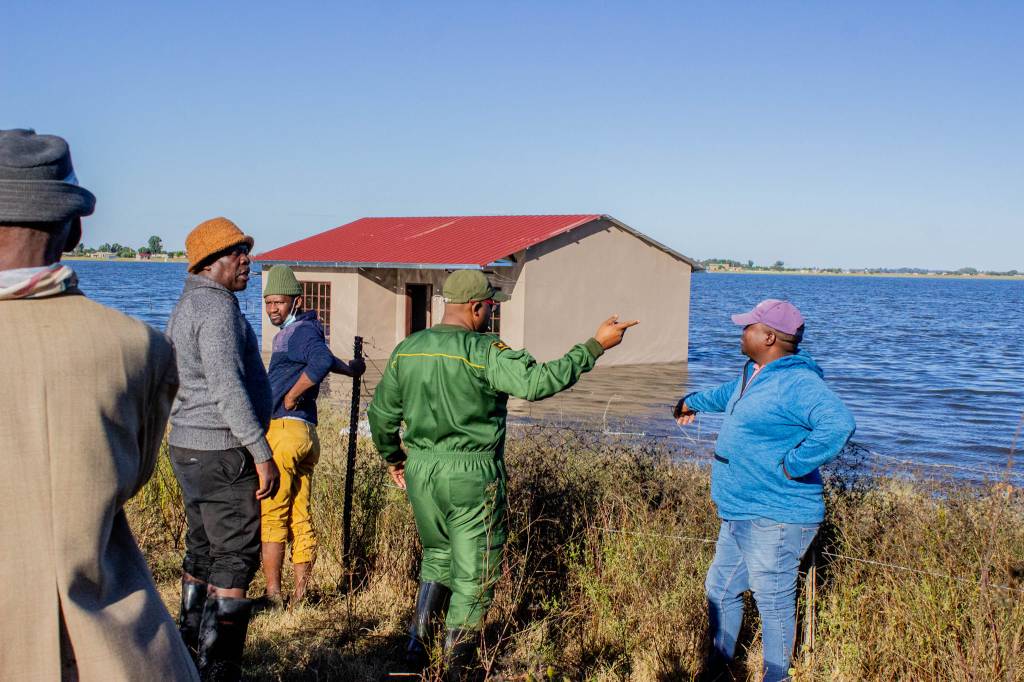
Picture: Water-locked RDP houses in Deelpan village/Supplied
By KEDIBONE MOLAETSI
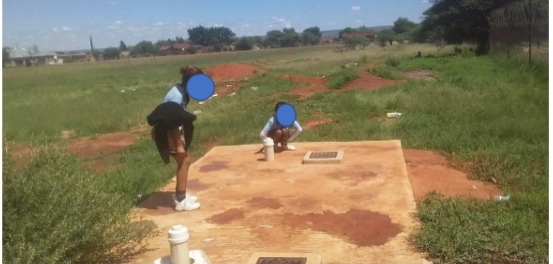
Situation continues to be unbearable for the residents, who were left destitute by a massive and lethal downpour in Deelpan village near Atamelang. More than 1200 households were affected and had to leave their water-locked houses to find shelter elsewhere.
Now, the North West Department of Health has urged residents to pre-boil the water before consumption as a preventative measure. The departmental spokesperson, Tebogo Lekgethwane said this comes after the results of the water samples that were taken in for testing, showed that only one point is safe for human consumption and the other two were not.
“The community was therefore advised to pre-boil the water before consumption. Child immunization, measles 1st dose, Vitamin A and deworming were also administered. We have also been on the ground each day of the week to ensure delivery of health services to the community.
“Since the area became flooded, it was difficult for ambulances and public transport to access the community. The department has moved with speed to implement the intervention measures to ensure provision of health services through placement of mobile clinics at the tribal office premises,” he said.
Lekgethwane further said the integrated service delivery including COVID-19 screening, testing and vaccination, vital signs, TB screening, assessment of clients, provision of treatment, doctor consultation, distribution of male and female condoms, mobilization and issuing of cloth masks have been conducted. Some patients have been traced and re-initiated on Anti-Retroviral Treatment and hypertension treatments.
“The awareness campaigns will continue to be conducted through community radio stations and health education pamphlets on safety measures. Environmental Health Practitioner (EHP) will also conduct assessment to the clients who complain of sores which might be related to water consumption.
“Going forward, the department intends to ensure placement of rescue vehicles for 24 hours at the tribal office to address emergencies and EMS activations when need arises. The department will also participate in the 24-hour disaster management call center located at the tribal office. Mobile services will continue until the situation is back to normal,” said Lekgethwane.
One of the residents, Isaac Mabepa (64) who is a taxi owner said his business was heavily affected by the situation.
“I am crestfallen by the torrential rains as you could see. I have five minibus taxis, but three of them are stuck in the yard as there is no way out. My house is also full of water and we have nowhere to sleep. We put crates in the water to create beds so that we can sleep.
“All rooms are full of water and I have also lost livestock such as pigs, chicken, cows and goats. We urge the government to assist us and bring remedial action as our livelihoods have been affected,” he said.
Another resident, Maria Mopedi (33) alleged that quarries that are induced with floods were dug up by contractors who came to their area to build RDP houses. Mopedi said the government needs to ensure that all contractors who dig up holes do not leave them unattended as that impacts negatively during the rainy season.
“We stay next to a quarry that was dug up by contractors who were building RDP houses here. It cannot be correct that these contractors leave these quarries unattended as they are risky to human lives. These quarries become flood-induced because the water has nowhere to go during heavy rains and spill into our yards,” she said.
The executive mayor of Ngaka Modiri Molema District Municipality, Khumalo Molefe said they have removed people from flood induced areas to mitigate risk and reduce vulnerability. Molefe said the engineers had dug up furrows to ensure that water flows out of residential areas in quest to enhance livelihood security.
“We have brought engineers to the area because we have realised that the situation is not going to subside unless we come up with a scientific approach. The aim is to alleviate the situation because water is not moving.
“There are dead animals and pit latrines are full, therefore, faeces are flowing into the houses that are water-locked. People cannot be accessed by ambulances or any other means because of the devastating situation,” he said.
The North West Cooperative Governance, Human Settlement and Traditional Affairs (COGHSTA) spokesperson, Tsholofelo Mathibedi said they are working together with all stakeholders involved to respond to the situation. Mathibedi said, as a government, disaster management relief funds will be unlocked for remedial actions.
Comrade Thabo Masebe, this week as we pay our last respects and bid you farewell to your final resting place, four events of major historic significance are stacked in my mind as if they only happened yesterday.
The first memory is when we met for the very first time on the 27th of October 1990 at Orlando Stadium during the heroic relaunch rally of the ANC Youth League. The rally also celebrated the 73rd birthday anniversary of President O.R. Tambo and conferred to him the status of honorary life presidency of the youth league as an eloquent expression of the high regard and adoration the militant youth of our country had for him. As President Tambo had not yet returned back from exile to receive the honorary award and celebrate his birthday with us, Tata Walter Sisulu was present to deliver a memorable keynote speech.
The second is when we met around February 1991 in Garankuwa, north-west of Pretoria during the funeral of comrade Bachana Mokoena. On that solemn occasion, thousands of young people and students across the length and breath of our country had come to bury one of the doyens of struggle who was mysteriously killed in a car accident. At the time, comrade Bachana Mokoena was the treasurer-general of the ANC Youth League as it was preparing for its relaunch after 30 years in exile. I vividly remember the event because it is where I saw and shook the hands of my heroes Chris Hani and Winnie Mandela. I will never forget the majesty of that moment. To this day, I have kept their pictures as memories I shall treasure for the rest of my life.
The third memory is in 1991 in Kwa-Ndebele during the 17th National Congress of the ANC Youth League (the first after the unbanning of political organisations). On that occasion, I sat, watched and marvelled how you, as the first Chairperson of the ANC Youth League in the Northern Transvaal (now Limpopo province), opened and welcomed all the delegates to the conference. That happened in the presence of a galaxy of senior ANC personalities who had graced the occasion. They included President O.R Tambo, Thomas Nkobi, Joe Modise, Joe Nhlanhla, Elias Motsoaledi and Andrew Mlangeni.
The fourth memory that remains fresh in my mind is what happened during the 19th National Congress of the ANC Youth League which was held at the Durban Exhibition Centre in 1996. After you presented the financial report as Treasurer General and the results of the Top 5 announced, together with Bheki Nkosi, Nono Maloyi, Saliva Molapisi, Tshepo Belebese and Khotso Khumalo among others, we gathered under the tree to assess what could have gone wrong.
Comrade Thabo, as a result of these memories and many others, it becomes understandable that the news of your departure this week has sparked a wave of grief to the movement as a whole especially to all who were with you in the trenches. Your departure leaves our hearts in heavy mourning, bows us with sorrow and draws our faces in disbelief. It touches us so deeply that it makes hard to put one’s feelings into words because we know that our movement and our country has lost one of its dependable cadres.
Throughout your struggle as a youth activist, you never doubted the victory of the sacred cause to which you had dedicated all your life. In your province -Northern Transvaal, under the tutelage of Peter Nchabeleng (the lion of the North), Ntate Pharephare Mothupi, Thabo Makunyane and Samson Ndou, together with the likes of Peter Mokaba, Ephraim Mogale, Jerry Ndou, Frans Mohlala, Cassel Mathale, Joe Mathebula and Castro Pilusa, you drank from the fountains of wisdom to deepen and sharpen your political acumen.
When the trumpet summoned the young lions in the 1980s to come forward to intensify the struggle for freedom, you were top among the first who positively responded to President Tambo’s call to render apartheid unworkable and the country ungovernable. You executed this mission with utmost precision and became part of a dynamo of militancy and activism which galvanized and rejuvenated the youth of our land until freedom was won in 1994.
Steeped in the discipline and value system of the ANC, you were a very humble cadre who never shirked from duty, and the tasks which were set before you were not above your strengths and their pangs and toils were not beyond your endurance. Unlike most of us, you leave with your name and integrity intact.
I list you among the top departed communication and media gurus in the ANC like Tom Sebina, Ronnie Mamoepa, Dumisani Makhaye, Jackson Mthembu and Parks Mankahlana. You were an immensely gifted cadre with a rare sense of fairness and unfailing courtesy to others, attributes, which undoubtedly earned you immense respect not only among your comrades but also among other people with whom you interacted.
But as you depart from our midst, your movement, the ANC is facing serious difficulties. It suffers from existential crisis due to warning signs of “sins of incumbency” which were identified by the Mafikeng conference in 1997. As a result, the ANC is running a risk of losing elections in 2024 if it continues with the path of factionalism and disunity.
As we speak today, the ANC is increasingly losing credibility and trust of the people because of poor service delivery record, corruption and state capture, and poor management of public resources. The ANC seems to have lost touch with key constituencies and the calibre of many of its leaders is not like you, comrade Thabo. They lack basic leadership, organising and communication skills, and they are unable to mobilise and motivate activists, civil society, supporters and voters. Lately, as you know, it has become easier to be a leader of the ANC and there is a lack of revolutionary morality, good ethics, discipline and the understanding of the core values of the ANC.
Comrade Thabo, you were endowed with great wisdom which impelled you on a direct road that carried you to lofty heights. With your rich articulations especially as a spokesperson, you depicted an African soul, its strive and yearnings, its sufferings and sorrow and its majesty. Your inborn scholarship revealed your creative works, a keenness of intellect, a gift of vivid expression and the arbour of a great African soul, fused with a power of your youth radicalism which freed our country from colonialism and apartheid.
We, your peers and comrades-in-arms, know that the only thing you wanted for your patriots was a right to a worthy life, to dignity without pretence and to freedom without restrictions. You felt deep in your heart that one day the enemy would be defeated and that the road to reconstruction and development would be unstoppable. On that score, you were vindicated.
As we bid farewell and to pay our last respects to you, we surely know that through your words and actions, you had dedicated your entire life exclusively to making public service work better for our people. Through your principled approach to communication and media liaison, you showed us what it meant to be a public servant who serves with integrity, leads with courage and acts with love in his heart.
As the chairperson of the SACP, Yusuf Dadoo said during the funeral of his general secretary, Ntate Moses Kotane in 1978, it is true that in the life of every nation, there arise leaders who leave an eternal stamp on their people; leaders who are both products and makers of history and when they pass they remind us of our historic past and leave a vision of a great future and the tools with which to build it. Comrade Thabo, you are such a leader.
For our part, we will be forever be inspired by your examples as a revolutionary and a great political figure. As we pay tribute to you, we shall not relent nor waver but work tirelessly to eradicate unemployment, corruption and poverty in our country. Through the process of organisational renewal, we also commit to extricate the ANC from the quagmire of ignominy and shame it is entrapped in, by rebuilding, renewing and uniting our movement.
We are going to remember you: your decency, sincerity, humility and your kind soul will stay with us forever. So, through our tears, we will see blessings of knowing and working with you – a great and noble man, and the best cadre a revolutionary movement could have. And in our grief, we will smile knowing that the angels are happy to receive you.
In all fairness, I hope a memorial should be speedily erected in your honour so that the father can point to his son, the mother to her daughter and the host to his guest and say with pride: “Herein lies immortal Thabo Masebe, a cadre with great revolutionary humility.”
As Joshua Nkomo, a Zimbabwean freedom fighter remarked during the funeral of cadre Lookout Masuku: “You cannot take away the status of a hero. You don’t give a man a status of a hero. All you can do is recognize it. It is his”.
Sooner, when history books will be written, they will say that comrade Thabo Masebe was a great communicator – a leader of unmatched skills, a cadre of formidable accomplishments, and a gentleman who executed the duties of his office with dignity and honour. And when future generation do research, they will one day unveil more of what you have done for your country. At that moment, you will smile in affirmation from your resting place and say: “My footprints are deeply entrenched and are visible.”
At this hour of grief, once more, we pledge our oneness with your family and pledge to carry forward your dream to create a better world and a better Africa for humankind.
Amandla!
NB: China Dodovu (former ANC Youth League Provincial Secretary in the North West and ex-officio member of the National Executive Committee. Currently, a Member of Parliament).
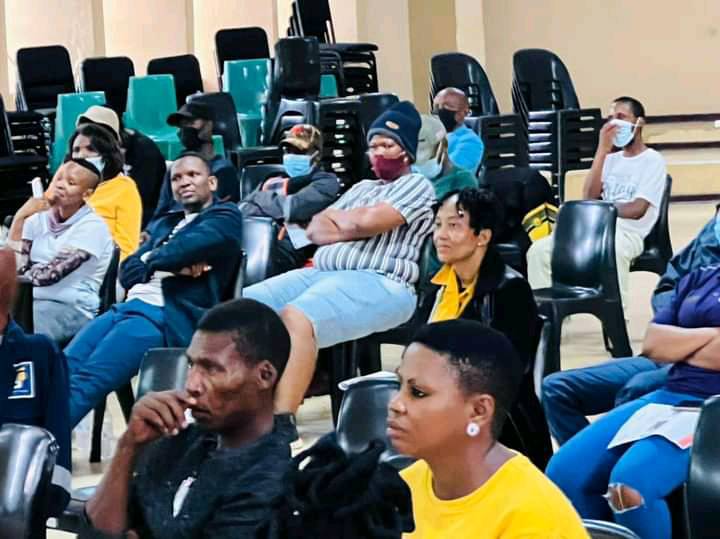
Picture: Some of LGBTQI+ members attending the launch at Taung Depot Hall in Taung/Facebook
By REGINALD KANYANE
The Greater Taung Local Municipality (GTLM) has established a forum for Lesbian, Gay, Bisexual, Transgender and Queer (LGBTQ+). The GTLM mayor, Tumisang Gaoraelwe said the Bill of Rights is enshrined in the constitution of the Republic of South Africa, 1996 includes a guarantee of equality and a prohibition of unfair discrimination on several grounds, including gender and sexual orientation.
“We have taken an initiative to recognise and further establish social forums that will enable planning, communication and coordinates on different social partners. Therefore, we have realised a dire need to establish a forum representing (LGBTQI+).
“We consequently need to place this vulnerable group on the forefront of the social charter as per constitutional mandate, which narrates that together we must build a non-sexist and non-racial society. Remember, Taung is predominantly rural and comprises 106 villages,” he said.
Gaoraelwe further said the societal stigma towards LGBTQI+ community emanates from non-conforming to patriarchal gender, low-level of education, cultural and religious beliefs, lack of understanding, intolerance, sexuality norms and roles that are prescribed by society are a driving force behind the discrimination. He added that, there are people who are unwelcoming of other sexual orientations because they deem homosexuality as a social evil.
“So, we deem it fit to give necessary recognition to this vulnerable group, educate the broader society, workshop and edify other sectors of the society to tolerate and co-exist with them. We intend to work with all other stakeholders such as South African Police Service (SAPS), Department of Justice, Department of Social Development, Department of Basic Education, Department of Corporate Governance and Traditional Affairs (COGTA).
“The municipality is embarking on a robust drive to respond to LGBTQI+ needs and specific vulnerability and strengthen the capacity. To address and arrest gender and sexual orientation-based violence against LGBTQI+ persons.
“Our objective is to create and maintain supportive environment, in which group members and their respective contributions are valued. We also want to rally behind a comprehensive approach to promote human rights of LGBTQI+ community, combat heterosexism and homophobia,” said Gaoraelwe.
The chairperson of LGBTQI+ forum, Tshepiso Pholisane who is a transgender said: “We experiencing discrimination at schools and workplaces. Our LGBTQ+ members are victims of Gender-Based Violence (GBV) and we cannot be allowed at certain churches. We are being criticized and sometimes cannot access healthcare services due to our sexuality,” Pholisane said.
She said she is grateful to receive a positive response from various stakeholders. Pholisane said, as the LGBTQI+ community, they hope things will change for the better.
“We need to continue to educate the public about the LGBTQ+ community. Most definitely, we will host such an event annually. We are happy that we have established the forum and we want to send our token of appreciation to the mayor and the municipality at large,” she said.
A local socialite, Moikanyi Kadisa who is affectionately known as the Public Figure said: “I feel that many people are trying to fit in within the society’s conventional way of being classified as male or female. However, if one comes out, they are subjected to all sorts of abuse and insults.
“I also believe that it is easier for an individual to criticize something that they are not familiar with. So, I applaud the office of the mayor for creating this platform, where the community as well as the LGBTQI+ members can engage and create awareness.”
Kadisa said he also had his fair share of criticism even though there is an increased number of acceptance. He said he is grateful that there is a higher visibility in the media too.
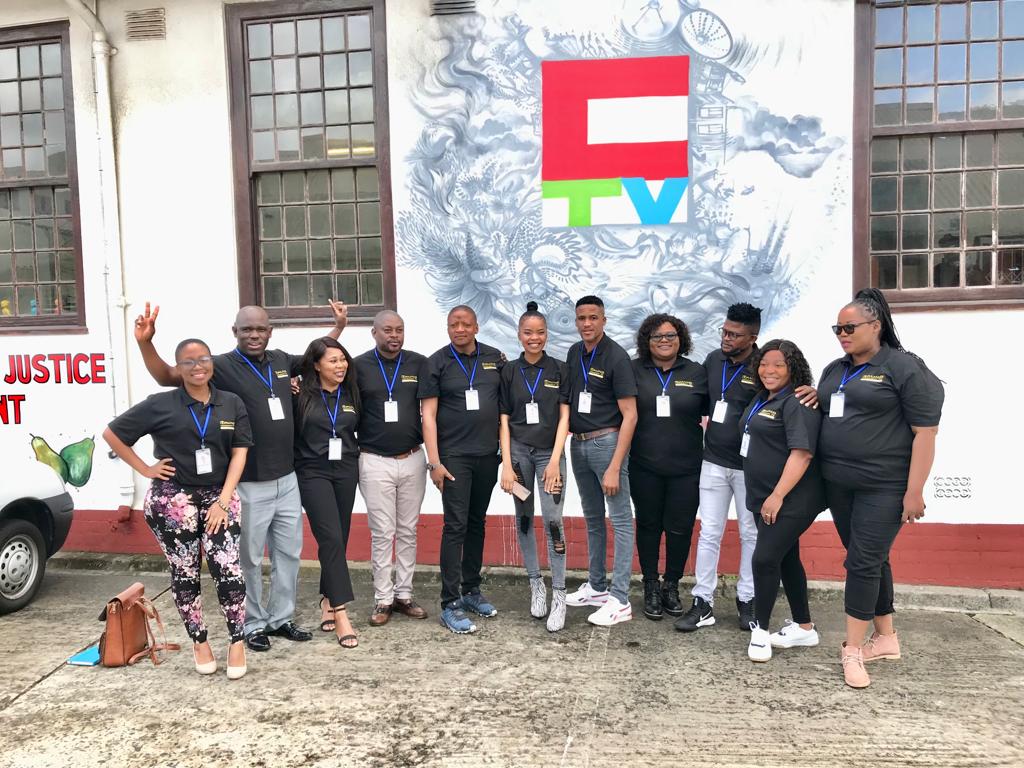
Picture: Taung Community TV crew bench-marking at Cape Town TV
By OBAKENG MAJE
A local philanthropist, Kagiso Kai who is a brainchild behind Taung Community TV, said television has proved to be a profound means of communication and potentially capable of leaving a tremendous effect on society.
Kai said the aim behind this initiative is to ensure that content of the iconic Taung is well-documented and future generations learn more about it.
“Taung has a lot of content that many people from afar are tapping into and making money out of it. Again, one has realised that, we rely too much on leaders who are not magicians to bring miracles to the challenges that our people face.
“I normally say to people that we are the solutions to the problems we are facing, not political parties. Now it is time for the people of Taung to go to the next level and establish a TV station to cater for creatives and producers in the filming and television industry,” he said.
Kai further said the platform will give independent producers, presenters and all other aspirant practitioners to come up with their own productions and TV shows that will be aired at the channel. He encourages people of Taung to use the station to tell their ordinary stories through reality shows, films, documentaries and educational programs.
“The aim is to assemble an arsenal of great individuals in Taung to shake up the industry with their innovative thinking and leadership. We want to tap into funding opportunities within our country and abroad to create a sustainable livelihood for those who are in the industry.
“Many people think that filming and television is something that can only happen in the big cities, but we need to change that narrative. The Taung Community TV is owned by the people of Taung,” said Kai.
He said this initiative will also create job opportunities, especially for the youth. According to Kai, many people are supporting this idea, including the Greater Taung Local Municipality (GTLM).
“Also those who are already in the industry have shown a keen interest, and that is really encouraging. We embarked on a bench-marking trip to Cape Town TV and we have an idea on how to go about it. I would like to send my special thanks to Mr Thapelo Moncho for organizing the trip including the unwavering support we received from the municipality.
He said there are various shows that are in place already such as If you can’t talk about it, post it. Kai said the show will tackle topics that some people are not able to talk about due to lack of support or understanding.
“We also have programs like Nthute Segarona, which focuses on our culture. We have realised that our parents are dying without imparting that knowledge to the young generation. We would be having news programs too and focus on Mathematics, Economics, Accounting and other subjects that we feel there is a need to tackle.
“Taung Community TV will air documentaries, films and reality shows like O Gata Kae. This is a show that aims to keep track of the progress made by many people or the government.
“There is another show called Youth in Tradition and we encourage our people to send their show proposals too. We will air those shows via over the top and YouTube platforms. For us to go on air, it will depend on ICASA to approve our license,” he said.
However, Kai said there are various platforms they will utilize for so long waiting for ICASA. He said they only started in January 2022 and ICASA wants NPO to be operational for more than two years.
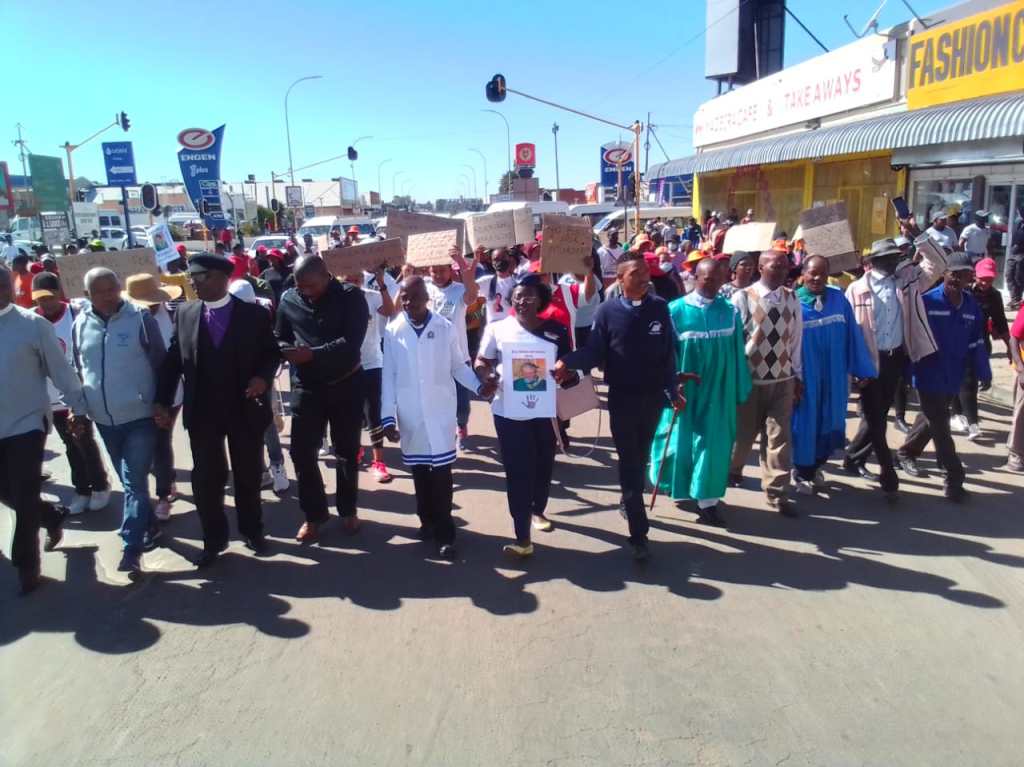
Picture: Community members embark on a peaceful march against crime and drugs
By BAKANG MOKOTO
The residents of Vryburg and neighbouring areas embarked on a peaceful march against various socio-economic challenges impacting negatively within their communities. One of the burning issues was drug abuse and crime.
The secretary of Naledi Community Against Crime Organisation, Itumeleng Mahanyele (37), said there are an assortment of challenges that have marred the communities such drugs and substance abuse, crime and Gender-Based Violence (GBV).
“As Naledi Community Against Crime organisation, we have invited various departments such as the South African Police Services, Department of Home Affairs, Department of Basic Education, Department of Social Development and Department of Arts, Culture, Sports and Recreation, Department of Health, Department of Justice and Correctional Services for intervention.
“The purpose of the invite was to be part of the solution of the social ills devouring our community. As the community, we intend to come up with sustainable solutions to these challenges. We have since consulted with the community at large to ensure that the process in solving our problems is all inclusive,” Mahanyele said.
He further said, it has come to their attention that a way to sustainable solutions is delayed because of the sale and usage of illegal substances that lead to the atrocious acts of rape, murder, loss of morals among the youth and the general increase of GBV in households and within the community.
Mahanyele added that the distribution of drugs in schools and within the community, theft and house-breakings have become a cause for greater concern.
“The cases are dragged over a long period and eventually disappear from the roll. There is also a concern over bribery of officials, early release of individuals imprisoned and undocumented citizens. There is a high need for police vehicles and personnel.
“Those investigating police officers who are conniving with drug dealers and tavern owners need to be harshly dealt with. We also call on the police to clap mushrooming shebeens and illegal alcohol outlets in our area,” he said.
Mahanyele said there is a high demand of satellite police stations in various areas like Colridge township, Ext 25, 28 and Dithakwaneng. He said social workers as well as offices and vehicles are needed to cater for individuals’ needs.
“There is a lack of disability centres, rehabilitation centres as well as orphanages. The non-implementation of the national drug master plan by the district and local government also needs to be taken into consideration.
“The shortage of security guards both in primary and high schools create a loophole for learners to enter school premises with drugs and weapons. Also, shortage of arts, culture, sports and recreation educators in schools is a challenge too. There is no integration of mural activities in schools,” said Mahanyele.
Meanwhile, the MEC for North West Community Safety and Transport Management, Sello Lehari who accepted the memorandum on behalf of government said: “I will ensure that the North West Premier, Bushy Maape receives the memorandum and all your grievances are attended to. We also have our police here and I hope they will address all crime-related issues raised today.”
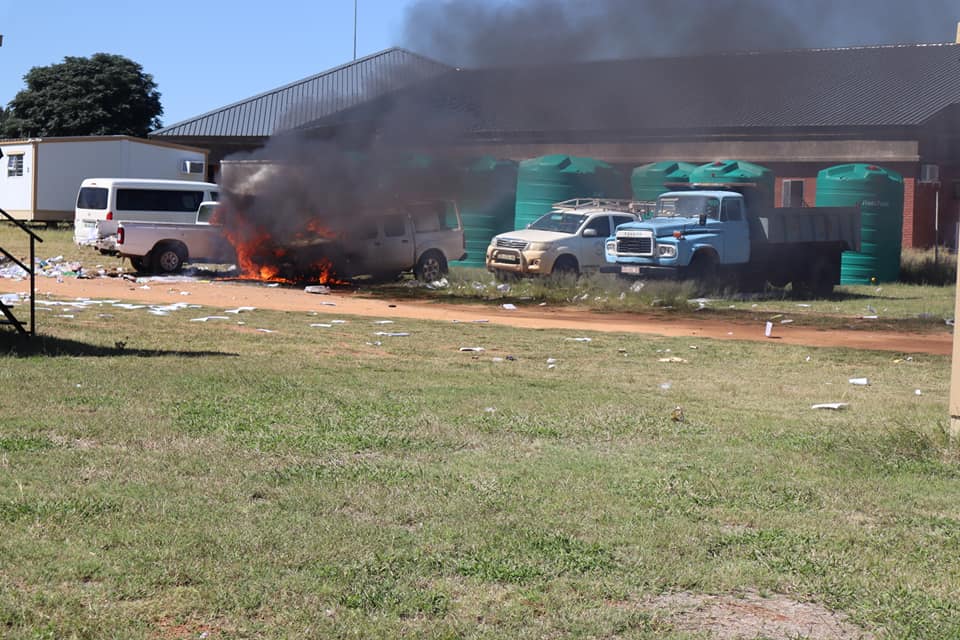
Picture: One of municipal vehicles up in smoke/North West Times
By OBAKENG MAJE
The ANC National Executive Committee (NEC) deployees in the Dr Ruth Segomotsi Mompati region, Malusi Gigaba and Obed will embark on a consultative engagement meeting with the ‘rebellious’ ANC caucus from the beleaguered Kagisano Molopo Local Municipality on Friday at ANC headquarters, Luthuli House in Johannesburg on Friday.
This comes after some defiant ANC members voted with the oppositions to oust the municipal speaker and mayor through motion of no confidence last week. The motion was sponsored by the Economic Freedom Fighters (EFF).
Now, it’s been a week since the smooth running operation of the municipality was affected after community members embarked on violent protests demanding the removal of the municipal manager, Olaotswe Bojosinyana.
One of the community members, Omphemetse Phillips, accused Bojosinyana of corruption and sowing divisions within the municipal council.
Bapela said they have received the report that a certain group of ANC councillors colluded with oppositions to remove the speaker and mayor.
“We have been telling them that they must not do so, because there is a mandate. Who becomes a mayor is not a provincial or a caucus decision, but a national decision.
“So, those councillors were told not to defy the ANC NEC decision. In the province, the speakers were agreed upon by the ANC Interim Provincial Committee (IPC), so one cannot just wake up and remove the municipal speaker,” he said.
Bapela further said, if there is anyone who feels aggrieved by the decision and wants certain speaker removed, should furnish them with reasons on why and they will conduct their own investigation.
“The decision will be taken based on our assessment and the legitimacy of the issues raised. However, the organisational processes should be followed instead of them defying the process.
“Remember, defiance is a serious offence within the organisation, but we will give them a hearing. We are assigned to assist the IPC to mitigate in seven municipalities in the province,” said Bapela.
He added that the NEC will give instructions that the status quo should go back to its original mandate. Bapela said this kind of behaviour will affect the ANC in the near future if not dealt with decisively.
The embattled Bojosinyana told Motsweding FM that he views allegations levelled against him as malicious and defamatory. He said he had opened various criminal cases against some community members who allegedly participated in violent protests, where three municipal vehicles were torched in the process.
“There are members of the public who came to the municipality as the situation was volatile. However, I would not get into the merits of the cases because they are still pending.
“But I can confirm that, names of all those who were involved are included in our statements. We also hear those allegations across various platforms, but what is important is, if someone accuses you of any wrongdoings, there should be a supporting document to substantiate those allegations,” he said.
Meanwhile, Tshireletso Marabutse has interdicted her removal as a mayor at the North West High Court where she cites that the processes of her removal was flawed. The court ruled in her favour pending a final decision on 23 June 2022.
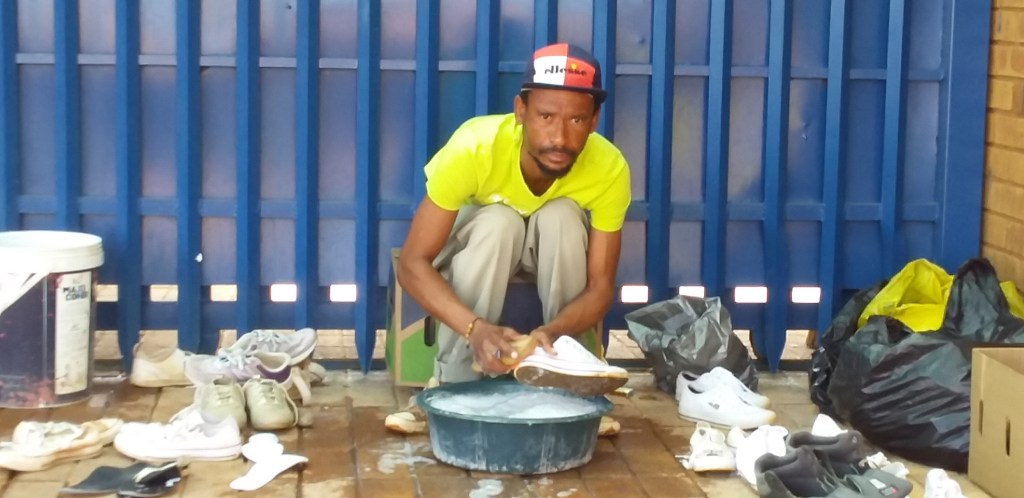
Picture: Katlego Setlhapelo (38) washing sneakers to earn a living
By OBAKENG MAJE
The high rate of unemployment continues to have a negative impact on people especially those in deep rural areas. Katlego Setlhapelo (38) from Pudimoe Township near Taung said, since he was retrenched back in 2015, life has been difficult.
Setlhapelo said he had to come up with a back-up plan to earn a living because he stays only with her mother who is a pensioner.
“I am now washing sneakers for people to earn an income. So, I started with this initiative after being retrenched from my previous job in Rustenburg. I saw this idea while in Rustenburg and I implemented it here at home.
“Before this, I tried my level best to look for a job, but my attempts were futile. So, I charge R40 per sneaker and I have been receiving unwavering support from my community since then,” he said.
Setlhapelo said even though some customers take long before they could come and fetch their sneakers, atleast he can put food on the table at the end of the day. He also urged anyone who could assist him with a proper structure with shelter to come forward because during the rainy season, he cannot perform his duties due to bad weather conditions.
“If I have a proper structure where I can work from, I think I could also create more job opportunities for other people. It is hard because our leaders do not take us seriously, especially the youth. When it is during voting time, they will come to us, but if there are job opportunities, they call their cronies,” he said.
Another young person, Palesa Pule (25) from Dinokana village in Zeerust, who is a Political Science and International Relations graduate from the North West University (NWU) shared the same sentiments.
“I’ve always dreamt of a corporate job, so I followed my dream and went in to enrol for a course that I believed could open doors for me to serve the people of my country. However, all that vanished in front of my eyes.
“I completed my degree in 2018, and I have been unemployed since then. I sought and actively applied for any vacancy possible without even being picky about the job because all I wanted was to work,” Pule said.
However, due to the high level of unemployment, Pule said she figured out that, one should by any means, put bread on the table.
“I ventured into entrepreneurship with very little knowledge, but with so much determination. I started by registering a decor and catering company called Dimpho Home Incentives PTY (LTD), which now has five permanent employees.
“I have now forgotten about the struggle of job hunting. The level of job scarcity in our country is without a doubt embedded in the preferences and requirements that come with the job specifications,” said Pule.
The chairperson of the Re Aga Taung Civic Organisation, Modisaotsile Lebitse (40) called on policymakers and leaders to address treble challenges such as unemployment, inequality, and poverty, as they are interdependent socio-economic phenomena.
“High rate of unemployment is a thorn in the flesh, especially in Taung. Our area is rich in mineral resources like diamonds, tourism, and agriculture. However, we continue to live beyond the poverty line.
“We are going to sign a petition to ensure that mining investors come on board and ensure that job opportunities are created. Remember, the high rate of unemployment contributes to socio-economic challenges such as crime, high rate of pregnancies among young people, drug, and alcohol abuse.”
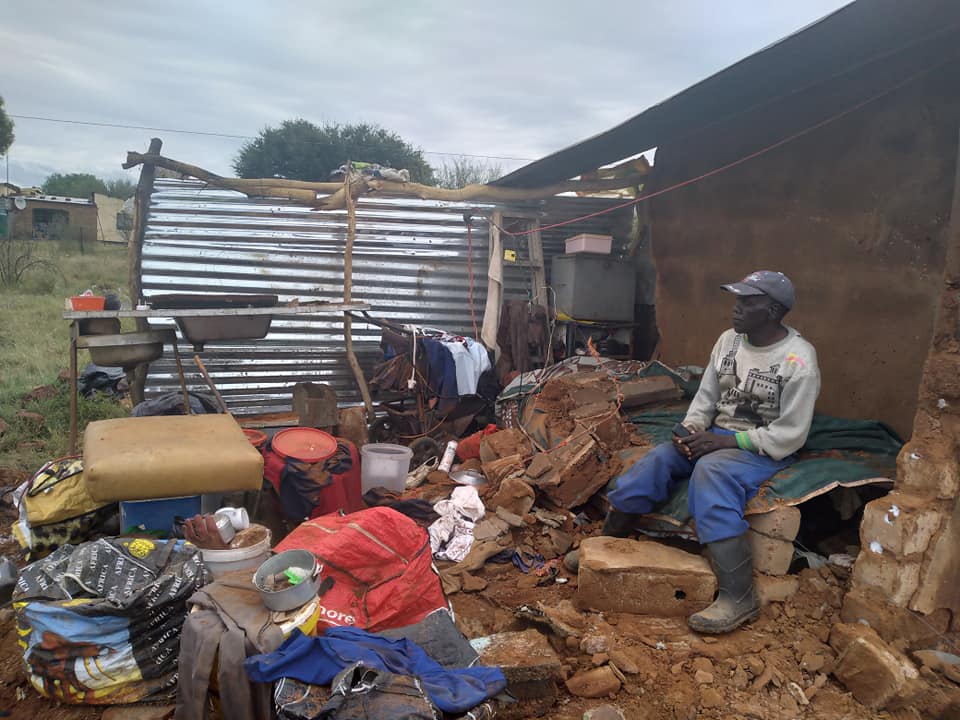
Picture: Andries Masibi (65) left destitute by torrential rains/Facebook
By REGINALD KANYANE
The emotional pictures of a man from Pompong Section in Dryharts village near Taung, who was left destitute after his house was demolished by torrential rains left people distressed.
Piet Masibi (65), who stayed with his father, Andries Masibi (86) said his one roomed house was ruined by torrential rains on Sunday morning.
“I do not have anywhere to go after my house was destroyed by torrential rains. I don’t even know where I will sleep tonight, so I urge anyone who could assist with anything to come forward. I have lost all my belongings because of the torrential rains and I’m also in need of a shelter.
“I have communicated with our ward councillor and he said he will only be able to assist on Tuesday. However, my situation is too bad to wait for Tuesday as I need a temporary shelter. So, I will highly appreciate it if there is any good Samaritan out there who could assist,” he said.
The Greater Taung Local Municipality (GTLM) mayor, Tumisang Gaoraelwe said: “We will liaise with our ward councillor to go and assess the situation of the affected family and we will take it from there. However, the municipality will definitely assist with a temporary solution for now and all administrative issues will be dealt with on Tuesday.”
Meanwhile, South Africa was hit hard by a massive and lethal downpour earlier this week, where Kwazulu-Natal province is the most affected. The chairperson of the Portfolio Committee on Human Settlements, Machwene Semenya said she has observed with concern the destruction of property in KwaZulu-Natal.
Semenya also urged the Department of Human Settlements to work with other government departments on all levels to find alternative accommodation for residents affected by the floods.
“We have received worrying reports that RDP houses and other dwellings have been destroyed by the storm, which has left many families destitute. We welcome the announcement made by the national government that KwaZulu-Natal has been declared a disaster area, which will assist in unlocking necessary resources to develop shelter for the people.
“We also extend our heartfelt condolences to the families that have lost their loved ones during this tragedy. Despite the obvious budgetary shortfalls that the department is facing, we urge the department to rally its stakeholders and agencies in efforts to rebuild infrastructure in KZN,” Semenya said.
She further said the committee urged departmental agencies, such as the Housing Development Agency and the National Housing Finance Corporation to enhance their systems to ensure that rebuilding efforts are not hampered.
Semenya added that the committee will hold a meeting with the department to assess the overall impact of the storm, the department’s interventions and plans to rebuild the affected houses.
“But the immediate concern is that the affected communities must be provided with interim shelter to alleviate the impact of the storm. In the long term, the committee will be preoccupied with how the department will speed up implementation of its projects to ensure that communities are provided with quality human settlements,” she concluded.
Anyone who would like to assist the Masibi family can contact Piet Masibi on 0788464161 or Kabelo Moshwetsi on 0762021209.
Twenty-five years ago, our new democratic Constitution came into effect. In adopting this Constitution, we affirmed our commitment to a society based on democratic values, social justice and human rights.
We were also making a complete break with our past. This was a past of race-based social engineering that manifested itself through influx control, job reservation, group areas and the dreaded dompas. When our forebears drafted the Freedom Charter in 1955, whose principles have been incorporated in our constitution, and declared that South Africa belongs to all who live in it, they were seeking a society free from ethnic chauvinism, tribalism, racism and sexism.
It is therefore deeply disturbing how the recent incidents of anti-foreigner sentiment in parts of the country echo our apartheid past.
We have seen people being stopped on the street by private citizens and being forced to produce identification to verify their immigration status. We have seen some political leaders making unscientific statements about immigrants to exploit people’s grievances for political gain.
We have seen marches being led on people’s homes and their dwellings raided for evidence of criminal activity. We have seen people being attacked, hurt and even killed because of how they looked or because they have a particular accent.
This was how the apartheid oppressors operated.
They said some people could only live in certain areas, operate certain businesses or take certain jobs. Under apartheid, black people were deemed suspects by default and stopped by police when found in so-called white areas. Black people were forced to produce a dompas and if they could not do so, they were jailed.
We cannot allow such injustices to happen again.
The events in the Gauteng township of Diepsloot last week were a tragedy. In the course of a single weekend, seven people were killed, sparking protests. This loss of life is deplorable, as is the killing of a fellow African from Zimbabwe allegedly at the hands of vigilantes.
Crime is a serious problem in this country. It affects all communities and people are justifiably tired of living in fear of criminals.
Contrary to what is claimed by some anti-immigration groupings and individuals, the perpetrators of crime are both black and white, male and female, foreigner and citizen.
Crime, not migrants, is the common enemy we must work together to defeat.
We cannot defeat crime through incitement, violence, intimidation and vigilantism aimed at foreign nationals, and specifically nationals from other African countries.
We acknowledge many communities are frustrated by the apparent inability of the police to deal with criminals. Among the measures we are taking to capacitate the police is the recruitment of an additional 12,000 additional police officers.
We are also re-establishing community policing forums (CPFs) across the country. These forums bring communities and police representatives together to improve local safety and hold police accountable. Communities need to work with the police by actively participating in CPFs and reporting suspected acts of criminality.
Even as we intensify our fight against crime, there is no justification for people taking the law into their own hands.
At the same time, we recognise that illegal migration poses a risk to South Africa’s security, stability and economic progress. Illegal migration affects service delivery and places additional burdens on essential services such as health care and education.
Like any sovereign nation, we have the right to implement policies and measures that guarantee the integrity of our borders, protect the rights of South Africans and provide that all who reside in our borders have a legal right to be here.
Controlling migration is the responsibility of government.
No private citizen may assume the role of immigration or law enforcement authorities by demanding that foreign nationals produce identification. Under Section 41 of the Immigration Act, only a police member or immigration officer can ask someone to identify themselves as a citizen, permanent resident or foreign national. If these officers believe, on reasonable grounds, that the person is in the country unlawfully, they may be detained while an investigation into their status is conducted. When doing so, law enforcement authorities must respect that person’s rights and dignity. They may not do so in a manner that is degrading or humiliating.
Enforcement of migration legislation is a priority for government. We are working to ensure that syndicates perpetrating immigration fraud in collusion with corrupt officials are brought to book. This year alone, several people implicated in passport fraud have been arrested.
No private citizen or group has the right to enter businesses and demand its owners produce proof that their businesses are registered or legal. This is the competence of municipal, provincial or national authorities, including inspectors from the Department of Employment and Labour and the South African Revenue Service.
Like all other businesses, foreign-owned businesses must obey the relevant laws, including health and safety regulations, have all the required permits and licences, and pay the necessary taxes.
We are a democracy founded on the rule of law. Acts of lawlessness directed at foreign nationals, whether they are documented or undocumented, cannot be tolerated.
Attacking those we suspect of wrongdoing merely because they are a foreign national is not an act of patriotism. It is immoral, racist and criminal. In the end, it will lead to xenophobia, whose consequences we have lived through in previous years. We do not want to go back there because in the main the people of South Africa are not xenophobic.
I want to appeal to all South Africans, but particularly to younger South Africans who thankfully never experienced the true brutality and dehumanisation of apartheid. Let us not become like the ones who oppressed us, no matter how legitimate the grievance.
Let us work together to resolve our country’s challenges without resorting to violence or vigilantism. Let us resist those who want to exploit the problems of crime and unemployment for political gain.
Today, our anger may be directed at nationals from Zimbabwe, Mozambique, Nigeria or Pakistan. Tomorrow, our anger may be directed at each other.
Let us heed the words of Martin Niemöller’s famous poem about the Nazis in Germany:
“First they came for the Socialists, and I did not speak out –
Because I was not a Socialist.
Then they came for the trade unionists, and I did not speak out –
because I was not a trade unionist.
Then they came for the Jews, and I did not speak out –
Because I was not a Jew.
Then they came for me – and there was no one left to speak for me.”
Let us focus on defeating crime, no matter who commits it.
Picture: Learners at Seile Primary School in Lokaleng village, Taung/Supplied
By OBAKENG MAJE
Poor infrastructure in various schools across the North West province continues to be a disturbing factor. This comes after learners at Seile Primary School in Lokaleng village near Taung, were forced to use the nearest bushes to relieve themselves because the ablution toilets are locked.
According to parents of learners who refused to be named for fear of reprisal, this has been taking place for more than a month.
“There is no proper hygiene practiced by the school even though we are in the fight against COVID-19 pandemic. The ablution facilities are locked, and this forces learners to go and relieve themselves in the nearest bushes.
“We urge the school to ensure that there are proper toilets. Learners’ privacy is compromised as others are forced to and squat in a bushy area within the school, which is littered with faeces,” said a parent.
The North West Department of Education spokesperson, Elias Malindi said: “The departmental officials visited the school and their findings were that the toilets were indeed locked due to the unavailability of water.
“So, infrastructure officials will be visiting the school to establish what might be the challenge with the borehole. Seile Primary is a big school and able to maintain from the 10% budget that is allocated to them annually by the department.”
Malindi further said the new principal will intervene during these school holidays to ensure that water is restored in the school toilets.
Recently, the department appeared before the South African Human Rights Commission (SAHRC) to respond to poor infrastructure experienced at 60 schools in the province. According to the commission’s Office Manager in the North West, Osmond Mngomezulu, they have probed the matter after receiving complaints.
Mngomezulu said even though they initially received complaints about six schools, their scope was widened when they identified more schools during their assessment and monitoring.
“Complaints raised allegations concerning deteriorating buildings, cracked walls, cracked floor, broken window, falling ceilings, exposed electricity wires, shortage of classrooms, overcrowding in classrooms, asbestos roofing and structures, lack of access to sufficient water and basic sanitation.
“Learners in those schools with damaged roofing do not attend classes when it rains. Some schools such as Setshwarapelo Primary School in Mokgareng village, Taung were closed due to infrastructure challenges resulting in learners being transferred to another school pending the delivery of mobile classrooms,” he said.
He said they have discovered that some schools have overcrowding and that negatively impacts teaching and learning. Mngomezulu said teachers are unable to perform their duties diligently and respond to the individual needs of learners due to overcrowding.
“We also visited Promosa Secondary School in Ikageng Township, near Potchefstroom and the pass rate was very low. However, I am not sure if that was caused by the infrastructure challenges.
“We had consultative engagements with the National Association of School Governing Bodies (NASGB) and Naptosa, which is a teachers’ labour union, where it presented additional schools including those in Madibeng that still use pit latrines,” said Mngomezulu.
Malindi who was cagey said the department appeared before the commission to present its side of the story and respond to the complaints raised by it. He said the department outlined how it is going to address issues raised in short and long-term periods.”
In 2019, R150 million allocations meant for infrastructure grants, were returned to the national treasury after not being unused by the department.

 The Guardian