Persue to Malema ally probe: DA


Image

Limpopo – A corruption probe into Limpopo roads and transport head Ntau Letebele should continue despite his resignation, the DA said on Wednesday.

“The investigations into the awarding of a R53 million contract to On-Point Engineering must continue, to ensure that individuals who were involved in the awarding of the tender face the full might of the law,” Democratic Alliance spokeswoman Meisie Kennedy said.

“The former MEC for the department Pinkie Kekana must step down with immediate effect as the MEC for economic development, environment and tourism, for the role she played as the executive authority in this matter.”

Limpopo transport spokesman Joshua Kwapa said Letebele handed in a resignation notice dated January 10.

“I confirm that he (Letebele) resigned and that the MEC has accepted his resignation. His last day of work was yesterday (Tuesday), after he requested to be let go early.”

The resignation followed the announcement of an investigation into the department’s awarding a R53 million contract to On-Point Engineering, that allegedly partly benefited former ANC Youth League leader Julius Malema.

Malema’s business partner Lesiba Gwangwa is chief executive of On-Point.

In October, Public Protector Thuli Madonsela found Letebele’s conduct in respect of the awarding of the bid to On-Point “improper, and constituted maladministration”.

Madonsela found the department unlawfully awarded tenders to On-Point Engineering.

She found On-Point and Malema benefited improperly from the contract. – Sapa

Six suspects arrested for cable theft


Image

By Obakeng Maje

Kimberley-Police are investigating a case of possession of suspected stolen copper wire after eight suspects has been arrested with copper wire in their possession. 

The police officials who arrested the suspects were busy conducting visible police patrols this morning police said.  

“The police officials noticed six males and two females that looked suspicious to them under the bridge in Old De Beers Road, Kimberley” lieutenant Andrea Cloete said. 

“They then pulled-off their vehicle and stopped the eight suspects and searchedthem” Cloete said.  

Police discover bags consisting of copper wire to the value of R2800-00. 

“All eight suspects were arrested on the scene and taken to the Kimberley Police station” Cloete said. 

The suspects will appear Kimberley Magistrate Court tomorrow for bail application. 

The police investigation continues. 

Follow us on Twitter@Taung_Dailynews

A suspect fatally injured after stabs cop


Image

By Obakeng Maje

Kimberley-Northern Cape police arrested two suspects while they were busy patrolling the area.

It is alleged that the police saw two suspects sitting in their car and looked suspicious.

“Police searched two suspects and a knife was found in a car. They arrest two suspects for question and while on their way to the police station,one suspect who was sitting behind driver seat allegedly drew a knife and stabbed a police officer cutting a throat” Lieutenant Donald Mdhuli said.

“The police officer who was driving managed to stop a car and a fight ensued that resuslt in a shoot-out” Mdhluli said.

A suspect who was armed with a knife was allegedly fatal shot and has been taken to hospital for with gun wounds.

“Another suspect was taken to police cell and the police officer was also rushed to hospital while his colleague is been treated for shock” police spokesperson said.

NORTH WEST HEALTH READY FOR ORANGE AFCON 2013


Image

By Staff Reporter

The North West Department of Health has activated its Orange Africa Cup of Nation 2013 plans to ensure clean bill of health during the biannual tournament scheduled for 19 January to 10 February. The Health Promotion team is already hard at work with blitz activities in hot spots around Rustenburg. Additional 300 000 Choice condoms have been procured for Rustenburg alone as more people are expected for the games. The condoms will be distributed in hotels and hot spots that may experience influx of people as result of the games. Rustenburg is a Host City.


A total of ninety Emergency Medical Rescue Service personnel together with five medical doctors and seven nurses will man the Royal Bafokeng Sports Palace on match days. Eight ambulances will operate within the stadium with 12 more ambulances strategically placed in all major routes leading to Rustenburg to ensure swift response during emergencies. Two buses and two quantums will be on standby at the stadium incase of stampede or disaster.


 The department recently added new 19 additional ambulances to its fleet to aggressively respond to the plight of communities and improve the response time during emergencies. This is in addition to 31 ambulance unveiled in June 2012.The Job Shimankane Tabane Hospital is also ready for any emergencies. 


The hospital’s accident and emergency unit with six resuscitation beds was refurbished for 2010 FIFA World Cup. Twelve beds for P2 patients, six beds in short stay ward, five obstetrics and gynaecology beds, five paediatrics and one isolation beds are in place in the emergency unit. Four treatment areas, triage area, counseling, administration and six theatres are also functional.Rustenburg will be home to Group D teams: Togo, Ivory Coast, Algeria and Tunisia.


Could this be the cure for Aids?


Image

Sydney – An Australian scientist said on Wednesday he had discovered how to turn the HIV virus against itself to stop it progressing to Aids, describing it as a major breakthrough in finding a cure for the disease.


David Harrich, from the Queensland Institute of Medical Research, said he had successfully modified a protein in HIV that the virus needed to replicate and instead made it “potently” inhibit virus growth.


“I have never seen anything like it. The modified protein works every time,” said Harrich.


“If this research continues down its strong path, and bear in mind there are many hurdles to clear, we’re looking at a cure for Aids.”


Harrich said the modified protein, which he had named Nullbasic, had shown a “remarkable” ability to arrest HIV growth in a lab environment and could have exciting implications both in curbing Aids and treating existing HIV sufferers.


He described it as “fighting fire with fire”.


“The virus might infect a cell but it wouldn’t spread,” said Harrich of his study, published in the latest edition of the journal Human Gene Therapy.


“You would still be infected with HIV, it’s not a cure for the virus, but the virus would stay latent, it wouldn’t wake up, so it wouldn’t develop into Aids,” he added.


“With a treatment like this, you would maintain a healthy immune system.”


A person with HIV is said to have Aids when their count of CD4 immune system cells drops below 200 per microlitre of blood or they develop what is known as an Aids-defining illness; any one of 22 opportunistic infections or cancers related to HIV.


The majority of people infected with HIV, if left untreated, may not progress to Aids for 10-15 years or longer, according to the UN. Antiretroviral treatments can prolong this further still.


The new Nullbasic gene therapy, if proven, could see the deterioration from HIV to Aids halted indefinitely, bringing an end to the deadly condition.


Harrich said the fact that a single protein could be so effective could spell an end to onerous multiple drug regimes for HIV patients, meaning better quality of life and lower costs to individuals and governments.


“In that respect, this is a world-first agent that’s able to stop HIV with a single agent at multiple steps of the virus lifecycle,” Harrich told ABC Radio.


“You either have to eliminate the virus infection or alternatively you have to eliminate the disease process and that’s what this could do, potentially for a very long time.”


Animal trials of the protein are due to start this year, with any treatment using it likely to be some years away.


According to the latest UN figures, the number of people infected by HIV worldwide rose to 34 million in 2011 from 33.5 million in 2010.


The vast majority (23.5 million) live in sub-Saharan Africa, with another 4.2 million in South and Southeast Asia.


There were 1.7 million deaths from Aids-related causes worldwide in 2011, 24 percent fewer than in 2005 and nearly six percent below the 2010 level.


New HIV infections have at least halved in 25 low and middle income countries, many in hard-hit Africa, over the past decade, with particular progress made towards protecting children from the deadly virus.


The UN said in November that achieving zero new infections in children was appearing increasingly possible. – AFP


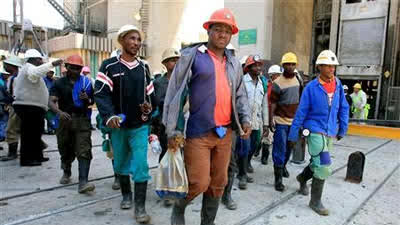
Miners refuse to work


Image

JOHANNESBURG – Thousands of workers have gathered at Anglo Platinum’s Khomanani Mine in Rustenburg.

They are refusing to go to work after the mining giant on Tuesday warned that 14,000 jobs could be lost during a major restructuring of the company.

Four shafts including Khomanani will be shut down.

Workers on the nightshift refused to go underground and are now planning a strike.

They said they will bring the company to its knees if it doesn’t reconsider.

Meanwhile, The African National Congress (ANC) condemned Amplats’ restructuring plans.

The ANC’s Jessie Duarte said it goes against the commitment made between the business and the party, to grow the country’s economy.

She said they are also concerned about the effect the job losses will have on Rustenburg’s economy because the majority of employees live there.

“We are really concerned about the manner in which Amplats have handled and that 13,000 out of the 14,000 jobs are being lost in the Rustenburg area, where there were major issues from Marikana not so long ago.”

Anglo Platinum CEO Chris Griffith said while they may have committed to a 50-year lifespan for the mine when their license was renewed in 2010, circumstances have changed drastically. 

Griffith said the restructuring couldn’t have been predicted.

“Clearly, life has changed. There’s been an impact on the industry, there’s a whole host of structural and economic changes that have happened, not only in Anglo Platinum.”

For more details go to http://www.ewn.co.za

When your partner says no to sex


Image

It’s that time of the year when couples take stock of relationships – and make some tough decisions. Like whether or not to leave a sexless marriage: one where couples have sex less than 10 times a year.


Society says it’s women saying no to sex, but in reality, it’s just as likely to be the man turning to face the wall.


Whether to leave or stay in a sexless marriage depends on what else is happening in the relationship, how important sex is to you and whether your partner intends doing something about it.


It also depends on how long you’ve gone without regular sex and if there’s a good reason why.


If you’ve just had a child and haven’t had sex for a few months, you’re panicking unnecessarily.


If you’re both young and healthy but you’ve spent four of your five-year marriage reaching into your bedroom drawer, you’re more than justified in feeling peeved.


Sadly, marriage itself is sometimes to blame for a sorry sex life because women often don’t marry the people they click with sexually.


We’ll happily attach our lips and hips to that pretty-but-pretty-thick hottie for a five-week flingette but choose long-term lovers for different reasons. Factors like kindness, stability, intelligence and emotional intelligence take precedence.


Which is all terribly sensible but sexual attraction is fundamental.


The best you can do in this situation is acknowledge it and decide whether you can live with it.


If your partner is a good friend and/or brilliant father, you might consider having little or no sex a fair trade. A rich fantasy life and lots of masturbatory sessions might be enough for you.


You might decide to “take a lover” and have your sexual needs satisfied outside the marriage. Or you might decide it’s more honest to leave and find someone who does it for both ends: heart and groin.


You had great sex in the beginning but now it’s all disappeared?


The first thing to examine before packing your bags, is your relationship outside the bedroom.


Sex is often used as a bargaining tool: it could be that you’re being denied it because your partner is angry with you.


Your relationship’s just fine? The first thing to do is admit there’s a problem – though there are many reasons why you may not have.


Saying it out loud – “Honey, I’m concerned because we haven’t had sex for 18 months” – makes the problem real.


You’re both then forced to face up to it and do something about it, maybe even get help.


It’s not a sign your marriage is failing to see a sex therapist or counsellor, it’s a sign you love each other and want your relationship to be as good as it can possibly be.


The critical factor: Once you start talking, it will become obvious what your future holds. This is the bit when you find out if your partner is willing to work with you to build a satisfying sex life – or has no interest in trying to solve the situation.


If it’s the former, it’s great news. You’ve taken the first, huge step towards solving the problem.


If it’s the latter, even the most faithful, supportive partner is forgiven for thinking about leaving – or having a bit on the side.


As one therapist friend of mine puts it: there’s something wrong with the picture if your partner is saying: “I know you’re desperately unhappy but I don’t plan on doing anything about it and still expect you to be faithful.”


Ever thought: “How come that couple are breaking up? They were perfect together?” Lack of sex is often to blame.


It’s rare for lustless lovers to live happily ever after in platonic bliss. Invariably, one person isn’t happy in a sexless marriage and ends up either leaving or having an affair.


A relationship stripped of the intimacy and physical closeness which sex provides feels hollow: the person who is supposed to find you attractive, sexy and desirable doesn’t. Who wants to live with that? – Daily Mail


Judge okays child sex


Image

Pretoria – It is no longer a criminal offence for children aged between 12 and 16 to engage in consensual sexual activities with each other, the Pretoria High Court ruled on Tuesday.


Judge Pierre Rabie’s ruling follows an application last April by the Teddy Bear Clinic for Abused Children, supported by the Centre for Child Law, challenging certain provisions of the Sexual Offences Act.


The two organisations argued the Act often resulted in many underage pregnant girls not wanting to have abortions at clinics, as this would lead to criminal charges against them and their partners.


They requested the court to declare certain provisions unconstitutional as they infringed on a child’s right to dignity and privacy.


The application was opposed by the justice minister and the National Director of Public Prosecutions.


While the judge’s ruling was described as a “victory for the rights of children” by the applicant and Teddy Bear Clinic director Shaheda Omar, the Department of Justice and Constitutional Development said it would impact on the escalating rate of sexual violence among children under the age of 16.


In his ruling, Judge Rabie declared the two sections of the Sexual Offences Act, which criminalise consensual sexual activity between children under the age of 16 years and above 12 years, invalid and deemed them to be inconsistent with the constitution.


The Sexual Offences Act states that all consensual sexual acts between children of that age, even kissing and not only penetration, are criminal offences. This meant that both consensual parties faced the possibility of being criminally prosecuted in terms of the act.


The act also stated that any person, be it parents, teachers or others, who were aware of consensual sexual activities between children had to report the children to the police, or face possible prosecution themselves.


During the trial last year, Judge Rabie voiced his own concerns about the legislation.


He noted that in terms of the act, it would even be an offence if a child under 16 was kissed on the mouth when relatives came together and greeted each other by kissing.


“This shows the absurdity of some of the provisions of this act,” he said at the time.


According to the respondents, the act is there to protect children from predatory adults and sexual predators. It is also meant to protect children from the criminal justice system, and to correct and regulate the sexual activity of children, among others.


“Very little, if anything, is added to the protection of children by criminalising consensual sexual conduct between children, and it has been proven by evidence submitted to court that children charged under the provisions will be severely harmed,” Judge Rabie said.


Omar said the Teddy Bear Clinic was delighted by the court’s ruling.


“It promotes the best interests of children by protecting them from being violated by the criminal justice system, therefore advancing the rights of children,” she maintained.

For more details go to http://www.iol.co.za