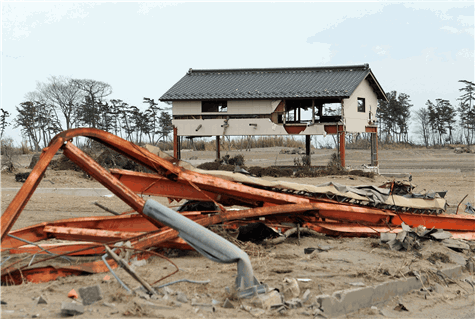
Khuma: A township in ruins


Following a recent 5.5 magnitude earthquake that left a trail of destruction in the township of Khuma near Orkney, North West, a frail 81-year-old man finds himself living alone in a house declared unsafe for occupation.

David Bohloko has no identity book and thus cannot receive a social grant, nor access other state benefits for people of his age. Compounding his problems, he has no immediate family.

During the August 5 quake his house was dislodged from its foundation. The walls cracked and an outside room was completely destroyed. Bohloko’s only piece of furniture is a mattress on top of plant pots, which he sleeps on.

A young woman has made it her responsibility to look after him. Lucy Masangane and other locals reported Bohloko’s plight to government officials.

“We went to register him on the database of those affected by the earthquake so that he could get help, but nothing has been done,” she says.

Masangane says a meeting was held with the local mayor who apparently told Bohloko to continue living in the house, despite it being declared unsafe.

More than 600 houses were damaged during the earthquake. A 31-year-old man was killed and at least 34 miners were injured.

Government at the time said those affected would be helped. Severely damaged homes were declared unsafe for occupation. Some families were moved to a community centre.

People’s names were taken and they were promised food parcels. Bohloko, to this day, has not received anything.

“There are people in the same street who received groceries but he was not given any,” Masangane says.

“When we inquired, we were told they would look into the matter, but to this day nothing has been done for him.”

Masangane is unemployed, but has been feeding Bohloko. She has decided to move into his house to be nearer to him in case he needs help.

“I make plans to get food so that I can cook for him,” she said.

A street away from Bohloko is the home of Mmalehlogonolo Mosaei. Standing in the middle of her badly damaged house she remembers August 5 and the funfair atmosphere when government officials visited the area.

“They assessed our houses and said they were not safe for us to stay in. Government said they would help us to rebuild the house, but since then they have not come back to us,” she says.

The unemployed mother of 10 says the family has been staying in a two-bedroom shack since the earthquake. She points to the cracks in the walls and says she lives in fear of the house falling down.

Some of her young children play near the house. She asks them to play further away from the unstable structure.

After registering her name on the database of those affected, she was optimistic that government would take care of her.

“[But] now we are hurting because they [government] are not telling us anything or giving us hope of when we would be assisted,” she said.

The shack leaks when it rains. Some of the children share one bed while others sleep on the floor with her. Her biggest worry is crime.

“Living in the shack, we are always scared that criminals can break in as it will be very easy for them to remove one of the corrugated iron sheets. It is not a nice feeling,” Mosaei says.

Just like Bohloko, she has had to watch as others around her receive groceries while she struggles to make ends meet. Her cupboards are empty except for a 10kg bag of mielie meal she bought on credit.

“We have not received help from the municipality or government, despite having given our details and explaining that no one is employed in the family,” she says.

SA Social Security Agency (Sassa) North West spokesman Smanga Selemeni on Tuesday told Sapa that after the quake information was collated on which families were affected and to what extent.

“This was used to determine who gets what… If we are not giving some families, probably they did not appear on the list. Also, the distribution of those food parcels is governed by the regulations of the Social Assistance Act.”

In terms of the act, prospective beneficiaries need to submit information on their household income and whether anyone in the family receives a social grant.

“Other families could have been excluded as a result of those regulations,” Selemeni said.

North West provincial government spokeswoman Bonolo Mohlakoana says an assessment on the extent of the damage is complete, but a request for funding has not yet been sent to the National Disaster Management Centre.

Asked why it has taken so long for this to happen, Mohlakoana says there are not enough structural engineers to assess the houses. Also, the list of properties needing assessment keeps growing as people phone in to report damage.

“The assessment has been done. Now they are working on the cost implications, which we will send to the National Disaster Management Centre soon.”

-Sapa
Seventh heaven for Amakhosi


Mandla Masango scored his fourth Premiership goal of the season as Kaizer Chiefs limped to a 1-0 win over Maritzburg United at FNB Stadium on Saturday night.

Masango scored from the penalty spot on the stroke of half-time as Chiefs bagged their seventh consecutive league victory of the season, maintaining their 100 percent start to the 2014/15 campaign.
For more http://www.thenewage.co.za

Hotel kicks out municipal team


STAFF from a North West municipality competing in the Southern African Inter-Municipal Association (Saimsa) games in Buffalo City Metro have been ejected from their hotel.

The participants from Ditsobotla Local Municipality, which is currently under administration, yesterday said they were kicked out of Gonubie Hotel because their accommodation bill had not been paid.
For more http://www.dispatch.co.za

EFF defectors burn their berets – report


Johannesburg – The EFF was unconcerned by a report on Friday that about 100 of its Northern Cape members had defected back to the ANC.

“Members of the ANC come to the EFF every day and we don’t make platforms to announce it,” spokesperson Mbuyiseni Ndlozi said.

“This is just a political stunt.”

The New Age reported on Friday that the 100 EFF members left the party, branding its leader Julius Malema a dictator.

According to the report, the members were welcomed back to the ANC in the Frances Baard region.

They reportedly burnt their red EFF berets, T-shirts and membership cards outside the Social Centre in Kimberley.

Former EFF Northern Cape leader Kabelo Mzolo told the newspaper the policies advocated by the party were in the wrong hands and that Malema used the EFF for his own ends.

Ndlozi said he did not know who Mzolo was and that it was debatable whether the group were actually EFF members.

“We are launching branches every day. There is a lot of progress happening across the country.”

He said the ANC was unable to accept that the EFF “is here to stay”.

SAPA

NWU Potch campus an ‘apartheid enclave’ – Nzimande


Johannesburg – The North West University’s (NWU) Potchefstroom campus is still rooted in apartheid ideas, Higher Education Minister Blade Nzimande said on Friday.

“The Potchefstroom campus of NWU remains fundamentally an apartheid institution, if not an enclave, in urgent need of transformation,” he said in a statement.

He was reacting to a report on apparent fascist initiation practices at the institution.

Nzimande said according to the report it was clear “that there are deep-seated practices at the institution related to its welcoming programmes for first-year students that violate human rights and dehumanise first-year students”.

Earlier this year, Nzimande asked the university council to investigate reports in February of Nazi-style stiff-arm salutes first-year students allegedly made during an initiation ceremony at the Potchefstroom campus.

He received the report of the investigation by an independent task team on 27 June.

Nzimande said that, at the time of receiving the report, he was asked not to make it public.

“I have decided not to comply with this request. It is unacceptable that a report that exposes a deep moral corruption at a major public university should be kept from the university community and the people of this country.”

Nzimande said the report indicated the problems in question were specific to the Potchefstroom campus and that the initiation practices at residences mainly targeted first-year students, especially those not from the dominant Afrikaans feeder schools.

The initiation practices had been carried out for so long that they had come to be considered cultural practices in the residences, said Nzimande.

“It is also clear that these practices are well known to the management of the residences, with some actively participating in the processes.”

He said that, according to the report, it was clear the university and campus management were not only aware of the practices, but refused to act against them, despite available evidence.

“A culture of fear exists at the institution and people do not talk freely.”

Nzimande said it seemed the university’s institutional model had fostered “a largely mono-cultural environment that appears to be designed mainly for white Afrikaners on the Potchefstroom campus”.

The minister agreed with the report’s recommendations and had asked for feedback on their implementation on a quarterly basis.

The task team that conducted the investigation included SA Human Rights Commission member Leon Wessels, NWU human rights committee chairperson Rehana Rawat, political analyst Somadoda Fikeni, and nuclear power expert Bismark Tyobeka.

SAPA

Fight against Cape fire hindered by weather


Johannesburg – Efforts to put out a fire that broke out in the mountains between Swellendam and Barrydale in the Western Cape had to be scaled back on Friday because of poor weather, an official said.

“We had people there, but we pulled them back because of the weather, Overberg fire chief Reinard Geldenhuys said.

He said the fire was higher up in the mountains where there was mist.

“We will go back when the mist clears tomorrow.”

Geldenhuys said the fire did not pose any threat to properties at the moment.

The fire broke out in the area after a lightning strike on Tuesday night.

Geldenhuys said an assessment on the extent of the damage caused by the fire could only be done once it had been put out.

SAPA

Court rules against SANDF HIV policy


Johannesburg – The North Gauteng High Court in Pretoria on Friday ruled in favour of two women army recruits whose contracts were cancelled because they tested HIV-positive, the SABC reported.

The court ordered that the SANDF re-employ the women, according to the report.

It ruled that the army was frivolous and abused court processes.

The two women had undergone two years of training before their contracts were cancelled because of their HIV status.

SAPA

East Rand businesses struggle without water


Johannesburg – Businesses in Bedfordview, east of Johannesburg, have been affected by the low water supply in the area.

– Are you affected? Send us your eyewitness accounts and photos.

Many have resorted to bringing containers of water from their homes or relatives’ homes to ensure their businesses are able to continue.

There has been no water in the area since Saturday.

Gym affected

Virgin Active Bedfordview club manager Shelley van Wyk said the gym had been heavily affected since the water shortage.

“We’ve been adversely affected. Members in the area don’t have water at home and they come here and there’s still none.”

Van Wyk said there had been no water from 10:00 until the end of business at 21:00 on Thursday. On Friday there was some water but she was not sure for how long. The gym had locked some toilets for hygiene reasons.

Between 2 500 and 3 000 people went to the gym on a daily basis and the lack of consistent water supply was becoming a problem, she said.

“Today we’ve got water slightly, but it’s not sufficient.”

She said water from the water tanker supplied by Rand Water often only lasted for about an hour.

Eating out

Gym member Nicole Katsouris, who lives in Senderwood, said it was difficult to gym with limited water.

She still had water where she lived and family and friends were coming over to her house to have showers.

“You can’t go to the malls because it’s unhealthy.”

She said she had gone to a restaurant during the week which claimed it had water, only to find out that it did not.

“It’s disgusting and unhygienic.”

No washing

Bedfordview resident Jennifer Valentim said she and her five family members had not washed dishes or clothes since the water shortage began on Saturday.

“We’ve been using pool water to flush our toilets and we’ve been eating out outside of Bedfordview.”

She said they were also relying on family in the south of Johannesburg for showers and food.

Valentim was at the Synergise spa having her nails done.

Spa owner Shirley-Anne Hale, who lives in the south, said she brought water from home for her business.

She had four 25-litre containers of water in her car’s boot and four five-litre containers in the spa’s toilet.

Quiet week

She said her business had been affected by the water shortage.

“It’s been a quiet week because some of the clients think we are closed.”

A salon owner, who lives in Edenvale but runs her business in Bedfordview, said she was also bringing water from home in containers.

She had resorted to washing her clients’ hair using mini bowls and buckets.

She said some clients refused to have their hair washed in buckets, and left, but most of them were understanding.

“We’re doing okay, we still have business,” she said.

“We run late every day. Things that take us 20 minutes will now take 45 minutes so it takes us longer [to do business].”

She said some of her clients brought containers of water with them to assist her.

SAPA

Alleged racist employer to know fate next month


Cape Town – A Cape Town man, accused of the racial abuse and assault of a domestic worker, will know on 24 October whether he will pay damages of R100 000 in a case before the Equality Court.

The last witness in the case, brought by domestic worker Gloria Kente against Andre van Deventer, was cross-examined on Friday.

Mariechen Pienaar, Kente’s former employer, originally testified for Van Deventer – her boyfriend at the time of the alleged racial abuse.

During cross-examination by Peter Williams, for Kente, on Friday, Pienaar conceded that on 28 June 2013 Van Deventer had called Kente a “kaffir” several times. She could however not recall exactly what Van Deventer had said to Kente.

Williams put it to Pienaar that her former boyfriend and father of her child had called Kente a “lazy kaffir”. Pienaar said she could not remember the exact words.

“I know there was the f-word. I know there was the k-word,” Pienaar conceded.

Pienaar did not witness Van Deventer allegedly grabbing Kente by the neck of her pyjamas, spitting at her, or calling her “a kaffir” repeatedly.

Kente had worked for Pienaar for nine years as a domestic worker and nanny. Kente says Van Deventer racially abused her for some time during the couple’s rocky relationship.

Williams said he would submit to the court that Pienaar had a “selective memory” where incidents between Kente and Van Deventer were concerned.

Van Deventer previously admitted to using the word but denied the assault, which led to a criminal matter in the Cape Town Magistrate’s Court, where he faces charges of crimen injuria and common assault.

Kente also turned to the Equality Court last year claiming Van Deventer had violated the Equality Act.

Kente is seeking R100 000 in damages and an unconditional apology from Van Deventer.

SAPA

Walkout shows bad faith – ANC


Cape Town – It was clear from the outset that opposition parties had not meant to participate in good faith in Parliament’s ad hoc committee on Nkandla, ANC Deputy Chief Whip Doris Dlakude said on Friday.

Briefing the media following a walkout by opposition parties from the committee proceedings earlier in the day – after the ANC refused to agree to call President Jacob Zuma – she said they had not “provided compelling and legitimate cause” for him to appear.

“It was clear from the outset that the opposition’s desire was never to participate in the committee process in good faith, with a view to assist Parliament to arrive at sound resolutions on the matter.”

The briefing was called in response to the opposition walkout.

Dlakude said the ad hoc committee was expected to conduct “a qualitative interrogation, robust analysis and thorough appraisal” of the reports before it, and formulate an opinion for the National Assembly’s consideration.

“The committee was neither called to re-investigate nor to review the findings of the reports.”

She said it remained the ANC’s view that the reports provided sufficient information to enable Parliament to form an opinion.

“While the committee is empowered in terms of the rules to summon individuals to appear before it for questioning, this would have meant a rehash of the investigation, which would have warranted an alteration of the findings of the report.”

If individuals mentioned in the reports were called to testify before the committee, a legitimate expectation would be created that their testimonies, which might either agree or materially contest the reports, should be taken into account when the committee reported to the House.

“This would have unavoidably compelled Parliament to review the reports, which is in conflict with the institution’s constitutional powers.

“In this regard, the ANC cautioned against opening the re-investigation process that would have thrown the institution into a legally untenable situation.”

‘Anti-Zuma campaign’

Dlakude said the opposition parties’ mission was “to abuse the committee to pursue [their] relentless and obsessive anti-President Zuma campaign”.

ANC committee members were present at the briefing.

ANC MP Mmamoloko Kubayi said the ad hoc committee – expected to sit again on Tuesday – would continue its work.

“As long as there’s a quorum, the committee can work… If they [opposition parties] don’t come back, it’s their loss,” she said.

Dlakude said Public Protector Thuli Madonsela had stated that the SA Police Service had to determine which non-security upgrades to Zuma’s Nkandla residence should be paid for by the president.

“In this regard, the president has tasked the Minister of Police [Nkosinathi Nhleko] to deal with the matter.

“Asking the president to appear before the committee to give details of how, when and how much he should pay, even before the minister of police can conclude his process, is tantamount to putting the cart before the horse,” she said.

SAPA