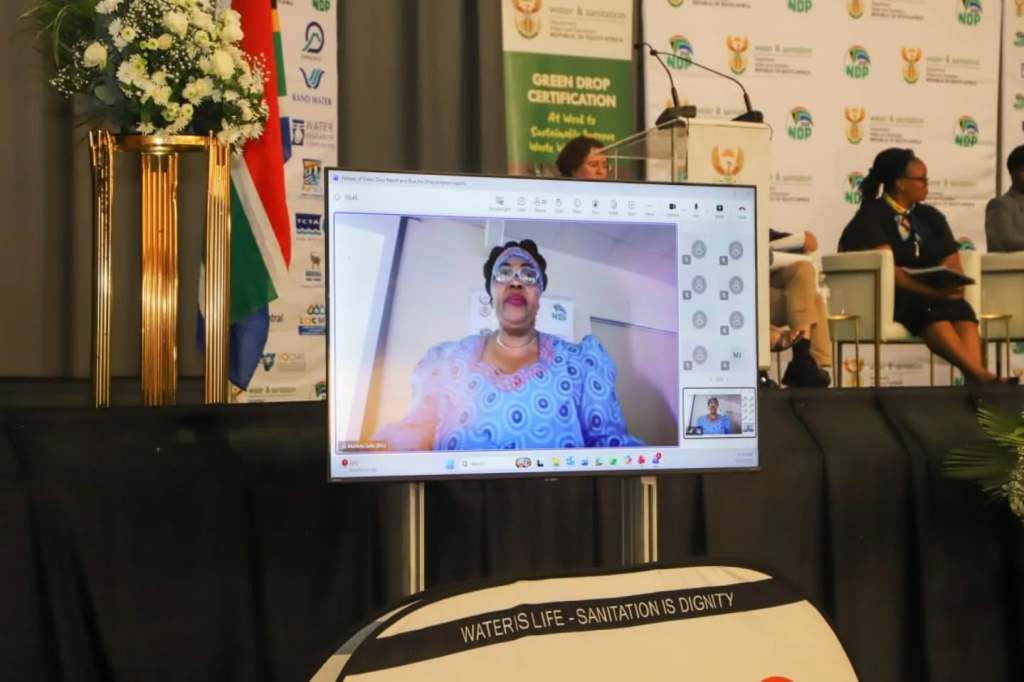
Picture: Minister of Department of Water and Sanitation, Pemmy Majodina
By KEDIBONE MOLAETSI
31 March 2026 – The Ministry of Water and Sanitation has released the 2025 Green Drop Report together with progress assessment reports on the Blue Drop and No Drop programmes on 31 March 2026, providing a comprehensive and evidence-based account of the state of water and sanitation services in South Africa.
The department said Green Drop Report, which reflects a full audit of 848 municipal wastewater treatment systems for the 2023/24 financial year, presents a concerning picture of declining wastewater performance across the country.
Addressing delegates, Minister of Department of Water and Sanitation, Pemmy Majodina said the report must be treated as a decisive moment for the sector. Majodina said the percentage of wastewater systems in a critical state has increased significantly from 39%, representing 334 systems in 2022, to 47%, representing 396 systems in 2025.
“At the same time, systems performing at excellent or good levels have declined from 14 percent, or 118 systems, to 8 percent, or 66 systems. Only 14 systems achieved Green Drop certification in 2025, down from 22 in 2022 (Those who comply with wastewater standards).
“These results show that systems previously operating at a poor level have continued to deteriorate into critical failure, placing increasing pressure on water resources, the environment and public health,” she said.
Majodina further said this report is not a routine compliance exercise, it lays bare the true state of wastewater management in the country and reflects how effectively they are protecting the water resources and safeguarding the dignity of their people. She added that the deterioration they are seeing is unacceptable and it demands urgent and sustained action.
“The Green Drop findings are complemented by the Blue Drop and No Drop Progress Assessment Reports, which provide further insight into drinking water quality and water use efficiency, respectively.
“While these two are not full assessments, they indicate that the risk profile for drinking water has stabilised, albeit at a high level,” said Majodina.
She said nationally, low-risk drinking water systems have increased marginally from 60.2% to 61.9%, while critical-risk systems have decreased from 9.9% to 7.9%. Majodina said despite these modest improvements, a significant number of systems.
“Department of Water and Sanitation South Africa remains in high and critical risk categories and requires urgent corrective action and intensified regulatory oversight. Furthermore, performance across provinces on drinking water quality remains uneven.
“The Western Cape and Gauteng continue to show the strongest overall performance, while Mpumalanga and North West have recorded notable improvements. However, the Northern Cape remains the poorest performing province, with the highest concentration of high and critical risk systems, and the Free State continues to be an area of serious concern,” she said.
 The Guardian