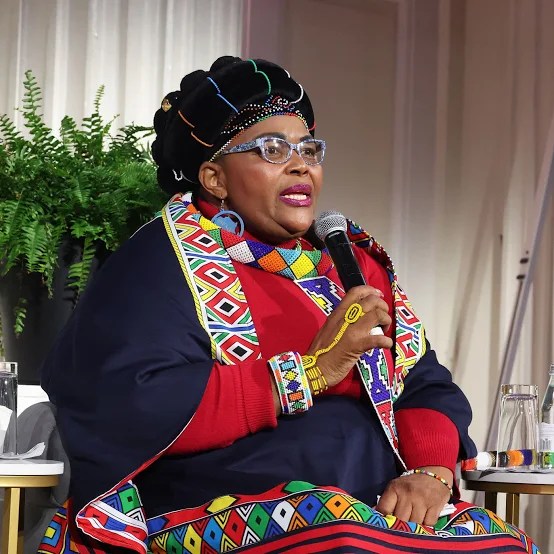
Picture: Minister of Department of Water and Sanitation, Pemmy Majodina
REGINALD KANYANE
30 March 2026 – The Minister of Water and Sanitation, Pemmy Majodina will on Tuesday, release the Green Drop Report alongside progress reports on the Blue Drop and No Drop programmes. Majodina is also expected to provide a comprehensive update on South Africa’s drinking water quality, service provision and wastewater management.
The Department of Water and Sanitation, Wisane Mabasa said the Blue Drop, Green Drop and No Drop Certification programmes are key regulatory tools of the department, designed to drive excellence and accountability across municipalities. Mabasa said these incentive-based programmes assess performance in drinking water quality, wastewater treatment, as well as water conservation and demand management.
“The Green Drop Report will provide an in-depth evaluation of wastewater management across municipalities, while the Blue Drop and No Drop progress reports will track improvements and ongoing challenges in drinking water quality and water use efficiency.
“Together, these reports will deliver a clear, evidence-based snapshot of how municipalities are meeting their constitutional obligations to provide reliable water and sanitation services,” she said.
Mabasa further said they will also recognise high-performing Water Services Authorities, identify areas of concern and outline targeted interventions to strengthen regulation and support struggling municipalities. She added that as the sector regulator under the National Water Act and the Water Services Act, the department has steadily strengthened its oversight through these programmes, first
introduced with the Blue Drop and Green Drop Reports in 2008 and later expanded with the No Drop programme in 2014.
“The release of these reports marks a critical moment for transparency, accountability and the
ongoing effort to secure safe and sustainable water services for all South Africans.
“The event will take place at Banquet Hall, Steve Tshwete Local Municipality in Mpumalanga, on Tuesday at 9am,” said Mabasa.
Picture: The Minister of Water and Sanitation, Pemmy Majodina
By OBAKENG MAJE
9 January 2026- The Minister of Water and Sanitation, Pemmy Majodina together with Deputy Minister, David Mahlobo, commissioned critical upgraded water infrastructure that will significantly improve water security for the residents of Rustenburg in North West, as well as Thabazimbi in Limpopo. Majodina said the commissioning included the upgraded Vaalkop Water Treatment Works Raw Water Pumpstation and the associated Bulk Water Pipeline, both of which are designed to respond to growing water demand and ensure long-term water security in the two provinces.
She was joined by the Members of the Executive Council responsible for Co-operative Governance, Human Settlements and Traditional Affairs (CoGHSTA) in the North West, Oageng Molapisi and his counterpart in Limpopo, Basikopo Makamu. Also in attendance were the executive mayors of Bojanala District Municipality, Rustenburg Local Municipality and Thabazimbi Local Municipality.
Magalies Water was represented by its Board Chairperson, Dr Lydia Sebego, and Chief Executive Officer (CEO), Ofentse Nthutang.
“The Vaalkop Water Treatment Works Raw Water Pump Station upgrade, implemented by Magalies Water from February 2023 and completed in November 2025 will ensure sustainable water supply for Moses Kotane and Rustenburg Local Municipalities in the North West, as well as Thabazimbi Local Municipality in Limpopo.
“The Pump Station directly abstracts water from Vaalkop Dam and has been upgraded from a capacity of 240 megalitres per day (ML/day) to 360 ML/day. It has been equipped with ten pump sets designed to efficiently supply raw water to the water treatment works, strengthening operational reliability, improving water management and reducing water losses,” she said.
Majodina also commissioned the upgraded Bulk Water Supply Scheme, which was initiated in response to increasing water demand from the rural communities of Bethanie, Modikoe and Berseba within Rustenburg Local Municipality. She further said implemented by Magalies Water in partnership with Glencore Rhovan PSV Mine, the project involved the construction and installation of a 23.4-kilometre bulk potable water pipeline, comprising 560mm and 400mm diameter pipes with associated valves.
“The pipeline runs from the Kortbegrip Reservoir to the Bethanie and Modikoe Reservoirs. The new pipeline replaces the ageing asbestos fibre-cement pipeline that had reached the end of its operational life and was prone to frequent bursts.
“The upgraded infrastructure increases bulk water supply capacity to meet the current demand of 7.05 ML/day and future demand projected at 12.60 ML/day. Importantly, the project will also enable additional water volumes to supply Makolokwe Village, where access to water remains critically low,” added Majodina.
She said currently, the village relies on boreholes that are insufficient to meet the growing needs of the community. Majodina said the second phase of the project, the bulk pipeline between Bethanie and Makolokwe village, is scheduled to commence in March 2026 and will include the construction of a booster pump station at the Bethanie Reservoir.
“Upon full completion, the project will provide a reliable water supply to a combined population of approximately 144,133 residents, including households, schools, clinics, businesses and community institutions.
“We commend the public-private partnership between Rustenburg Local Municipality and Glencore Rhovan PSV Mine, noting its positive contribution to accelerating service delivery in Bethanie and Modikoe villages,” she said.
Majodina said today’s handover represents progress, but more importantly, it represents partnership. She said when the government, communities and stakeholders work together they can overcome scarcity, defeat criminality and deliver sustainable services.
“The benefits of this investment are clear and far-reaching. For households, it means a more reliable water supply and greater resilience during peak demand periods. For local businesses, industries and emerging enterprises, it provides the certainty needed to operate efficiently, expand production and create jobs.
“For municipalities, it strengthens the backbone of service delivery and long-term development planning. We also call on communities to protect the newly commissioned infrastructure and keep it safe from vandalism and sabotage,” said Majodina.
She strongly condemned individuals and syndicates who deliberately damage water infrastructure to sustain illegal water trading activities. Majodina said these projects must be protected and she wants to speak clearly and firmly today that water infrastructure is not a playground for criminals.
“The vandalism of pipelines, theft of equipment and manipulation of water systems by so-called water mafias is a direct attack on the dignity and well-being of our people. It deprives families of water, disrupts livelihoods and undermines development.
“This government will not tolerate water mafias. Those who vandalise, steal or illegally profit from water infrastructure are stealing from children, the elderly and the most vulnerable. Law enforcement agencies are working closely with the department, municipalities and water boards and we will pursue arrests, prosecutions and harsh consequences for anyone who undermines service delivery,” she concluded.
Picture: Minister of Water and Sanitation, Pemmy Majodina
By REGINALD KANYANE
18 September 2025- As part of Heritage Month commemoration, the Minister of Water and Sanitation, Pemmy Majodina, will hand over the World Heritage Irrigation Structure (WHIS) Award to the Orange-Vaal Water Users Association, and the newly refurbished Douglas Water Treatment Works (WTW) to Siyancuma Local Municipality, in the ZF Mgcawu District Municipality, Northern Cape on Thursday.
Majodina spokesperson, Cornelius Monama said the WHIS award is a prestigious designation given to historic irrigation structures by the International Commission on Irrigation and Drainage (ICID), and it recognises the cultural, historical, and technological significance of these structures. Monama said the Douglas Weir, a 134-year-old engineering marvel that pioneered irrigation-led rural development in the Northern Cape was recognised as a World Heritage Irrigation Structure by the ICID.
“It was nominated by the South African National Committee on Irrigation and Drainage (SANCID), and the award was accepted on behalf of the committee by ICID Vice-President and SANCID Chair, Prof Sylvester Mpandeli last September at the 9th Asian Regional Conference of ICID in Sydney, Australia.
“Since then, the weir, located at the confluence of the Vaal and Orange Rivers in Douglas and regarded as the world’s oldest, has been included in the ICID Register of World Heritage Structures,” he said.
Monama further said a weir is a barrier across the width of a body of water that alters the flow characteristics of water and usually results in a change in the height of the water level. He added that weirs are used to control the flow of water for rivers and other water resource structures.
“This is the first time that a South African irrigation structure has received the award since the inception of the WHIS recognition category in 2012. The award will be officially handed to the Orange-Vaal Water Users Association responsible for managing the infrastructure.
“Majodina will thereafter hand over a refurbished Douglas Water Treatment Works also located near the confluence of Vaal and Orange River, which serves as raw water abstraction supply points for water purification and supply to the town and surroundings,” said Monama.
He said the existing purification plant was not operating efficiently as it had exceeded its 30-year design life cycle, and it therefore needed an urgent refurbishment. Monama said the R28 million revitalisation project scope entailed the refurbishment of the water purification plant, the general rehabilitation work of the plant and the installation of a 200KVA emergency generator.
“The plant will filter a total capacity of 4 273 cubic metres per day of purified water to the population of 22 180 persons residing in 4 704 households within the area of Douglas.
“Following the handover of the WHIS Award and the WTW, the Minister will have a community engagement with the local residents, and later conduct an oversight visit at Douglas Weir,” he said.
Monama said Majodina will be joined by the Chairperson of Water Research Commission (WRC), Dr Rethabile Melamu as well as the Chief Executive Officer of the Orange-Vaal Water Users Association, Mr Peter Joseph.
Picture: The Minister of Water and Sanitation, Pemmy Majodina/Supplied
By AGISANANG SCUFF
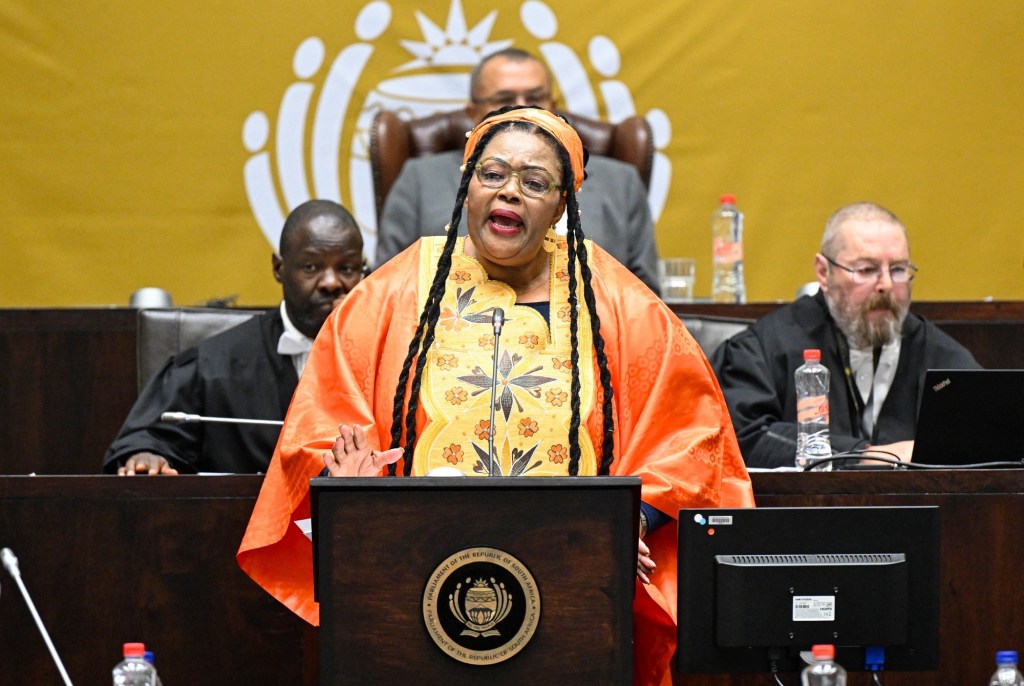
9 July 2025- The Minister of Water and Sanitation, Pemmy Majodina said municipalities are responsible for reticulation and ensuring that water reaches the homes of residents. Majodina who tabled the departmental budget today in Parliament said, it is important for government officials to understand the value chain of water provision so that they can properly guide members of the community, whenever issues of water are raised in their constituencies.
She further said in his State of the Nation Address (SONA) delivered on 6 February 2025, President Cyril Ramaphosa said: “An urgent priority is to ensure a secure and reliable supply of water across the country. Many people in our cities, towns and villages are experiencing more and more frequent water shortages as a result of failing water infrastructure.
“It is impossible to live without water and it is impossible for the economy to grow without water.”
Majodina said Ramaphosa declared water as an immediate crisis and made a firm and unequivocal commitment for the government to take a series of decisive actions to resolve the water crisis. She further said perhaps at this point, they must restate the point that as a national department, they are responsible for bulk water supply and water resources.
“You will recall that we held a Water and Sanitation Indaba on 27 and 28 March 2025, which was attended by delegates from national government and national 2 entities, provincial government, the municipalities which are water services authorities, SALGA, the private sector, and water and sanitation experts.
“The Indaba unanimously agreed on a set of practical resolutions related to delivery or implementation models. There are five pillars identified such as increasing investment through financing options, ensuring the financial viability of the sector, enhancing and strengthening technical and operational capacity and efficiency,” said Majodina.
She added that this includes building partnerships through building water sensitive and resilient communities and fighting criminality and corruption in the water and sanitation sector.
“The Infrastructure Fund which was established by Ramaphosa has been assisting the department to put in place such blended finance projects. Secondly, we identified a need to diversify the water mix and increasingly make use of other sources of water, including increased sustainable use of groundwater, seawater desalination, and water reuse.
“In this regard, the department is providing funding for groundwater projects through its grants in many different municipalities, including in the Dr Ruth Segomotsi Mompati District Municipality in the North West, Oudtshoorn Local Municipality in the Western Cape, Dikgatlong Local Municipality in the Northern Cape and Thaba Chweu in the Free State,” she said.
Majodina said in addition, their Water Partnerships Office is assisting various water services authorities to put in place partnerships with the private sector for waste water reuse projects, including for the Umhloti, Umkomaas, Northern and Kwa-Mashu wastewater treatment works in eThekwini. She said this includes the Olifantsfontein and Waterval waste water treatment works in Ekurhuleni, the Rooiwal waste water treatment works in Tshwane; the Sebokeng waste water treatment works in Emfuleni, the Pelsvale waste water treatment works in Rand West City, the waste water treatment works in Outeniqua and the waste water treatment works in George.
“More municipalities are starting to develop seawater desalination projects, including Overstrand, Saldanha Bay and the City of Cape Town in the Western Cape, the City of eThekwini in KZN, and Ndlambe municipality in the Eastern Cape.
“Thirdly, we made an undertaking to continue to monitor the implementation of more effective water conservation and demand management programmes to bring our water consumption per capita levels in line with, or below, the international average, and to ensure that industries use water as sparingly as possible,” said Majodina.
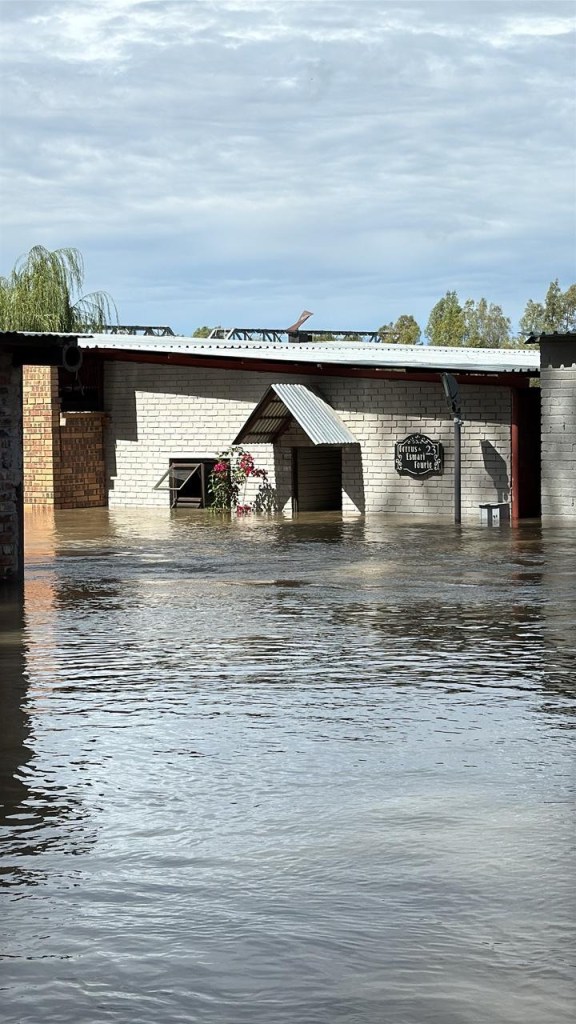
8 April 2025- The Minister of Water and Sanitation, Pemmy Majodina together with Deputy Minister David Mahlobo, will visit the Vaal Dam on 9 April 2025, to assess the water resource infrastructure amid heavy inflows into the dam as a result of ongoing rainfall in the Vaal River Catchment.
The Department of Water and Sanitation, Wisane Mavasa said due to torrential rains in the past few weeks, the department had to implement necessary dam safety precautions and controlled water releases from the dam to safeguard the infrastructure. Mavasa said the department has five sluice gates opened gradually from 20 March 2025, with the fifth sluice opened on 6 April.
“The Vaal Dam is currently releasing 793 cubic metres per second (mᵌ/s) of water downstream the Vaal River System into the Bloemhof Dam, while the Bloemhof has also activated its releases up to 3000 mᵌ/s, also through five gates by this
1 March 2025- The Minister of Water and Sanitation, Penny Majodina said they will continue to confront water supply challenges, whenever they rear their ugly heads. Majodina said this during the launch of National Water Month in Eikenhof, Johannesburg, Gauteng.
She further said the National Water Month is commemorated annually in South Africa during the month of March. Majodina added that, it is South Africa’s expansion of World Water Day, which is observed on 22 March and focuses its attention on the importance of fresh water and advocating for the sustainable management of freshwater resources.
“National Water Month is a moment to reflect on water supply challenges, strides we have made together to expand access to water, and the long road that we still need to traverse. The department and its partners reaffirm their unwavering commitment to addressing the pressing water challenges faced by communities across South Africa.
“Anchored around World Water Day observed annually on 22 March, this critical period highlights the urgent need to tackle water scarcity, improve infrastructure, and ensure equitable access to clean water and sanitation for all,” she said.
Majodina said the National Water Month programme is particularly significant as it aligns with Human Rights Month and International Women’s Day, underscoring the critical role of water as a fundamental human right and its disproportionate impact on women, who often bear the brunt of water scarcity. She said water is the foundation of life, essential for human survival, economic development, and environmental sustainability.
“Yet, millions of South Africans continue to face challenges in accessing clean water and safe sanitation. The government has elevated water to the top of its agenda, recognising that universal access to water and sanitation is not only a moral imperative, but also a prerequisite for sustainable development.
“It is befitting and symbolic that we are hosting this event in Eikenhof, Johannesburg. The City of Johannesburg and other parts of the province and country have experienced water supply disruptions,” said Majodina.
She said through the January 8 Statement and the State of the Nation Address (SONA), water has been elevated to one of the apex national priorities. Majodina said as a department and the water sector in general, they are determined to respond practically to this clarion call by President Cyril Ramaphosa.
“We welcome the announcement that the government will spend over R940 billion on infrastructure over the next three years to revitalise roads and bridges, build dams and waterways, modernise our ports and airports and power our economy. In response, our department is identifying key unfunded projects (both national water resource infrastructure and water services infrastructure) to be considered for funding by the Treasury.
“This will put the department in a good position to gain access to the R100 billion mentioned by Rampahosa. We are developing innovative ways of funding infrastructure,” she said.
Majodina said they are engaging local and international financial institutions and investors to unlock R100 billion in infrastructure financing. She said to date, the Infrastructure Fund has secured R23 billion for seven large water infrastructure projects.
“We are taking a series of decisive actions to resolve the water crisis, to enable our people to get water where they live, whether in townships or rural areas. Starting this year, we will work with our municipalities to establish professionally managed, ring-fenced utilities for water and electricity services to ensure that there is adequate investment and maintenance,” said Majodina.
Picture: Minister of Water and Sanitation, Pemmy Majodina
By REGINALD KANYANE
8 December 2024- The Minister of Water and Sanitation, Pemmy Majodina will on 9 December 2024, return to Ngobi village in Moretele, to fulfil a commitment she had made by handing over a completed house to a family that lives with a child with disabilities.
On 17 November 2024, Majodina had visited the family of Kgomotso Motlhajwa (18), who is wheelchair-bound and handed over a wheelchair friendly Ventilated Improved Pit (VIP) toilet, which was part of a Sanitation Project Hand-Over to the Moretele Local Municipality to mark World Toilet Day in the area.
Majodina spokesperson, Cornelius Monama said, upon witnessing the living conditions of the family, the Minister pleaded with the contractor responsible for the Rural Sanitation Project to donate and erect a house for the family of four as their current structure was not fit for habitation.
Monama further said the house has been built in the same yard as the toilet and will officially be handed over to the Motlhajwa family. He added that during the World Toilet Day celebration, Majodina handed over the Rural Sanitation Project, which was funded by the Department of Water and Sanitation through its Water Services Infrastructure Grant (WSIG) and implemented by Moretele Local Municipality.
“The project comprised of 1865 Ventilated Improved Pit (VIP) toilets to the local communities, particularly in Phedile village of ward 1, Selepe, Transectie, Ngobi, Jumbo, Dipetlelwane villages of ward 6, Swartboom, Mmoti, Makgabetloane, Rabosula and Norokie villages of ward 7.,” added Monama.





 The Guardian