‘We cannot talk of JET without talking about women and other vulnerable groups’


By BAKANG MOKOTO

29 August 2025- The Deputy President, Paul Mashatile, who delivered a keynote address at the official launch of the JET Skills Desk and National JET Skills Advisory Forum, said these are two pillars of South Africa’s Just Energy Transition Skills Portfolio. Mashatile said they cannot talk of a Just Energy Transition without talking about women and other vulnerable groups and the impact that a Business-as-Usual approach to climate change has on their lives and livelihoods.

He further said as such, the launch of these structures is critical to their broader developmental objectives and commitment to building a prosperous and equal society. Mashatile added that they will leave no one behind.

“These structures are part of a vital transition towards a low-carbon, inclusive, and equitable energy future. They will provide the leadership and coordination necessary to advance a cohesive and demand-driven skills development agenda.

“They will also tackle the green skills gap hindering the equitable energy transition and affecting our economic development and competitiveness,” he said.

 Mashatile said the skills mismatch gap prevents organisations from locating suitable individuals, resulting in sluggish production, delayed innovation, and diminished competitiveness. He said this launch is going into effect because they collectively recognise the need for a holistic strategy that includes education reform and an increase in skilled labour, to guarantee that all South Africans, particularly those living in coal-dependent and disadvantaged areas, can participate in the green economy.

“We want the communities in these areas to understand and be aware of the skills needed for employment as a result of the green transition, as well as the sectors in which they will be created, the skill level required, and who is most suited to offer them.

“This highlights the importance of transforming the skills base to facilitate a just and inclusive transition to green energy by establishing strong industry collaborations for practical training and rapidly improving university and TVET curricula,” said Mashatile.

He said in the context of South Africa, a country grappling with the challenge of transitioning to a sustainable energy future, the importance of skills development cannot be overstated. Mashatile said the concept of Just Energy Transition emphasises the need to move towards cleaner energy sources, while ensuring a fair and equitable transition for all stakeholders, particularly those from communities reliant on traditional energy sources.

“South Africa’s transition to renewable energy requires individuals and organisations to acquire new skills in renewable energy technologies, energy efficiency practices, and sustainability principles and a profound understanding of the social and economic implications of the transition.

“Our government is focusing on a green energy transition to improve energy security and combat climate change by creating new economic opportunities, reducing poverty, and improving public health outcomes,” said Mashatile.

He said through the Just Energy Transition Investment Plan (JET-IP), he said they aim to build new, sustainable energy sources, develop sectors like green hydrogen and electric vehicles and enhance energy security through a massive rollout of clean energy infrastructure. Mashatile said in all these areas, the government recognizes the need to proactively build skills to ensure the transition is just and creates employment opportunities, making skill development a core element of JET-IP rather than an afterthought.

“Suffice to say, at the heart of South Africa’s energy transition is South Africa and her people. It is about restoring dignity through decent work and creating opportunities, ensuring that no one is left behind.

“Whether we are talking about upgrading grid infrastructure or expanding green manufacturing, nothing moves without the people,” he said.

taungdailynews@gmail.com

Mashatile to visit North West as part of outreach programme


By KEDIBONE MOLAETSI

28 July 2025- The Deputy President, Paul Mashatile is set to visit the North West Province. Mashatile’s visit is a part of an outreach programme that will commence on 1August 2025, with the official handover of a 25 ML Moretele South Bulk Water Supply Scheme Water Reservoir at the Dilopye village, as part of improving the provision of reliable water supply to communities.

Mashatile spokesperson, Keith Khoza said he will then embark on a Clean Cities and Towns campaign in Mogogelo village. Khoza said this is a nationwide campaign led by Mashatile and aimed at fostering cleaner, greener and more inclusive urban spaces, while advancing sustainability, equality and solidarity among all citizens.

“Mashatile and delegation will have the opportunity to provide feedback on progress made in addressing service delivery issues affecting members of the surrounding communities.

“The community meeting is scheduled to take place at the Mogogelo Community Hall. On 2 August 2025, Mashatile will officiate at the Launch of the Provincial Human Resource Development Council (HRDC) at the ORBIT TVET College at Mankwe Campus,” she said.

Khoza further said amongst others, the HRDC mobilises various key stakeholders to rally behind the country’s revised Human Resource Development Strategy 2030, which is aimed at developing the requisite skills relevant which supports economy growth of the country.

taungdailynews@gmail.com

Inaugural Global SME Ministerial Meeting filled with pride and optimism  


By OBAKENG MAJE

24 July 2025- The Deputy President, Paul Mashatile said the inaugural Global SME Ministerial Meeting could not have come at a better time. Mashatile said as they do draw to a close, he could say the discussions and exchanges held in recent days have been filled with pride and optimism, as they highlight their shared commitment to enhancing access to finance, promoting digital transformation and promoting green transitions in the SME sector.

He said the discussions have further demonstrated the potential for collaboration and shared goals to unlock significant opportunities for SMEs globally. Mashatile said in this sense, they are grateful to see the UN expanding its efforts and collaborating with the South African government to foster multilateral cooperation.

“This relationship is critical in this challenging period of abrupt shifts towards unilateralism, which jeopardise the sustainability of our respective countries and the world. I am also impressed by the Call to Action for this Global SME Ministerial Meeting.

“It reaffirms support for critical multilateral initiatives, such as the Sustainable Development Goals, the Pact for the Future, the Global Digital Compact, the Declaration on Future Generations, the Paris Agreement on Climate Change, and the Group of Twenty,” he said.

Mashatile further said South Africa is hosting the G20 Presidency under the theme of Solidarity, Equality, Sustainability, aiming to champion developmental issues in the Global South, particularly Africa. He added that as they approach the G20 Summit, this forum has been essential in bringing together a number of ministers and deputy ministers from the continent and the Global South to exchange perspectives.

“We have heard your voices and will ensure that we champion the issues you have raised in the broader G20 processes and the G20 Leaders Summit in November. I am pleased that our G20 Startup Engagement Group’s Mid-Term Meeting happened on the side-lines of this Ministerial Meeting, which allowed for cross-pollination of ideas and propositions.

“I know Minister Ndabeni is championing the establishment of a dedicated G20 Working Group on small business and start-ups, an idea which started under Brazil’s Presidency. This Ministerial meeting has given this initiative the momentum it needs,” said Mashatile.

He said he was also pleased to see that a meeting of Trade Promotion Organisations from around the world happened also alongside this Global SME Ministerial Meeting to discuss the impact on trends of trade protectionism and the disruption of global supply chains. Mashatile said practical measures were discussed to share trade intelligence, build greater resilience in our MSMEs, and transition to new markets and possibilities.

“As Governments, we need to step up. This means we must enhance our capabilities to strengthen trade and economic diplomacy, allowing ourselves to engage more effectively in both bilateral and multilateral trade agreements.

“As South Africa, we are strengthening regional trade through the Southern African Customs Union, the Southern African Development Community, and the African Continental Free Trade Area Agreement,” he said.

taungdailynews@gmail.com

‘Many young people in SA not living the future they hoped for’


By BAKANG MOKOTO

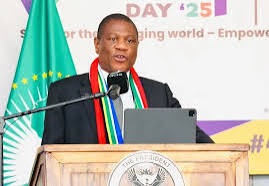
16 June 2025- The Deputy President, Paul Mashatile said today they honour and pay tribute to the valiant and fearless young people who stood at the forefront of the liberation struggle on 16 June 1976. Mashatile who delivered a keynote address at NWU REC Farm stadium in Potchefstroom said, regardless of their youthful stature, the youth of 1976 stood strong in the face of the oppressive system of the apartheid regime.

He further said they faced death with unwavering determination, fuelled by a vision of equal rights and a more just society. Mashatile added that, as former president, Dr Nelson Mandela recounted in his address on Youth Day on June 16, 1996, “When freedom beckoned, you faced death and bullets and did not flinch. You responded to the call to build the underground and the mass democratic movement.

“You swelled the ranks of the people’s army and acquitted yourselves with distinction on the battlefield.”

“It has been 49 years since that significant day, yet we will always remember the student leaders like Tsietsi Mashinini and Hastings Ndlovu who orchestrated the mass demonstration that transformed our nation.

“We must never forget those who joined the long list of martyrs and paid the ultimate price for our freedom. These are the young brave souls who fought for a dream that they never saw come to life, a dream that continues to inspire and guide us,” he said.

Mashatile said by taking action in 1976 against an enforced Afrikaans language as the exclusive medium of instruction in African schools, those young learners were carrying out the path of struggle defined by their forefathers through the Freedom Charter. 

He said ten days from now, they will commemorate the 70th anniversary of the Freedom Charter.

“The adoption of the Freedom Charter on June 26, 1955, and the Soweto Uprising on June 16, 1976, are significant milestones in South Africa’s journey towards freedom. Both occurring under unique circumstances but inspired by the shared vision of a free and equal South Africa for all.

“The Freedom Charter continues to be a pillar of South Africa’s Constitution, influencing the political and social climate of the country. It demands that, “The Doors of Learning and Culture Shall Be Opened,” said Mashatile.

He said this clause signifying the Charter’s commitment to equality and access to education for all South Africans. Mashatile said in this regard, this year’s theme, “Skills for a Changing World—Embracing Youth for Meaningful Economic Participation,” is more relevant to the noble cause for which the generation of 1976 and those who came before them were prepared to lay down their lives.

“It embodies the essence of what we aim to achieve together – a future where our youth are not just empowered, but actively engaged in shaping a better tomorrow.

“The reality is that many young people in South Africa are not living the future they hoped for.

They are confronted by high levels of unemployment, inequality and a lack of access to opportunities, especially in the digital world,” he said.

Mashatile said, as a government, they acknowledge that, for these young people, their reality remains untenable, undesirable, and unsustainable. He said according to Stats SA, young people between the ages of 15 and 34 make up just over half of South Africa’s working-age population, about 20.9 million people.

“However, far too many of them can’t find work, especially those between the ages of 15 and 24. Currently, South Africa’s unemployment rate has gone up to 32.9%, and if we include people who have given up looking for work, the rate jumps to 43.1%.

“The latest data from the Quarterly Labour Force Survey shows that more than half of young people aged between 18 and 34 are unemployed. This is one of the highest levels we have ever seen, and it is of grave concern,” said Mashatile.

taungdailynews@gmail.com

‘TB continues to be a serial killer’ 


By BAKANG MOKOTO 

26 March 2025- The Deputy President, Paul Mashatile said they joined the global community to commemorate World TB Day. Mashatile said they unite as a nation with a shared purpose, which is to end tuberculosis (TB).

He further said South Africa bears one of the highest TB burdens in the world, but they also stand on the threshold of real change. Mashatile added that they can end TB and together, they will. 

“Two years ago, SANAC embarked on a process to develop Human Rights Charters for key populations in all provinces. These include Human Rights issues identified in communities. That process has now been completed, although some provinces are yet to launch their Charters. 

“The Charters emphasise the need to protect TB and HIV-related human rights, particularly the need to address stigma against people with TB. The Human Rights hubs in the provinces, supported by AIDS Councils, will ensure that these issues are followed up and addressed,” he said.

Mashatile said there is a need to develop national-level plans for scaling up and institutionalising HIV, TB, and human rights training for health workers and law enforcers. He said the next financial year will be key in developing those plans.

“TB programmes remain under-served compared to HIV and human rights programmes. There is an urgent need to implement national-level TB stigma and discrimination reduction programmes and to engage community-level networks and organisations in district-level efforts. 

“This will also be prioritised in the next financial year.

The Stigma Index Report by People Living with HIV is being finalised, and the recommendations from the survey will guide the country’s response to TB and HIV stigma,” said Mashatile.

He said that he is also aware that SANAC is in the process of developing the next human rights strategy for HIV and TB, which will strengthen and guide the country’s human rights interventions in alignment with Goal One of the National Strategic Plan for HIV, TB, and STIs, which speaks to breaking down barriers. Mashatile said TB continues to claim too many lives around the world. 

“In South Africa in 2023, around 270 000 people were diagnosed with TB, and tragically, 56 000 lives were lost, which translates to 153 people every day. TB knows no boundaries—it affects people across all communities, but the burden falls most heavily on the poor and vulnerable.

“These are our mothers, fathers, brothers, and sisters—people who deserve care and dignity. We must reach them! TB is not just a medical issue. It is a human rights issue,” he said. 

taungdailynews@gmail.com