Five provinces in Zuma’s corner


IOL pic nov29 jacob zuma microphone

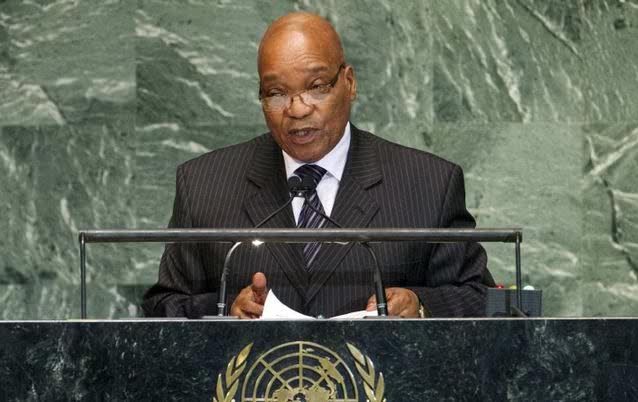
Johannesburg – South African President Jacob Zuma looks set for re-election as head of the ruling African National Congress in December, but the battle for the post of his deputy could thrust millionaire businessman and former unionist Cyril Ramaphosa back into political prominence.

Despite sluggish growth in Africa’s biggest economy, bloody labour strife that dented South Africa’s image this year and a slew of scandals during Zuma’s three years in power, five of the country’s nine provinces are backing the president to stay on as leader of the ANC.

This line-up suggests Zuma has seen off a campaign to replace him with Deputy President Kgalema Motlanthe, whose own silence on whether he is in the running has opened up the chance of a political comeback by business tycoon Ramaphosa.

Leadership of Nelson Mandela’s 100-year-old liberation movement would virtually guarantee Zuma another five years as state president in a 2014 election, given the support the ANC can still count on from South Africa’s black majority.

Nominations for top ANC leadership positions for the December 16-20 party conference close on Friday.

Zuma, who ousted former President Thabo Mbeki in a fight to head the party in 2007, has obtained wide endorsement from ANC branches across five provinces, including his home KwaZulu-Natal, which will have the largest number of voting delegates at the conference in the central city of Mangaung.

The expectation that Zuma will carry the ANC leadership race has taken some steam out of the contest and provides an element of political continuity, even though many have been critical of his lacklustre performance in office.

Zuma’s reputation as president was tarnished by criticism that his government mishandled a wave of violent mining strikes in recent months that saw at least 50 people killed, 34 of them striking miners shot by police in a single day in August. It was the deadliest labour violence since apartheid ended in 1994.

Critics on the left within his own party accused the 70-year-old president, who is proud of his Zulu origins and likes to present himself as a genial “man of the people”, of abandoning poor and working class South Africans.

Business leaders said Zuma’s government did not move quickly enough to halt the labour troubles that led to downgrades from two credit ratings agencies for South Africa, whose deep social and economic inequalities are seen as an Achilles Heel.

“His leadership has led to a myriad of conundrums around policies, and investors expect more inaction from him,” Peter Attard-Montalto, emerging market economist at Nomura International, told Reuters.

Since Zuma took office in 2009, protests about basic services have become an almost daily occurrence in urban areas across South Africa as the ANC struggles to fix a broken education system and address chronic unemployment and poverty.

This has generated opposition to Zuma from elements within the party who demand radical economic and social reforms to achieve a fairer sharing out of the national wealth.

Two provinces have come out in favour of Motlanthe to be party leader.

But sources in the camp of the bearded and bespectacled deputy president, who is 63, said he was reluctant to challenge his boss in next month’s internal ANC election.

Motlanthe’s silence on whether he will stand has also forced Zuma’s supporters to look elsewhere for a deputy president.

“Zuma’s emissaries initially approached Motlanthe to stay on as deputy president on condition that he will get their support for president in the next ANC election (in 2017),” said one Zuma campaigner. “But his silence, and subsequent support from some provinces to go it alone, has made us decide to look elsewhere.”

This has opened the door for Ramaphosa, a respected and influential member of the ANC’s National Executive Committee, who has been backed as candidate to be Zuma’s deputy in the party by at least four of the provinces.

Reuters spoke to official sources and lobbyists in all nine provinces and although Ramaphosa, 60, appeared to have strong grassroots support from local branches, it was not clear if he would in the end accept the nomination.

“Cyril is the best man for the job, he brings integrity but we can only hope that he accepts the nomination. He expects guarantees that this will line him up to become the automatic choice for president next time around,” said one ANC official from KwaZulu-Natal.

Ramaphosa is hailed along with Mandela as a hero of the anti-apartheid struggle. As a founder leader of the National Union of Mineworkers, he led a three-week strike against South Africa’s white mining bosses in 1987 that gained him international renown.

But he left politics for business in 1997 three years after the end of apartheid, and is now South Africa’s second richest black entrepreneur.

But his shareholding in Lonmin, the company at the centre of the August 16 Marikana mine killings in which 34 strikers were shot by police, has laid him open to accusations that he has betrayed his original working class allegiances.

An ANC member from the Free State province, who asked not to be named, said: “We really don’t know if he will leave his high life in business to come back to a position in the ANC.”

Ramaphosa’s extensive business empire includes ownership of the McDonald’s South Africa franchise, he is the chairman of telecoms giant MTN, and also sits on the board of Standard Bank, Africa’s largest bank by assets, and of brewer SABMiller.

In the ANC’s closed political culture, open ambition is frowned upon, so Ramaphosa, Mothlanthe, or any other candidates are unlikely to go public with their intentions before the nomination process closes on Friday.


Image


Pampierstad will never ever be the same again


Image

Five provinces in Zuma’s corner


Image


Sexwale rejects “unlawful solutions” in Lenasia


Image

Whatever solution is found to the Lenasia housing problem, it must be “within the law”, Human Settlements Minister Tokyo Sexwale said on Wednesday.


He warned the Special Lenasia Intervention team – comprising representatives from communities, the government, the police, and other organisations – that illegal solutions would not be accepted.


“No agreement emanating from this room must be unlawful, even though the temptation might be there. I cannot implement unlawful solutions,” he said at the team’s first meeting in Pretoria on Wednesday.


“We are a constitutional state and we have no choice but to operate within the law.”


Almost three weeks ago, the Gauteng housing department demolished about 50 houses in the area. The department said it was acting within the law because the houses were illegally built on government land.


Further demolitions were halted following a ruling by the High Court in Johannesburg.


The SA Human Rights Commission (SAHRC) took the department to court, calling for demolitions to be stopped so it could investigate whether any human rights were infringed.


Sexwale on Wednesday said the state should protect citizens who found themselves with “illegal neighbours” unlawfully connecting electricity and water, which affected the values of their homes.


“I stress that because in this whole debate legal residents are forgotten and government stands for and with them.”


He said the state was also behind people who had been duped into buying the land.


The team is tasked with helping those who had acquired land illegally but had not started building, those whose houses had been demolished, and those who had finished building but had not moved in.


The minister called on people to work with the government in identifying and reporting criminals involved in the illegal sale of government land in Lenasia.


The SAHRC welcomed the establishment of the team.


“The SAHRC supports, and has always advocated for, an approach grounded in dialogue,” it said in a statement.


“A mediated approach recognises that our legal framework is built on the values enshrined in the Constitution, which are reflective of our history and struggle as a country. These must be made a reality for communities.” – Sapa

600 rhinos could be lost to poaching this year


Image

KwaZulu-Natal – With an average of 49 rhino poached a month, and with just over one month to go until the end of the year, South Africa could end up with the unenviable figure of 600 – or more – poached rhino in 2012.


The country has lost 588 rhino to poaching so far this year – 140 more than last year’s total of 448.


Since mid-November, 39 rhino have been poached.


KwaZulu-Natal has lost 59 rhino to poaching so far, compared with last year’s total of 34, and 38 in 2010.


In a statement released on Tuesday, the Department of Environmental Affairs said the Kruger National Park had been the hardest hit, with 362 rhino lost to poaching, while the North West, KZN and Limpopo collectively lost 186.


“If 588 rhino were poached so far, this means for 12 months, there is an average of 49 rhinos poached per month, so it is very likely that this number will exceed 600 by the end of the year,” said Ezemvelo KZN Wildlife spokesman, Musa Mntambo.


“We need to be more vigilant and try to better understand how poaching syndicates work in order to bring this number down next year,” he added.


World Wildlife Fund SA head of conservation, Deon Nel, said the country was reaching a worrying level of rhino poaching.Image

Manokwane residents given light of hope after meeting


Image

By Bonolo Kgarane

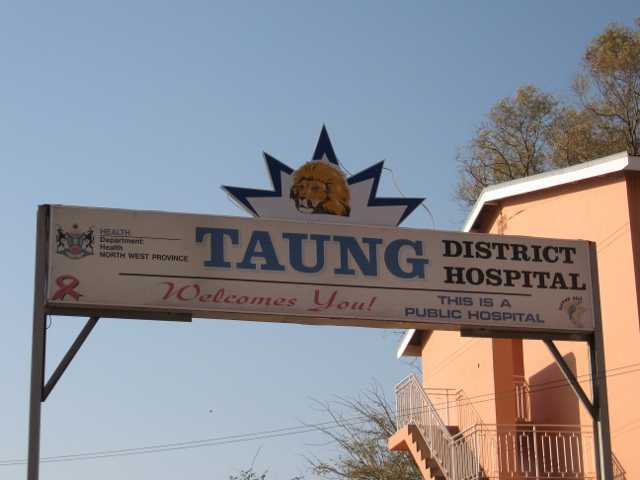
Taung-After a week of Orebone re Gobone campaign by the North West provincial legislature in the Greater Taung Municipality, the parliament portfolio committee on Local Government together with petitions committee visited the municipality again.

The committe were to wrap up their campaign with consultation to the municipality and the petitioners within the GTLM.

Among the meetings held today was a meeting between GTLM council and the portfolio committe on Local Government headed by Honourable Auchalie Mothupi.

Mothupi urged the municipality to increase their level of communication to interact with the residents.

“This is after the campaign held last week reported that most community members were unhappy during their meetings with different portfolio committee heads that took place in all 26 wards” he said.

“The members of community in the municipality complained about the poor service delivery especially on basic issues such as water and proper sanitation as well as poor roads conditions” he continues.

According to Hon Mothupi, the GTLM has the capacity to run the municipality that can empower people and that can deliver great services to its people.

“Only if the municipal heads could give a proper and conceive thought on their priority lists and targets” He said.

” I urge the municipality to ascertain that within 7days they should have written a conscience report to parliament to address issues affecting the people such as RDP housing back log, poor roads,water and sanitation” he asserted.

Meanwhile chairperson of the portfolio committee Zakes Moolotsi met with all petitioners from the municipality at a local library to address key issues in their memorandum.

The meeting was attended by residents of ward12 and amongst them,Manokwane residents were part of them.

The residents were recently making headlines complaining about poor service delivery.

The meeting brought new lease and a light of hope as parliament promised the communities that they shall report all their grievances to different departments in parliament and after such shall be voted for in parliament before it can be debate.

“I promise to come back to you to address your grievances. Within three months time we should have a way forward” Moolotsi said.

Follow us on Twitter@Taung_DailyNews

Zuma wishes a retiring judge well


Image

President Jacob Zuma has wished Supreme Court of Appeal Judge Thomas Cloete well with his retirement from next year.


Zuma has discharged Judge Cloete with effect from May 16, 2013.


Cloete served the country’s judiciary for many years and would reach the age of 65 years on May 15 next year.


He was a judge for more than 20 years and appointed to the Supreme Court of Appeal in 2003.


Presidency spokesman Mac Maharaj said Judge Cloete would be eligible for discharge from active service with effect from May 16, 2013.


Zuma thanked Cloete on behalf of government and the country’s people for his service.


Wishing Cloete a restful retirement, Zuma said he hoped the judge would not be entirely lost to South Africa if required to perform any national duties in the future.


-SapaImage

Sol Plaatje Commemorative Lecture and Book Launch in Mahikeng


Image

By obakeng maje

On December 7 2012 the Sol Plaatje Educational Trust and the North West Department of Sport, Arts and Culture will be hosting the Sol Plaatje Commemorative Lecture at the Mmabatho Convention Centre.

This year marks the 80th year since Solomon Tshekisho Plaatje died. He took his last breath on June 19, 1932 in Johannesburg.

He was buried three days later in Kimberley. 


“Plaatje was the founding secretary-general of the ANC (then called the South African Native National Congress), the Editor of Koranta ea Becoana, Tsala ea Becoana and Tsala ea Batho newspapers. He also wrote Native Life in South Africa, Mhudi and the Mafikeng Diary of Sol Plaatje. He also translated William Shakespeare’s works into Setswana” Vusi Kama said.

“He compiled and translated into English almost a thousand Setswana proverbs and idioms” He asserted.


Mahikeng has been chosen as the venue for the commemorative lecture based on the fact that Plaatje spent ten years of his life here.

He first arrived in Mahikeng in 1898 to work as an interpreter at the magistrate’s court. In 1902 he assumed editorship of Koranta ea Becoana, the only Setswana/English newspaper in the area. 


“The city of Mahikeng can be said to have launched Plaatje” Kama said.

“His first newspaper articles were published in the Mafikeng Mail in 1900. His first book, The Mafikeng Diary of Sol Plaatje, was written while he was here between 1899 and 1900, though it was only published three decades after his death. As the Editor of Koranta ea Becoana, Plaatje established himself as the spokesperson for his people” He continues.

Through his editorials he addressed matters that included racial equality and the sticky land question. 


It is therefore a fitting tribute that a lecture that marks eighty years since he died be held in Mahikeng. 


There are also two schools in Mahikeng, a primary school and a high school, that are named after him. The house in which he lived in Mahikeng, the Maratiwa House, is a heritage site. The plot on which he lived in Seweding village is also a heritage. His cattle kraal, borehole and the row of trees that he planted, are all still there at the plot in Seweding village. 

Follow us on Twitter@Taung_DailyNews

Banyana Banyana’s Portia Modise nominated for CAF Women Footballer of the Year


Image

BY Obakeng Maje

Banyana Banyana midfielder Portia Modise is among three of Africa’s women football stars nominated in the CAF African Footballer of the Year category, as a part of the Glo – CAF Awards.


The awards’ winners will be announced in Accra on Thursday, 20 December 2012.


Modise, who has scored 73 goals in her 102 appearances for the Sasol-sponsored Banyana Banyana, played a key role during the national team’s campaign to the final of the CAF African Women Championship 2012, held in Equatorial Guinea last month.


“I am delighted that my performances have been recognised in what has been one of Banyana Banyana’s busiest and most successful years in the national team’s history, and must thank Safa, Sasol, my team-mates and all persons who have supported and encouraged me,” said Modise.


The Palace Super Falcons (Sasol League Gauteng) player will contest the title along with 15-year-old Nigerian goal-scoring sensation Chinwendu Ihezuo, who scored 6 goals during the FIFA U-17 women’s World Cup this year, and Equatorial Guinea playmaker Genoveva Anoman, who scored 6 goals to help her country clinch the CAF African Women Championship title.


Africa Cup of Nations champions Zambia are in the running in the National Team of the Year category along with Cape Verde (highest placed ever CAF and FIFA rankings of 10 and 51 respectively achieved in 2012), Central African Republic (qualified for the 2013 Africa Cup of Nations eliminating record-holders Egypt in the qualifiers) and Cote d’ Ivoire (2012 Africa Cup of Nations finalists and the highest placed African team on the FIFA world rankings).


The Women’s National Team of the Year award will be decided between Equatorial Guinea (2012 CAF African Women Championship winners) and the Ghana U-17 side (bronze medalists at the FIFA U-17 Women’s World Cup bronze medalists knocking out tournament favourites Japan en route to the semi-finals).


The Coach of the Year finalists are Zambian mentor Herve Renard (who led Zambia to the 2012 Africa Cup of Nations title), Al-Ahly coach Hossam El Bady (who plotted his team’s path to a record 7th CAF Champions League title), Esperance boss Nabil Maaloul (who took his club to the CAF Champions League final) and AC Leopards, Tunisia coach Nasreddine Nabi (who led his charges to the first CAF Confederation Cup trophy).


The Most Promising Talent section of the awards, will be a battle between Egyptian U-23 star Mohamed Salah (who scored in three of his team’s four matches at the London Olympics), Senegalese striker Moussa Monate (who scored in all four of his country’s matches at the London Olympics) and Kenyan midfielder Victor Wanyama (who scored a sensational goal to help Celtic beat Spanish Giants Barcelona in the UEFA Champions League).


The club of the Year category is also expected to be closely contested with Egyptian giants Al Ahly, Esperance (Turkey), AC Leopards (Congo) and Mali’s Djoliba (CAF Confederation Cup finalists) nominated.