The ANC must solve its Zuma problem


Zuma.jpg

Vukani Mde looks at the SONA farce and says it speaks not to the state of our democracy but to the state of the ANC.


The ANC has a severe problem. And unfortunately for the rest of us, when the ANC has a problem, particularly a severe one, we as a country have a problem.

The ANC’s problem is how it can govern effectively.

A strange thing to say about a ruling party that is still the biggest, most popular and most trusted by the electorate. Not to mention one that has in fact been governing for over 20 years. But governing does not happen in a social or political vacuum.

The slightest change in the socio-political context can often result in a catastrophic change in a ruling party’s ability to lead. Sometimes the changes may be imperceptible, but ultimately lead to insurmountable challenges.

The manifestation of the ANC’s problem is the rather sorry figure of President Jacob Zuma, the first head of state or government to be disrupted while trying to deliver a State of the Nation address in Parliament.

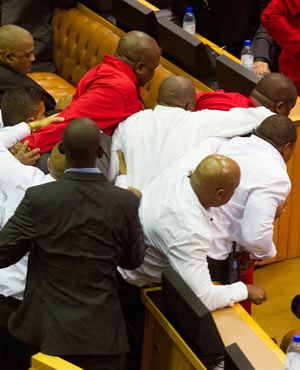
On Thursday night, Zuma’s speech was delayed for more than an hour as Parliament’s presiding officers dealt with a revolt against Zuma led by the Economic Freedom Fighters (EFF) first, but which was later joined by the DA and the UDM.

ADVERTISEMENT

The scenes in Parliament were farcical, beginning with the institution’s transparent attempts to muzzle both the media and MPs by jamming the mobile signal in the chamber.

So even before Zuma had the chance to be disrupted, he had to sit patiently and watch MPs yet again challenge Speaker Baleka Mbete’s heavy-handed exercise of her authority.

Within minutes of the session starting, the hashtag #bringbackthesignal was trending on social media.

Things degenerated as soon as Zuma started speaking, with first Mbete and then Thandi Modise (Speaker of the National Council of Provinces) unable to impose themselves on proceedings and restore order.

The ejection of the EFF and the walkout staged by the DA and UDM was one of those moments when the ANC’s challenge just crystallised for all to see.

The immediate challenge on Thursday night was this: after watching those scenes, who exactly is likely to remember what the State of the Nation address was about, and what Zuma had to say about the multiple challenges that beset his government and his country?

It was like watching a season of Idols distilled into one single episode: once the no-hopers and jokers who come mainly for the Wooden Mic segments of the show are gone, the rest of the season is a monotonous blur of competent musicians, few of whom will be remembered if they don’t win the competition. It was the same with Zuma. Once the fireworks were over, his speech – the very point of the State of the Nation, the actual governing – was rendered almost irrelevant.

In his reaction outside Parliament after walking out, UDM leader Bantu Holomisa said the reaction of the presiding officers, especially summoning armed police to remove elected representatives, was suggestive of a “police state” and bodes ill for the state of our democracy.

The first part of his reaction rings true, the second is a misdiagnosis. Mbete’s and Modise’s actions speak not to the state of our democracy; they speak to the state of the ANC.

What happens now when Parliament resumes? How does Mbete, who in the end had to cede her presiding responsibilities to Modise as she once again completely lost her cool, re-establish authority and legitimacy? Is the ANC prepared for the possibility of future SONA events in which the president of the republic addresses only the ANC and a handful of opposition politicians, with all the bigger opposition parties vacating the chamber every time Zuma enters it?

Because this now really is on the cards, so eroded is his legitimacy in the eyes of the opposition and a growing number of citizens.

And before the ANC points to its still large electoral majorities to argue that it, and by extension Zuma, still has the mandate to govern, consider that in a democracy citizen’s consent is both active and dynamic, ebbing and flowing in-between electoral cycles.

Winning 62 percent of the vote in 2014 is not a free pass to railroad both people and institutions in 2015.

The ANC so far doesn’t seem capable of a political response to the challenge to Zuma’s and Mbete’s authority, preferring rather a purely security response. This will, over time, chip away at the party’s already fraying hegemony, and undermine citizen’s active consent to be governed by the ANC.

It does not help the ruling party that it appears increasingly to govern through re-warmed and repackaged promises. Zuma presented a new nine-point plan to “ignite growth and create jobs”, in his words. But look at the nine promises, and remind yourself how much of this you’ve heard before.

* Resolving the energy crisis.

*Revitalising agriculture and agro-processing.

* Advancing beneficiation or adding value to mineral exports.

*More effective implementation of a higher impact Industrial Policy Action plan.

*Encouraging private sector investment.

*Unlocking the potential of SMMES, co-operatives and micro enterprises.

*State reform and boosting the role of state-owned companies.

*Operation Phakisa, which is aimed at growing the ocean economy.

Other than the first (resolving the energy crisis) and last (Operation Phakisa) items on that list, everything would have been said in the SONA 10 years ago.

If the ANC is to win back its right to govern effectively, and more importantly to lead, it will have to find a way to solve its massive Zuma problem. And Zuma himself must remove the Nkandla albatross around his neck if he hopes to continue as president of the republic.

And in order to solve the Nkandla problem, the obfuscation and the blame shifting will need to stop.

It is frankly irrelevant whether Zuma ordered the so-called “security upgrades” to his private homestead in rural KwaZulu-Natal, or knew anything of what the government euphemistically calls the “cost overruns” in that project, but which most of us call embezzlement through inflation of costs.

His innocence or the extent of his guilt in this regard no longer matters.

What matters is that Nkandla prevents Zuma from speaking to Parliament without occasion descending into drama and farce, and that’s unacceptable.

* Vukani Mde is Group Editor of Opinion & Analysis at Independent Media.

Political Bureau

This is just the beginning: EFF


malema.jpg

The chaos that erupted in the National Assembly as President Jacob Zuma was delivering his State of the Nation Address (SONA) is just the start of things. This is according to Economic Freedom Fighters spokesperson, Mbuyiseni Ndlozi.

Chaos broke out after the EFF disrupted President Jacob Zuma “on a point of order”, demanding that he gives answers as to when he would repay the money for security upgrades to his Nkandla homestead.

For more http://www.sabc.co.za

Mantashe calls EFF MPs hooligans


df1386285bcd4516bae90a9d8ca48975

Cape Town – President Jacob Zuma abided “very well and precisely” to policy set out by the ANC and government, ANC secretary general Gwede Mantashe said after the opening of parliament.

“The work that took place, if you follow our 8 January statement, to the lekgotla, all that is covered very well and precisely in the State of the Nation address,” he said.

For more http://www.news24.com

We are part of a police state – Malema


3490e820c87e4c8785f5fa28e7f41add

Johannesburg – Protest and violence overshadowed President Jacob Zuma‘s State of the Nation address on Thursday night as the Economic Freedom Fighters carried out a threat to confront him on misspending on his Nkandla home and were manhandled by police in the National Assembly.

As riot police dragged EFF MPs out of the chamber and down the corridor, the Democratic Alliance walked out and accused the ANC of becoming as oppressive as the apartheid regime.

For more http://www.news24.com

SONA security: More questions than answers


3490e820c87e4c8785f5fa28e7f41add

Cape Town – Questions remain over the security personnel sent in to forcibly remove EFF MPs from the National Assembly.

Clad in white shirts and black pants, the men – whom EFF MPs alleged were armed – moved in through both entrances of the National Assembly just as Speaker Baleka Mbete ordered that EFF leader Julius Malema and his fellow MPs vacate the House.

For more http://www.news24.com

EFF conduct ‘cannot and must not be tolerated’


91384947a35b4c5a8af2e0bee8a3dfdc

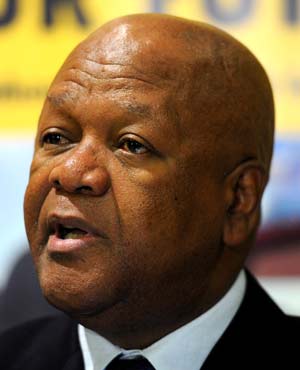
Cape Town – Parliament should take stern action against members of the Economic Freedom Fighters who disrupted President Jacob Zuma’s state-of-the-nation address, Minister in the Presidency Jeff Radebe said on Thursday night.

“Such behaviour and conduct cannot and must not be tolerated and we urge Parliament to apply the rules and take stern action against those members,” Radebe said at a media briefing held shortly after Zuma ended his speech.

“The government of the Republic of South Africa is deeply disappointed and disgusted at the despicable conduct of some elected public representatives who are hell-bent on holding our democratic institutions, the electorate and our country at ransom.”

The National Assembly descended into chaos and violence when EFF MPs refused to leave the chamber when National Assembly Speaker Baleka Mbete order them to.

Mbete ordered the legislature’s protection officers to enter the chamber, adding “the security forces must come in in terms of the powers and privileges act”.

The security officers clashed with the EFF MPs who tried to stand their ground.

EFF leader Julius Malema was one of the last to be dragged out of the House after fist fights broke out between party members and the security officers.

Radebe said the actions of Malema and his MPs were aimed at rendering Parliament ungovernable.

“The events that unfolded before our eyes…were aimed at bringing our hard-earned democracy into serious disrepute,” he said.

“People of this great land died for this great democracy. Their actions… dishonour the lives of those who paid the ultimate sacrifice.”

– SAPA

Hijacker shot dead, 2 others arrested in Durban


88748106.jpg

Durban – A suspected armed robber has been shot dead and two others arrested following a robbery in Durban North, KwaZulu-Natal police said on Thursday.

A man was hijacked at gunpoint outside his home in Durban North on Wednesday, Colonel Jay Naicker said.

A local security firm was alerted to the hijacking and spotted the alleged hijackers in Glen Anil, Durban.

Shoot-out

“The suspects allegedly opened fired on the security officials and there was an exchange of gunfire resulting in one suspect being killed.”

The other two men fled the scene and were later arrested by the police K9 unit. The police took possession of two firearms and the vehicle used in the robbery.

“Initial investigations indicate that suspect’s vehicle was hijacked in Phoenix,” said Naicker.

The two would appear soon in the Verulam Magistrate’s Court on charges of robbery with aggravating circumstances, and possession of unlicensed firearms and ammunition. They were also expected to be linked to the Phoenix hijacking.

“The confiscated firearms will be sent to ballistics to ascertain whether they had been used in the commission of any other crime in the country,” Naicker said.

‘We are at war with criminals’

KwaZulu-Natal police commissioner Lieutenant General Mmamonnye Ngobeni commended the K9 unit officers and security guards on the arrests and confiscation of firearms.

“We are at war with criminals in KwaZulu-Natal and they must expect police to meet fire with fire,” she said.

“Police will never back down when confronted by heavily armed criminals and we will do whatever it takes to remove these thugs from our streets.”

– SAPA

TUT increases security at all campuses


fa4121061ec4492bb40c27b53f4f3e48

Pretoria – The Tshwane University of Technology (TUT) has increased security at all its campuses following protests, it said on Thursday.

“Activities at all our campuses are continuing,” spokesperson Willa de Ruyter said.

This was after protest action which resulted in the suspension of business at the Soshanguve north and south campuses last week spilled over to other campuses.

De Ruyter said additional security had been put in place to ensure the safety of students and staff.

It was important for students to attend classes to begin the academic year on a good footing, she said.

Student funding

University management met student leaders on Wednesday evening in an attempt to resolve points of contention, primarily student funding.

“Although progressive proposals from the university’s side were tabled, these were rejected by the student leaders,” said De Ruyter.

The SA Students’ Congress criticised university management last week for failing to help needy students.

“It is outrageously irresponsible for university management to provide students with no alternative than sending them home,” Gauteng deputy chairperson Sthembiso Ndlovu said in a statement at the time.

“Students are cancelling their academic courses due to outstanding fees and NSFAS [National Student Financial Aid Scheme] budget cuts.”

De Ruyter said on Thursday that although the student leaders had rejected TUT’s proposals, management remained committed to continue engaging to resolve the problems.

In September, the university was forced to close some of its campuses when protests about student funding became violent. The protests lasted almost three weeks and 18 cars were torched.

– SAPA

Hewitt fails in bid to have case struck from roll


court1.jpg

Johannesburg – Efforts by former tennis champion Bob Hewitt to have his case struck from the roll failed in the South Gauteng High Court, sitting in Palm Ridge, on Thursday.

Hewitt’s lawyer Terry Price had submitted that, among other things, the evidence of the three women who accused Hewitt of sexual assault and rape could not be accepted.

“I’ve considered the relevant issues and listened to the arguments,” said Judge Bert Bam.

“None of it comes as a surprise. As far as the application is concerned, it is without merit and is refused,” he ruled, without giving reasons.

Wearing a blue knee-length dress, Hewitt’s wife Delaille stood and left the courtroom once the ruling had been delivered.

She has remained by her husband’s side as one by one his accusers took the stand.

Tears

At the back of the courtroom, one of Hewitt’s alleged victims Suellen Sheehan broke down and cried.

She testified that Hewitt raped her in 1982 in his car before tennis practice when she was 12 years old.

Another of Hewitt’s accusers Theresa Tolken told the court Hewitt touched her inappropriately and forced her to perform oral sex on him 34 years ago when she was 12.

A third alleged victim, who may not be named, testified that Hewitt rubbed himself against her back in an inappropriate way during private tennis lessons.

The Australian-born Hewitt has pleaded not guilty to two charges of rape and one of indecent assault.

He took the stand on Thursday to give his evidence-in-chief.

– SAPA

Parliament vs EFF: What the rules say


malema.jpg

Cape Town – Economic Freedom Fighters parliamentarians are determined to disrupt President Jacob Zuma‘s State of the Nation address on Thursday, but may they?

Here’s what the official rules of a joint sitting of the National Assembly and the National Council of Provinces say, and how things might play out between the EFF and the Speaker of Parliament, Baleka Mbete.

For more http://www.news24.com