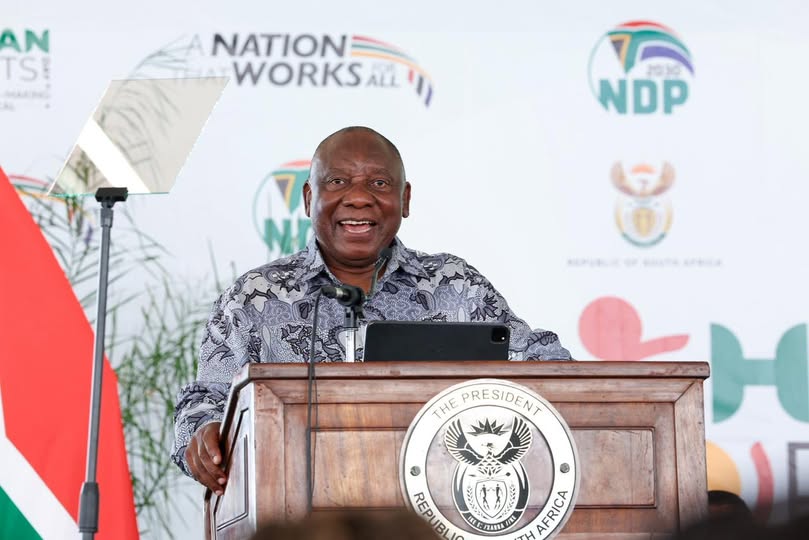
Picture: RSA president, Cyril Ramaphosa
By OBAKENG MAJE
23 March 2026 – The Republic of South Africa (RSA) president, Cyril Ramaphosa said the Human Rights Day takes place in the year that marks 30 years since their democratic Constitution was signed into law. Ramaphosa said it is significant that President Nelson Mandela chose to sign the Constitution into law in Sharpeville, the site of one of the apartheid regime’s worst acts of brutality.
He further said on the anniversary of the Sharpeville Massacre of 21 March 1960, they honour the memories of all those who were killed in the struggle for human rights. Ramaphosa added that it is fitting that the place that had known so much suffering and tears should be the site from which a new South Africa would rise.
“Signing the Constitution into law was the most significant act of our democratic era. It was a clear moral commitment to build a society rooted in equality, freedom and human dignity. Our Constitution is more than the supreme law of the land.
“It set the coordinates for a journey towards a just, inclusive and united future for all South Africans. This is a journey that we remain on to this day. The Constitution is our greatest source of national pride not only because of what it contains, but because of how it was written,” he said.
Ramphosa said the constitution-making process was the most extensive public participation exercise to ever take place in the country. He said the Constitutional Assembly was determined that theirs should be a homegrown Constitution with broad legitimacy and acceptable to all South Africans.
“For nearly a year and a half, we travelled through cities and villages, suburbs and townships, factories and farms to gather people’s contributions to the Constitution. We engaged with men and women, and with black, white, Indian and coloured South Africans alike.
“We met with young people with little experience of apartheid and with older people who still carried its painful wounds. We listened to the hopes, dreams and fears of middle class and working-class South Africans, with the employed and the unemployed,” said Ramaphosa.
He said they held community meetings, met with people at their places of work and study, and shared their views, concerns and proposals on the airwaves. Ramaphosa said everyone who took part in these discussions had a deep understanding of why human rights mattered.
“In many cases, their views were born of their own personal experiences of injustice. Today, we have a People’s Constitution, which every South African citizen of the time had a hand in writing.
“These places a particular responsibility on us as a country to uphold the fundamental rights of all people. We have a special responsibility to protect and advance the human dignity of all,” he said.
Ramaphosa said the Constitution obliges them to restore what was lost or taken. He said since the adoption of the Constitution, they have worked together to restore the dignity of all those who were denied this fundamental right.
“We have done this in many ways. More than 9 million learners in schools across this country are being fed through the National School Nutrition Programme. More than 29 million indigent, unemployed and vulnerable South Africans are receiving old age, disability and child support grants and other forms of social assistance.
“More than 80% of the population now have access to clean water and adequate sanitation, and more than 2 million poor households across this country receive free basic services,” said Ramaphosa.
 The Guardian