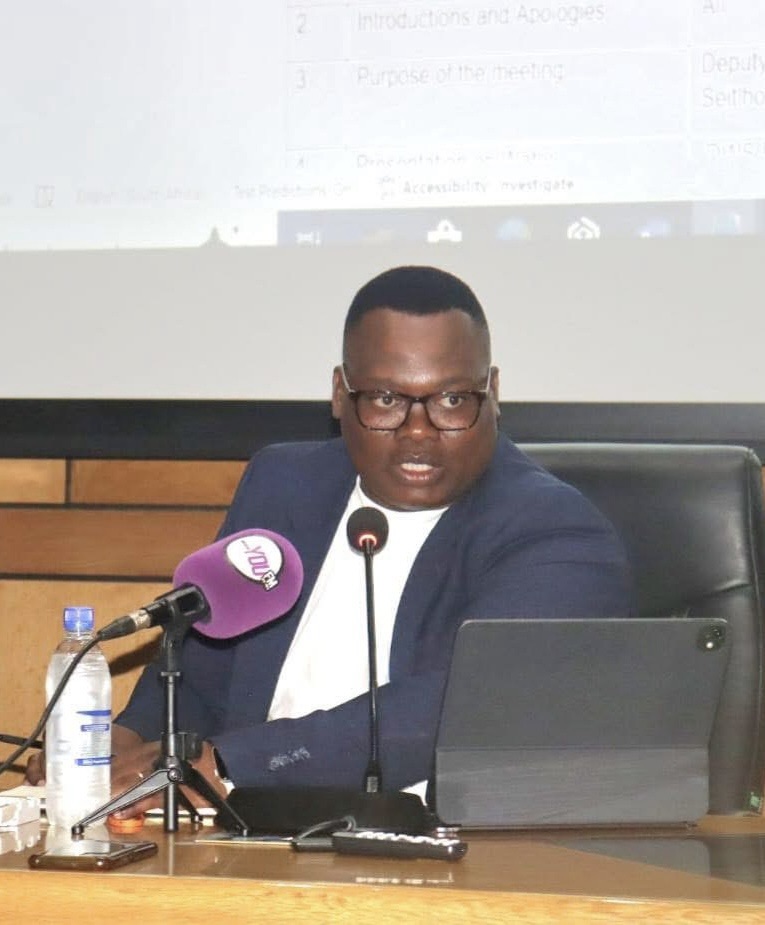
By AGISANANG SCUFF
10 March 2026- The Deputy Minister of Water and Sanitation, Sello Seitlholo has called on Rustenburg and Moses Kotane Local Municipalities under Bojanala District Municipality and the Magalies Water, to work together to solve infrastructure failures and service delivery constraints that affect consistent water supply to communities.
In a stakeholder meeting held at Rustenburg Civic Centre Council Chamber on 9 March 2026, Seitlholo highlighted the significance of the gathering in that it was taking place during the month of March, in which the country is observing the National Water Month, and therefore a critical time of reflection.
“We commemorate National Water Month because many people in our country still do not have reliable access to water, and our responsibility is to close that gap and ensure that every South African has access to safe and reliable water services.
“The meeting was used as a platform to engage directly with stakeholders responsible for water services in the area and to assess the status of interventions that are already underway,” he said.
Seitlholo further said among the issues discussed were bulk water supply disruptions and wastewater management that contributes to water pollution in Rustenburg and Moses Kotane Local Municipalities. He called for a strong coordination among stakeholders, accountability and practical and time-bound solutions to restore operational stability across affected systems.
“We also expressed a serious concern about the contamination of the Vaalkop Dam, noting the widespread proliferation of alien invasive Salvinia plants that have covered almost the entire surface of the dam.
“The presence of Salvinia plants significantly affects the ecological balance of water resources by blocking sunlight, reducing oxygen levels, and damaging aquatic ecosystems, while also complicating water abstraction processes,” said Seitlholo.
He added that dysfunctional wastewater treatment works in both Rustenburg and Moses Kotane have contributed to the deterioration of water quality in the area. Seitlholo indicated that the department has taken regulatory action by issuing notices and directives in terms of the National Water Act to address the discharge of untreated sewage into water resources.
“The Department of Water and Sanitation (DWS) has a clear mandate in matters relating to wastewater management, sanitation, and pollution control, but must also intervene when broader water service challenges threaten the sustainability of water resources.
“Our responsibility is to ensure that our water resources are protected and managed properly. When wastewater treatment systems fail and untreated sewage enters our water bodies, it undermines the very resources that communities depend on,” he said.
Seitlholo said as far as operational systems are concerned, he noted that the Kortbegrip Reservoir System is currently operating with only one functional pump instead of three, significantly limiting the system’s capacity to supply water. He also raised concerns over the persistent electricity supply challenges at Phatsima Pump Station, which have been ongoing since 2023, and has been a major operational constraint to water distribution.
“We further pointed out that the decommissioning of the Bospoort Reservoir has placed significant pressure on the remaining 35-megalitre reservoir, which is unable to meet the growing demand for water.
“In addition, Bospoort Plant 3 is currently operating with only three of the required five pumps, resulting in frequent operational failures and reduced supply capacity. Frequent pipe bursts along the Monakato pump line were also highlighted as a major challenge, as these incidents often result in water supply disruptions lasting between two and three days,” said Seitlholo.
He said they also raised concern about the Tlhabane Reservoir under the Pilanesberg Phase 2 Project, which remains non-operational because the Mafenya Pump Station has not yet been energised despite the project having already been publicly unveiled.
 The Guardian