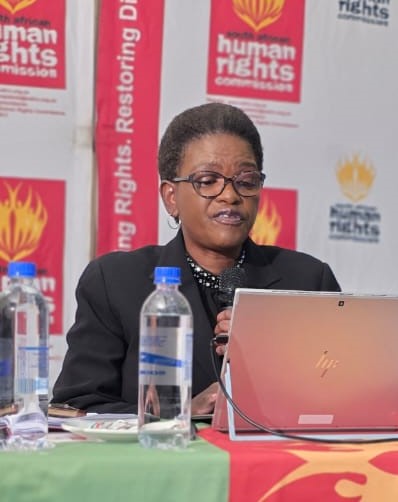
Picture: SAHRC Commissioner, Nomahlubi Khwinana/Supplied
By OBAKENG MAJE
19 January 2026- The South African Human Rights Commission (SAHRC) painted a grim picture regarding scholar transport in the North West. The Commission presented its findings after an investigative inquiry into systemic scholar transport challenges.
According to the SAHRC Commissioner, Nomahlubi Khwinana, the inquiry was prompted by widespread and persistent concerns relating to the safety, reliability, accessibility and adequacy of scholar transport in the province, which significantly impaired the realisation of learners’ rights. Khwinana said the inquiry was convened in March, April and May 2025, supplemented by site inspections, as well as pre- and post-inquiry correspondence with the North West Department of Education (NWDoE), the North West Department of Community Safety and Transport Management (COSATMA) and the North West Department of Treasury (NWPT).
“During the inquiry, extensive testimony from stakeholders, including unions, a representative from the legislator, a parent, civil society organisations, and operators was heard.
“The investigation identified pervasive failures in the scholar transport system, characterised by the use of unroadworthy and unsafe vehicles, including buses with mechanical defects, expired discs, fuel leaks, inadequate safety features, and in some cases described as “coffins “, she said.
Khwinana further said scholar transports are marred by chronic overcrowding and multiple-trip operations, which cause late arrivals, missed lessons, and learner exhaustion. She added that frequent breakdowns leave learners stranded or forced to walk long distances.
“There was a lack of supervision during transportation that exposed learners to bullying and safety risks, especially where young and older learners travel together. There was a lack of accommodation for learners with disabilities due to inaccessible vehicles.
“There was inadequate contract monitoring and enforcement, with evidence of misrepresentation, non-compliance and procurement irregularities. Payment backlogs in payments to operators, leading to service withdrawal, deferred maintenance, and unlawful vehicle substitutions,” said Khwinana.
She said thousands of eligible learners are being excluded from scholar transport provision due to funding limitations, thereby impeding regular and equitable access to schooling. Khwinana said these challenges collectively disrupted teaching and learning, increased absenteeism and placed learners at continuous risk of physical, psychological and emotional harm.
“The Commission has found that these systemic failures stem from a combination of institutional, operational, and financial weaknesses, including fragmented functional responsibility between the NWDoE and COSATMA, resulting in unclear accountability and reactive oversight.
“Budgetary constraints, late invoice processing, and prolonged operator non-payment which directly undermined safety compliance. Weak enforcement capacity, including insufficient inspections, inadequate consequence measures, and tolerance of non-compliant operators,” she said.
Khwinana said other challenges were inadequate planning mechanisms and delayed learner data submissions, compounded by increased travel distances caused by school rationalisation. She said governance failures identified by the Auditor-General South Africa (AGSA), including irregular expenditure, lack of performance evidence, and payments for services not delivered.
“There is insufficient capacity of School Governing Bodies (SGBs) and school-level monitors to detect, report, or prevent safety breaches. The Commission noted that, since the start of the investigation and the inquiry, the state has implemented some remedial measures, including the inspection of some vehicles, the establishment of WhatsApp reporting groups, operational “war rooms”, workshops for operators, route audits, engagement with stakeholders, planned implementation of electronic monitoring and payment systems, termination of some non-performing contracts and additional budget allocations in select financial years.
“Additional measures taken since the commencement of the inquiry include clearing certain payment backlogs and accommodating previously excluded learners. However, the investigation found these measures insufficient and inconsistently applied,” said Khwinana.
She said in particular, enforcement remains limited, supervision remains inadequate, safety gaps remain unresolved and the transport needs of thousands of learners remain unmet, including learners with disability. Khwinana said the failures documented throughout the inquiry constitute a violation of learners’ rights to a basic education, as the service is not consistently accessible, safe or reliable.
Meanwhile, the SAHRC has given stakeholders involved 60 working days to implement the recommendations.
 The Guardian