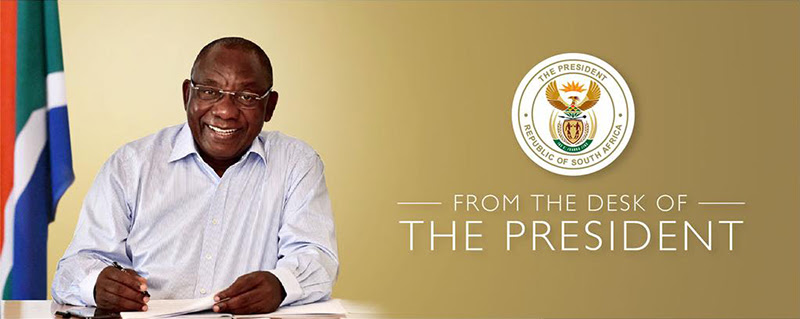
By OBAKENG MAJE
23 June 2025- The Republic of South Africa (RSA), Cyril Ramaphosa said across many parts of the world, human rights are under threat and constitutionalism is increasingly being tested. Ramaphosa said in March 2025, the UN Human Rights Council said the world is facing ‘a moment of profound instability’ – characterised by conflict, democratic backsliding, declining respect for the rule of law, right-wing populism, attacks on civil society and judicial independence being undermined.
He further said the council stressed the need for countries to strengthen democratic institutions charged with safeguarding fundamental rights and freedoms. Ramaphosa added that, as South Africans, they can be proud that they continue to strive to live up to this obligation.
“Even as we face numerous challenges, our democratic order is in good health, anchored in a progressive constitution and a Constitutional Court that continues to safeguard the rights of all.
“This year marks 30 years since the court convened for the first time, marking a new, bold chapter of our democratic journey. The imperative for the establishment of a specialised constitutional court was a key facet of the multiparty negotiations that preceded the democratic transition,” he said.
Ramaphosa said whilst some believed that existing structures such as the Supreme Court could perform this task, the African National Congress (ANC) advocated for a new court that was untainted by the past. He said just as drafters of the constitution itself drew heavily on the experiences of other countries – when considering the model of the court, they looked to other jurisdictions for inspiration.
“One of these was Germany’s Federal Constitutional Court that was established in 1951. Retired Constitutional Court Judge Richard Goldstone recalls how the 11 members of the new court met for the first time in the German city of Karlsruhe, the seat of the Federal Constitutional Court.
“Retired Judge Johann Kriegler recalls how they learned skilled adjudication of constitutional issues from their German colleagues. In this respect, this proud institution of our democracy is the product of constitutional solidarity,” said Ramphosa.
He said it draws on the wisdom and support of international partners, yet remains uniquely South African in its outlook, its orientation and values. Ramaphosa said the court’s first case in 1995, on the constitutionality of the death penalty – set the tone for a humanistic jurisprudence grounded in human dignity that endures to this day.
“In his judgment, one of South Africa’s finest legal minds, South Africa’s first black Chief Justice Ismail Mohamed, immortalised the vision of the new court.
“The South African Constitution is different,” Justice Mohamed writes. “It retains from the past only what is defensible and represents a decisive break from, and a ringing rejection of that part of the past which is disgracefully racist, authoritarian, insular and repressive, and a vigorous identification of and commitment to a democratic, universalistic, caring and inspirationally egalitarian ethos,” he said.
Ramaphosa said over the past 30 years, the Constitutional Court has advanced this aspirationally egalitarian ethos in far-reaching ways. He said landmark judgments are well-known on issues such as the death penalty, access to HIV/Aids treatment, prisoners’ right to vote, and others.
“Yet its less well-known judgments that have had equally dramatic impact on matters such as upholding the rights of pensioners to not having their old age grants disrupted, the rights of smallholder farmers to not have their livestock impounded under colonial-era ordinances, the rights of women in customary marriages, and upholding the rights of rail commuters to safety.
“The composition of the Constitutional Court bench, particularly with respect to judges with different backgrounds and different views on the law, has played an important role in shaping the court’s jurisprudence,” said Ramaphosa.
He said in 2007, former Chief Justice Pius Langa highlighted the centrality of judicial diversity, saying this was not confined solely to an appropriate racial or gender mix, but that a wide range of views and life experiences are represented. Ramaphosa said judicial diversity, Justice Langa said, is likely to increase judicial dissent, and hence improve the quality of decisions.
“Throughout its proud history the court has carried out its work without fear or favour, not hesitating to hold even the most powerful in society to account. An Ipsos poll released earlier this year found that most South Africans view democracy, human rights and the rule of law as universal values that all nations deserve and must aspire towards.
“The majority of respondents also believed that South Africa is a good example of a democracy, and has a responsibility to be a moral leader in the world. This confidence is a result of the abiding trust the public has in our Constitutional Court,” he said.
Ramaphosa said as they celebrate this milestone, they should honour the proud history of the court by continuing to work together as all of society to realise the full promise of their Constitution.
 The Guardian