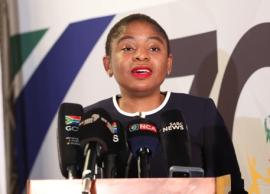
Picture: North West MEC for Finance, Kenetswe Mosenogi/Supplied
By BAKANG MOKOTO
25 May 2025- In line with Chapter 6, Section 131(1)(a) of the Constitution of the Republic of South Africa, the North West Premier, Lazarus Mokgosi, has appointed the North West MEC for Finance, Kenetswe Mosenogi as the acting Premier effective from 24 May 2025 to 8 June 2025. Mokgosi said as acting Premier, Mosenogi will execute all responsibilities entrusted to her in line with the provisions of the constitution.
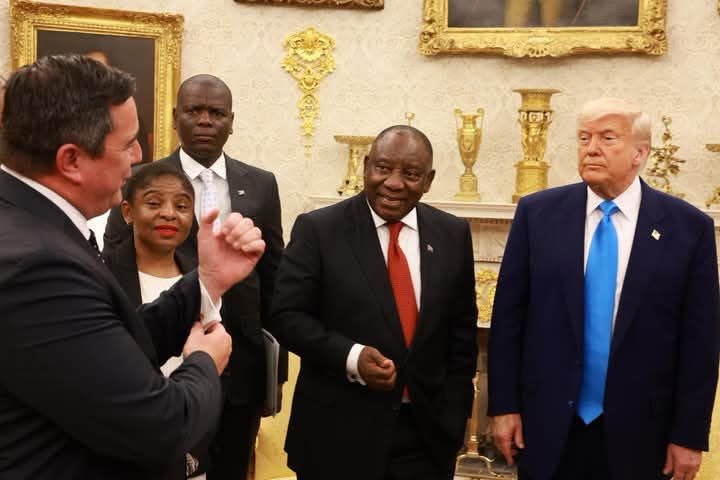
25 May 2025- Cyril Ramaphosa has officially betrayed the people of South Africa. He stood before Donald Trump, the president of the United States, and bowed. He chose the side of white monopoly capital. He spat on the graves of our liberation heroes.
He denounced our victory songs that carried us through the darkest days of apartheid. He turned his back on the struggle and chose to serve those who benefit from our oppression.
How can an African leader go and kneel before Trump with no evidence of genocide in this country? He did not defend our sovereignty.
He made us look like beggars in the eyes of the world. He made us look like we have no backbone, no pride, no history.
He betrayed the spirit of Biko, Sobukwe, Chris Hani and every freedom fighter who bled for this land. Let’s be clear.
The capitalist system does not solve problems. It creates them.
Then the same capitalists return in suits and say they have the solution. That’s how white monopoly capital operates.
That’s what Johann Rupert does. He creates a crisis then raises his hand and says, “I can fix it,” and fools call him a saviour.
He is not. He is the problem. He is the symbol of economic apartheid. He has captured the state and owns the president.
Africans do not need Donald Trump. We do not need Elon Musk. We do not need Rupert. We need economic justice. We need dignity. We need land. Elon Musk insulted South Africa before.
Now, he wants to skip our laws and operate Starlink without following BEE requirements. We say no. He must follow the law like everyone else. No exceptions. No favours. No billionaires above the constitution.
And now Trump dares to call for the arrest of the Commander in Chief, Julius Malema on 21 May 2025. This is how the USA starts its campaigns of assassination.
It begins with propaganda, then false charges, then bullets. We have seen it before. They killed Lumumba, Sankara, Gaddafi. And now they want to come for Malema.
We say Hands off Malema. We will protect our own. If Ramaphosa truly cared about bilateral relations, why didn’t he speak out about the police brutality in America?
Why didn’t he confront them about the murder of black people by their police? He remained silent because he was not there for the people. He was there for business, for billionaires.
For those who feast while our people starve. He went there not as a president of the people, but as a servant of imperialism. He has surrendered our dignity, our sovereignty, and our future.
Cyril Ramaphosa is not the people. He is not the constitution. He is not Parliament. He is not the revolution. We the people are the voice of this country.
Donald Trump or no Donald Trump
Elon Musk or no Elon Musk
Johann Rupert or no Johann Rupert
The land will be expropriated without compensation
(Note: The Guardian Newspaper does not agree nor disagree with content raised in this article. The content in this article remains of the author and it does not represent The Guardian Newspaper and its associates.)
25 May 2025- The uMkhonto weSizwe Party (MKP) in the North West said it is outraged by the News24 report confirming that 36% of staff in the North West Premier, Lazarus Kagiso Mokgosi’s office is not qualified for the positions they occupied. The party said this shocking figure is only the tip of the iceberg — because the truth is, Mokgosi himself is not qualified to lead this province.
According to MKP provincial convenor, Alfred Motsi, Mokgosi has never emerged through any proper political or organizational processes within the ANC — not at branch level, not at regional level. Motsi said Mokgosi is a political unknown, who was elevated to power purely because of his allegiance to a faction led by ANC provincial chairperson, Nono Maloyi.
“Mokgosi is nothing more than a puppet of Maloyi, installed to protect factional interests, not to serve the people of this province. This is a betrayal of democracy, governance and public trust.
“We demand a public explanation from Mokgosi on his own qualifications and political background. A full independent audit of all staff appointments in the Office of the Premier. Immediate removal of all unqualified personnel,” he said.
Motsi further said they also demand a clear commitment to merit-based, transparent appointments free from factional influence. He added that, the North West deserves competent, ethical and experienced leadership.
“What we have now is a state-captured provincial government run by factional interests and deployed puppets, who cannot deliver services, cannot govern and do not respect the people.
“MKP is rising to break this cycle of corruption, cadre deployment and incompetence. We are building a government of the people, by the people, and for the people,” said Motsi.
However, the North West Premier, Lazarus Mokgosi has refuted reports that only 36% of his staff is qualified. Mokgosi said all 44 senior managers qualify and met all the requirements for the positions they currently hold at the time of their appointments.
“Following engagements with the Public Service Commission (PSC), it was established that certain information in relation to the suitability of some managers was not captured correctly when a survey on senior management qualifications was conducted.
“The Office of the Premier can confirm that qualifications relating to all senior managers have been authenticated, and they all meet the minimum entry requirements into the Senior Management Service,” he said.
Mokgosi said an updated report in relation to this matter will be shared with the Public Service Commission (PSC). He said that he is committed to the professionalisation of the Public Service, as well as ethical leadership, which encapsulates accountability and transparency.
25 May 2025 – The Chairpersons of the Constitutional Review Committee have reminded the public of the looming deadline for written public submissions on the annual review of South Africa’s Constitution in accordance with section 45(1)(c) of the Constitution. Committee Chairpersons, Advocate Glynnis Breytenbach and Mtikeni Patrick Sibande said that, at the beginning of May, the committee made the call for public participation, which is a crucial element of the committee’s mandate.
Breytenbach said: “In addition to the written submissions, submitters should also indicate if they are interested in making oral presentations to the committee. Submissions should reach the committee by no later than 31 May 2025.
“Thus far, the committee has received over 200 submissions and urges to public to exercise their democratic right to participate in the work of Parliament.”
Sibande shared the same sentiments. He said enquiries and written submissions can be addressed to Adv P Gwebu, Committee Section, PO Box 15, Cape Town 8000, email pgwebu@parliament.gov.za, tel. 021 403 8257 or cell 083 709 8395.
Picture: Minister of Communications and Digital Technologies, Solly Malatsi
By REGINALD KANYANE
25 May 2025- The Congress of the People (COPE) said it unequivocally condemns the alleged disgraceful decision by Minister of Communications and Digital Technologies, Solly Malatsi, to tamper with the Broad-Based Black Economic Empowerment (BBBEE) legislation, a complete betrayal of South Africa’s transformation agenda. COPE said this is not policy reform, but a legislative betrayal.
COPE’s acting national treasurer, Teboho Loate said what Malatsi is doing is that he is opening the backdoor for billionaire Elon Musk and his Starlink enterprise to enter South Africa without adhering to the legislation imperative of 30% black ownership. Loate said to be clear, this is not empowerment.
“It is cowardice. Once again, President Cyril Ramaphosa’s government has bowed before the altar of white capital, foreign interests and right-wing propaganda.
“The same embarrassing delegation that paraded itself at the White House, a group of golfers and disconnected elites has returned not with dignity, but with a legislative sell-out disguised as the so-called Equity Equivalent Investment Programme (EEIP), spitting in the face of South Africa’s long and painful transformation journey,” he said.
Loate further said Malatsi wants to tell South Africans that this amendment will attract multinational investment. He added that, but what he truly means is, “Let us bend our rules so foreign billionaires can bypass our people and our policies.”
“The BBBEE legislation is not optional and non-negotiable. If a multinational wants to do business here, it should be a given that foreign investors doing business in South Africa must ensure that they empower historically disadvantaged South Africans.
“That means ownership, which means real participation. This has nothing to do with innovation or connectivity. It has everything to do with giving in to the influence of Elon Musk, a known right-wing tech billionaire, who has shown open disdain for our democracy and our people,” he said.
Loate said Musk has shamelessly pushed false, racist narratives of “white genocide” and aligned himself with organisations and ideologies hostile to South Africa’s transformation. He said they should not pretend this betrayal is coincidental.
“The timing of this gazette, immediately after a suspicious, self-serving trip to the US, is not by chance. Following high-profile meetings with Donald Trump, Ramaphosa’s administration now appears to be facilitating Elon Musk’s entry into South Africa, a country he has controversially accused of targeting white people for genocide.
“We must ask ourselves questions around Starlink, given the character of its owner. Is Starlink simply a tech venture, or is it a surveillance operation disguised as a satellite dish?” he asked.
Loate said why would the country allow someone with clear political interests and ties to extremist ideologies to establish this kind of infrastructure in South Africa, without firm guarantees for the sovereignty, the data and the people? He said they should not stand by while a sitting minister spits on the principles of economic justice to appease US billionaires.
“South Africa is not for sale. Our laws are not bargaining chips. Our dignity will not be traded for satellites. We call on all South Africans to reject this betrayal.
“We must defend the principles of empowerment, equality and justice, not only in word, but in action,” said Loate.
Police Minister Senzo Mchunu has moved to correct what he describes as a longstanding misrepresentation in the reporting of farm murders in South Africa, stating that Black victims have historically included the majority of the affected.
“The history of farm murders in the country has always been distorted and reported in an unbalanced way; the truth is that farm murders have always included African people in more numbers,” Mchunu said.
Mchunu made the remarks, when he was presenting the fourth quarter crime statistics of the previous financial year (1 January 2025 – 31 March 2025) in Pretoria, on Friday.
The report showed a notable decrease in farm attacks, with six incidents recorded in the fourth quarter, compared to 12 in the previous quarter.
The victims included two farm owners, two farm employees, one farm manager, and one farm dweller.
While the South African Police Service (SAPS) does not categorise crime statistics by race, Mchunu addressed the racial aspect in response to recent claims of a “White genocide” in the country.
“The two farm owners that were murdered during the fourth quarter were African and not White. Further to that, the two farm employees and one farm manager were also African – it is the one farm dweller that was White.
“Last quarter, we reported that a total of 12 farm murders had been reported, with one farm owner having been murdered. Notable progress has been made in respect of investigations into these cases, and a number of arrests have been made,” Mchunu said.
Mchunu reiterated the SAPS’s commitment to prioritising all types of crimes with urgency; as well as to conduct thorough investigations to ensure that justice is ultimately served.
He further highlighted the government’s commitment to the National Rural Safety Strategy, which aims to create a safe and secure environment in rural areas.
“We have appeared before the Parliamentary Portfolio Committee multiple times to account for our efforts. The National Rural Safety Strategy is designed to create a safe and secure environment in rural areas, and we are committed to fully implementing it.
“As from this year, when we release the first quarter results, we will include a number of other categories of crime in the country, to show a fuller picture. For an example, killings in rural and urban areas, instead of just on commercial farms, but for now, our statistics are based on commercial farms,” the Minister said.
No land grabbing in the country
Mchunu also sought to dispel misconceptions about so-called “land grabbing” in South Africa.
While confirming that land invasions do occur, he rejected the notion that they reflect government policy.
“Land invasions are not government policy but are by and large acts of desperation for land by African people who find themselves landless and in need to settle. It is sporadic and it remains unlawful, hence the cases and investigations thereof,” he explained.
Mchunu stressed that the policy of expropriation without compensation is a lawful and systematic effort to resolve the issue of landlessness.
“My colleague in the Department of Land Reform and Rural Development, [Minister Mzwanele Nyhontso], has expressed concern about the misuse of the term ‘land grab’ and will provide further clarification next week,” Mchunu said. – SAnews.gov.za
Minister of Mineral and Petroleum Resources, Gwede Mantashe, has declared the South African National Petroleum Company (SANPC) as open for business and ready for investors.
The Minister was delivering remarks at the official launch of SANPC in Johannesburg, on Friday.
The new state-owned enterprise (SOE) is an amalgamation of PetroSA, the South African Gas Development Company (iGas) and the Strategic Fuel Fund Association.
It is aimed at enhancing South Africa’s energy security, reducing dependence on imported petroleum products and ensuring more effective management of the country’s petroleum assets.
“The real issue is ensuring energy security in the country. In the wake of evolving global trends, including the push to shift away from fossil fuel usage, the SANPC is expected to operate in an increasingly volatile, unpredictable and polarised world.
“The local refining capacity is also quite critical. Reviving PetroSA is important, SAPREF is important and therefore, if there are people who want to partner with us…we are open for business, we are open for partnerships and we are open for people who want to invest,” he said.
The Minister highlighted that the demand for fossil fuels is expected to grow, despite the “shift in demand towards cleaner sources of energy production”.
“To this end, the SANPC is expected to oversee strategic planning, coordination, and governance of the country’s petroleum resources, and thereby contribute to the country’s sustainable development and inclusive economic growth.
“For the entity to generate revenue for self-sustainability and sufficiency, it must take advantage of the strategic partnerships and national capabilities in the energy industry to champion energy supply and investment in associated infrastructure,” he said.
The Minister emphasised the need for good governance and leadership at the SOE.
“To enable the entity to deliver on its mandate, we had to ensure good governance, and in so doing, reduce both the operational and financial risks; hence, we swiftly appointed the board of directors, an interim CEO, as well as the non-executive directors in April last year.
“Since then, tremendous work has been done in winding down the outstanding matters and getting governance arrangements going.
“For the entity to succeed, it must have a strong leadership with vision, common objectives, and the ability to develop managerial capacity. It is equally important for all employees to foster a new culture and a sense of community that encourages collaboration and teamwork, as well as transparent and honest communication.
“A task at hand for all of us is to ensure that the entity remains financially sustainable and independent in order to fulfil its developmental mandate,” Mantashe concluded. – SAnews.gov.za
During President Ramaphosa’s recent working visit to the USA on the invitation of President Trump, AfriForum had definitely wished for a different treatment of our President or at the least a different outcome of the meeting. However, wishes are not horse or else beggars will be riding.
Let me address a few themes about the visit that do not support attempts by AfriForum to keep themselves relevant.
1. On diplomatic courtesies accorded to President Ramaphosa: I have been part of a few delegations that have accompanied President Ramaphosa to the US. I must indicate, this working visit is one of those where better diplomatic courtesies were accorded to our President. From the reception at the airport and at the White House itself. As I have pointed out during the Post-Cabinet media briefing, President Ramaphosa was a guest of President Trump and the treatment accorded was that of a valued guest.
2. An acknowledgment of South Africa as an important player in geopolitics: President Ramaphosa is the first African Head of State and Government to be invited to the White House in this second term of the Trump administration. It is not only the significance of the invitation that matters, it is the issues the two leaders discussed beyond South Africa’s domestic issues. We should recall that during President Zelensky’s working visit to South Africa, Presidents Ramaphosa and Trump compared notes on their approaches towards ending the Russia-Ukraine conflict. During the media session at the Oval Office, President Trump took the opportunity to update President Ramaphosa on the progress on his Russia/ Ukraine conflict settlement initiative. To which President Ramaphosa emphasised the role South Africa continues to play in also seeking a negotiated settlement to that conflict.
It must be remembered that during President Zelensky working visit to South Africa, Presidents Ramaphosa and Trump telephonically compared notes on their approaches to ending that war. Furthermore, on this working visit to the White House, President Trump also updated President Ramaphosa on the US efforts to settle the DRC/ Rwanda conflict. In diplomatic terms, this is another acknowledgment that any peace initiatives in Africa cannot exclude South Africa. Equally, President Ramaphosa updated him on the confidence building measures as driven by SADC and the EAC towards a negotiated settlement for peace in the eastern DRC.
3. Decorum of the Engagements: Both at the Oval Office and during the luncheon discussions, the engagements were both cordial and respectful. There were no signs of the impatience the world had witnessed during other recent visits to the White House. Conspicuously, President Trump was not on babysitting duties of his favourite toddlers. I must confess though, that President Trump just loves children and Minister Steenhuisen benefitted a copy of baby John-John’s photo hiding in The Resolute Desk whilst his father President JFK worked in the Oval Office. Even during the media interactions, except for the rowdy media, there was no butting-in from our US counterparts but everyone spoke when invited to do so. Whereas President Ramaphosa was allowed space to make his points without any rude interruptions (I can imagine a big disappointment to the AfriForum).
4. The revealing Q & A with the media: The most significant revelations that President Trump suspected he was being fed a dummy by AfriForum and their ilk that sought to gaslight South Africa came during the Q&A. I will only focus on those questions asked that had to do with South Africa. When one journalist sought to light the fire under South Africa on its ICJ case against Israel, it was President Trump who was very clear that he has no expectations on South Africa as the Court must adjudicate the matter (that noise shut). When asked if he has made up his mind about white genocide in South Africa, he was equally clear that he has not made up his mind but just needs explanations on what has been shared with him regarding those claims (I will come back to this point).
5. On the videos shown: Of course South Africans and the rest of the world know that the videos of Julius Malema and Mr Jacob Zuma chanting historical struggle songs are dated and that the AfriForum supported by the DA lost a court case to ban the sing of the “Kill the Boer” slogan at the Concourt, and as Tshidi Madia put it during her CNN interview – South Africans are conversing about the relevance of such songs except for their historical significance. But most stunning of the lies fed to President Trump is the claim that Malema and Zuma are part of present day government of South Africa. Of course, President Ramaphosa was on hand to explain how the SA Constitution and parliamentary system works. He also emphasised that the Freedom Charter as adopted by the ANC in 1955 envisaged a South Africa that belongs to all who live in it, black and white and that these are some of the ideals we continue to be guided by in our governance of the country. Of course, Minister John Steenhuisen was on hand to explain why the DA choose to accept an invitation of the ANC to join the GNU ala carte in a true politician style. The final nails to the AfriForum misinformation were hammered in by Mr Johan Rupert (wealthiest South African outside of Elon Musk) and Ms Zingiswa Losi of COSATU. Mr Rupert supported by police crime statistics and his lived experience confirmed the highest crime area in South Africa is the Cape Flats were the DA governs and not farm murders and also blamed former President Zuma for stopping the deployment of technology by business to fight crime. Ms Losi explained the horrors experienced by women and children in the rural areas of South Africa who are victims of crime. Whereas Ernie Els confirmed the Government-Business Partnership that is focused on addressing challenges confronting South Africa which initiatives must be supported.
When President Ramaphosa wrapped up on this matter, he emphasised what is known and acknowledged by all South Africans that we have a crime challenge that the security cluster must more than double their efforts in addressing for the safety of all South Africans. On the memorial crosses that were beamed, News24 has already factchecked this but the lack of gadgets at that session disabled me to relay the location and context of that memorial crosses to the President as the SSA conveyed to me during the video show. Should the SSA have anticipated that display given that Elon tweeted about it on 14th May, most definitely and it is an area that the SSA must never fail the President on their briefing to him again. On the alleged forensic pathologists clearing a murder scene, all South Africans know the uniform of our forensic pathologists and has no red crosses at the back. Those were images of incidents in Goma in the DRC. The full footage of that video has been relayed to the team in the White House.
6. On the G20: When asked if he will come to South Africa for the G20? President Ramaphosa set the tone of explaining that the G20 as much as the G7 platforms were initiated by the US amongst other countries and SA must handover the G20 Presidency in November 2025 to the US. President Trump was very clear that the G20 like the G7 are important platforms and there can never be a G20 without the US. So should we prepare for President Trump in SA for the G20 in South Africa? Most definitely, at a minimum he has committed to a round of golf with President Ramaphosa and his favourite SA golfers.
7. Do we have The Deal: The final details of the deal will be concluded by our joint teams, however the broad strokes as communicated by Minister Parks Tau at the President’s wrap-up briefing are there:
7.1 Critical Minerals -SA is a crucial supplier of raw materials to many US supply-chains. Both countries will collaborate on investment in critical minerals, recognizing SA’s developed processing capabilities to promote value-added trade. This includes the establishment of a Joint Fund for exploration.
7.2 LNG – SA will import 75 – 100 PJ (petajoules) per annum for 10 years of LNG gas from the US which will unlock approximately $900 million to US1.2 billion in trade per annum and US$9 billion – US$12 billion for ten years based on applicable price. This will be complemented with US investment in gas infrastructure in SA. SA will work with the US to explore areas of cooperation in key technologies, including fracking technology to unlock production of gas in SA. SA and US will negotiate an arrangement to facilitate LNG imports from the US at the appropriate price. This will not replace our current suppliers of gas but complement those supplies.
7.3 A duty-free quota of 40000 vehicles per annum for the autos sector and duty-free access for automotive components sourced from SA for automotive production in the US.
7.4 A duty-free quota of 385 million kg for steel per annum and of 132 million kg of aluminium per annum.
So what difficulties does the SA government foresee? The next round of AGOA negotiations are going to be very tough and unfortunately the biggest losers in South Africa if AGOA is canned or 32 participating African countries get less favourable terms will be white farmers courtesy of AfriForum. The biggest beneficiary of AGOA in South Africa is white farmers. Around that dinner table, President Ramaphosa’s message was not just about South Africa but SACU, SADC and the AfCFTA. As the largest economy in the African continent, we understand that our responsibility is not only to ourselves but our development is intricately linked to the development of our region (SADC) and the entire African continent.
On a lighter note, I learnt more about golf at that dinner table than all the years that I boosted a 15-handicap (no invitation for rounds of golf please). I also witnessed sports diplomacy at play.
But most of all, the reset of relations between South Africa and the United States opens up an opportunity to advance South Africa’s economic development and job creation agenda in a manner that is mutually beneficial with our United States counterparts. Despite the challenges, we are on a firm footing.
*Khumbudzo Ntshavheni is the Member of Parliament, Minister in The Presidency, and Spokesperson of Cabinet
As South Africa gears up for the fourth annual Sustainable Infrastructure Development Symposium South Africa (SIDSSA) in Cape Town this week, Public Works and Infrastructure Minister, Dean Macpherson, has reaffirmed government’s commitment to transforming the country into a hive of construction activity to drive economic recovery, job creation and scale up service delivery.
The Minister was speaking at media briefing on Sunday, ahead of the SIDSSA, which will be held on Monday and Tuesday.
The symposium follows closely on the heels of Finance Minister Enoch Godongwana’s Budget Speech, in which he announced that government will invest approximately R1 trillion in infrastructure over the medium term.
“This week, government, business, development financiers and technical experts will come together with a singular focus: how do we use infrastructure to drive South Africa’s economic recovery, attract investment and most importantly, create jobs? SIDSSA is not just a conversation. It is a platform for execution,” Macpherson said.
The Minister announced that during the symposium, the second edition of the Construction Book, compiled by Infrastructure South Africa, will be launched.
“This is a live inventory of construction ready projects that are already funded and scheduled to go to the market over the next 12 months. It showcases the real work being done to build roads, expand water supply systems, unlock energy capacity and rehabilitate public infrastructure.
“This year’s construction book includes over 200 funded projects part of the annual procurement plans of State-Owned Enterprises, municipalities and provinces across the country. The goal is clear, we must accelerate delivery, stimulate growth and turn South Africa into a construction site,” the Minister said.
He said the next wave of priority projects will also be announced.
“These include eight nationally significant infrastructure projects that were prioritised at SIDSSA last year. I will also be providing an update on these projects while [President Cyril Ramaphosa] will outline the broader significance of these projects in his keynote address,” he said.
Macpherson emphasised that it is evident that “we are making real progress in the infrastructure space across the length and breadth of South Africa”.
“These projects are no longer aspirational. They are funded, contracted and moving through feasibility and procurement stages with urgency and transparency.
“One of the biggest reforms we’ve made has been to prioritise project preparation funding. Through Infrastructure South Africa, we are ensuring that public sector projects no longer fail at the first hurdle due to weak planning, poor structuring or lack of compliance. Over R600 million has now been committed to prepare strategic infrastructure projects from basic services to catalytic energy and water investments,” he revealed.
For the public good
Macpherson highlighted that the symposium will also provide an opportunity for reflection on “how we use the assets of the state for public good”.
“Over the past year, we have begun repurposing public buildings for public good. We are turbo charging private investment into public properties which will see investment supporting infrastructure.
“For the first time, we are releasing 31 properties nationwide for investment which will allow the public and private sectors to work together on how best they can be utilised. This is the first phase of this programme which we estimate will attract an additional R10 billion in these properties through the private sector and create – between construction and services related jobs – 165 000 opportunities,” he said.
Additionally, vacant properties are being handed over to local and provincial authorities to serve as shelters, youth centres and service delivery points.
“The era of state buildings standing idle while communities go without them must come to an end. Public properties must serve the public and the public purpose,” the Minister said.
He assured that the symposium is “not about making new promises”.
“It’s about reporting back, building momentum and demonstrating that this government is serious about delivery and serious about infrastructure. This week is about showing South Africa what is being built and what is coming up to be built.
“We are ready, the projects are ready and it’s now time for us to deliver,” Macpherson concluded. – SAnews.gov.za
Workers can be seen maintining equipment at the Selemela Solar Park near Lichtenburg in the North West province of South Africa. Picture: Ihsaan Haffejee
Solar power moves virtually from farmland in North West province to factories hundreds of kilometres away. How does it work, and what does it mean for the country’s energy transition?
By NTHUSANG LEFAFA
25 May 2025- The practice of electricity wheeling is gaining momentum in South Africa as a pathway for companies and municipalities to transmit renewable energy using Eskom’s grid. A large-scale solar energy facility about 15km outside the town of Lichtenburg in North West province is reshaping how this virtual transfer works. Developed by a South African company, the SOLA Group, the project is taking place on grazing land leased from two farmers who each earn rental of about R1million a year.
Called the Selemela Solar Park, it supplies renewable energy to factories in KwaZulu-Natal and the Western Cape via a wheeling agreement with the Eskom transmission network. Katherine Persson, managing director of assets at the SOLA Group, says the Selemela facilities together represent one of the largest electricity wheeling initiatives in South Africa.
The project comprises two solar plants that generate about 200 megawatts per hour for the
Tronox wheeling deal. A third plant still in commissioning phase will supply another 100MW to African Rainbow Minerals.
According to Persson, the scale of the project reflects its significant financial backing.
“We raised about R4.2-billion to construct them, so they are large infrastructure investments,”
she said.
“They were funded by a consortium of banks, including Absa, Standard Bank, Nedbank
and DBSA. Additional equity finance was provided by the SOLA Group and African Rainbow Energy Partners.
Wheeling deal Tronox Mineral Sands, which manufactures products used in paints, plastics and paper, off-takes the electricity via the National Transmission Company South Africa (NTCSA), a recently unbundled division of Eskom responsible for managing transmission infrastructure.
“We engage with NTCSA and Eskom in parallel,” said Persson.
“These projects connect at the Watershed main transmission substation, which is managed by NTCSA. So we have agreements with both NTCSA and Eskom Distribution around the grid connection for the projects.”
Building and connecting private energy projects to the grid, however, is far from simple.
Selemela was constructed under a self-build agreement, where the project company is
responsible for building most of the required grid infrastructure, but collaboration with Eskom
and NTCSA remains essential.
“Even though you’re building most of the stuff yourself, there are still certain points where
there’s interaction with Eskom, where they need to do bits of work on their side,” Persson
explained.
Oxpeckers submitted a set of detailed questions to Eskom on May 7, seeking clarity on wheeling
arrangements, grid readiness, regulatory alignment and infrastructure upgrades. No response was received by the time of publication.
Growing trend
The Selemela project is part of a growing trend in South Africa’s energy landscape. Eskom recently launched its Virtual Wheeling platform as a commercial product, marking a break-through in how renewable energy is transmitted to end-users.
The platform, co-developed with Vodacom subsidiary Mezzanine, simplifies billing and reconciliation for off-takers, making wheeling more accessible for large companies with distributed operations. It forms part of broader reforms unveiled alongside a new national wheeling framework recently approved by the National Energy Regulator of South Africa.
Together, these reforms are widely seen by commentators as a major step toward liberalising the energy market and unlocking large-scale private investment.
Municipal transitions
Nhlanhla Ngidi, head of energy and electricity at the South African Local Government Association (SALGA), said municipalities are joining the virtual trend by slowly transitioning from electricity resellers to facilitators of third party wheeling.
“More than 40 municipalities currently have wheeling contracts with Eskom,” he said.
This is progress since a 2023 #PowerTracker investigation that found only four municipalities had operational wheeling systems at the time: Nelson Mandela Bay, Ekurhuleni, City of Cape Town and George. Ngidi said SALGA had contributed to the national wheeling framework and has provided municipalities with training and guidelines to implement it.
However, Eskom has warned that wheeling through municipal grids is only permitted in areas, where municipalities are up to date with their Eskom payments.
“The concerns are around security of payments for IPPs. Some alternative arrangements such as escrow accounts have been identified as a solution,” Ngidi said.
While SALGA was not involved in the Lichtenburg project under Ditsobotla Local Municipality,
Ngidi said these projects highlight the financial potential of wheeling.
“If the municipality signs the wheeling agreement, it won’t completely lose revenue from the customer receiving the power. There is revenue to be made through wheeling, which will cover the lost income,” he said.
Community benefits
There are direct and indirect benefits that flow into local communities from wheeling projects in
the form of job creation, investments and enterprise development – with the potential to uplift rural communities and support vulnerable groups.
As a private project that was not developed under the government’s Renewable Energy
Independent Power Producer Procurement Programme (REIPPPP), Selemela Solar Park does not include a formal community trust. However, the project has implemented various social impact
initiatives.
“The landowners are one of our most critical partners in the project,” Persson said.
“It’s important for us to maintain good relations with them and with all the local community stakeholders.
“About R335-million has gone directly into procuring goods and services in the local community, and in addition to that around R7 million has been spent on community investment,”
she said.
Working through a project liaison committee, the project has provided 305 educational opportunities and established a stakeholder engagement structure to ensure ongoing community
support and dialogue.
“The project liaison committee consists of members of the community and representatives from the provincial government. We focus mostly on healthcare, education and infrastructure,”
explained Janine Bergstedt, economic development administrator at the SOLA Group.
Formal education
Letlhogonolo Mabitso, who lives in the neighbouring community of Grasfontein, about 10km from the solar park, was unemployed and had no hope of receiving formal education. Today, he
is one of 30 adults enrolled in a three-month sewing and fashion design skills course at the
Grasfontein Community Hall — a facility renovated by Selemela’s developer, WBHO, and the
SOLA Group.
Once he and his peers complete the course, they plan to start selling school uniforms to nearby
schools. Mabitso said they’ve already started a five-member cooperative, and the income will
soon begin circulating within their community.
Bergstedt said this is just one of many initiatives. Communities in Ward 16 have benefitted from
school internet installations, nutrition programmes and school supplies such as shoes and bags for learners.
“It’s always important to have a healthy relationship with the communities we work in and know what their needs are in order to do a thorough community needs analysis,” she said.
Tshepo Oliphant, economic development officer at the SOLA Group, said the project created over 800 temporary jobs for community members during construction.
“This was mostly general workers. We also had the workers trained in health and safety,” he said.
Through a partnership with the provincial Department of Economic Development, Environment, Conservation and Tourism, local service providers also received mentorship and training.
“Some of the local contractors that continue to benefit from the solar project are those who are
doing solar panel washing and grass cutting. All of the buildings on the site, like the warehouse
and maintenance building, were built by local contractors,” Oliphant said.
Power flows
Tebogo Tong, plant manager at Selemela, explained how power flows from the more than
390,000 bifacial solar panels at the plant to the national grid.
“You get the resource which is your sun getting absorbed by the solar panels, going through
inverters at transformer stations,” he said.
“At the transformer stations, that is where the power is converted from DC (direct current) to AC (alternating current). Then from there, it goes through underground cables to the substation. From the substation, it’s then linked to the Eskom national grid through their transmission lines.”
The solar park is equipped with a metering system that records how much energy is exported,
which is then offset against how much the buyer consumes.
“The buyer has a wheeling agreement with Eskom, and they pay a fee for that. It’s the same as
when you are utilising the road from here to Johannesburg – you’re going to be paying some toll
gates to utilise the road. That is how the power is transmitted,” Tong said.
Questions sent to Tronox on May 9 about its role as the off-taker in the wheeling deal remain unanswered.
Greener energy
As South Africa accelerates its shift towards greener energy, the solar park offers a glimpse into
what the future of electricity could look like — decentralised, decarbonised, and community-
aware. It shows how wheeling can unlock private investment, stimulate rural economies and
chart a path beyond coal.
“The renewable energy industry is quite small, so all the companies know each other. And what
we’re seeing now is that there are other projects who are coming after us,” said Persson.
“Some of them are facing similar challenges to the ones that we faced during the construction and
commissioning of these projects. We’re happy to share our experiences with others.
“Ultimately the whole industry works together. We’re just trying to support each other to deliver
projects,” she said.
NB: This investigation was supported by the African Climate Foundation’s New Economy Hub









 The Guardian