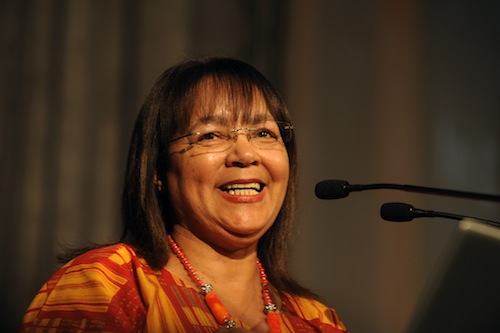
Picture: The Minister of Tourism, Patricia de Lille
By KEDIBONE MOLAETSI
Minister of Tourism, Patricia de Lille conducted site visits to two tourism establishments that are beneficiaries of the Department of Tourism’s Green Tourism Incentive Programme (GTIP). De Lille said her visit to the Timosha Guest House and The View Guest House in Ekurhuleni was part of outreach activities.
She further said they inspected the solar PV installations at these establishments, which were funded by the Department’s GTIP. De Lille added that the GTIP was developed by the Department of Tourism in collaboration with the Industrial Development Corporation (IDC) to respond to the escalation of electricity prices, coupled with energy supply challenges, load shedding and general water scarcity which pose a significant risk to the future growth potential and sustainability of the tourism sector.

“The GTIP offers partial grant funding on the cost of retrofitting tourism facilities with energy and water efficiency equipment and systems based on the outcome of a resource efficiency audit. Phase 1 of the application process involves a resource efficiency audit, the cost of which is fully covered under the programme.
“This is followed by Phase 2, where an applicant can apply for funding support (50% to 90% grant funding up to R1 million) on the cost of installing relevant technologies and equipment recommended during Phase 1. The IDC, as the Department’s implementation partner for the GTIP receives all GTIP applications and administers the programme on behalf of the Department,” she said.
De Lille said efficiency solutions supported under the GTIP may include, the renewable energy generating systems e.g. solar, wind, etc. She said including energy efficient equipment and lighting e.g. solar water heaters, gas stoves, Heating, Ventilation and air conditioning (HVAC) systems, Light-emitting diode (LED) lights, etc.
“Water efficient appliances and systems e.g. washing machines, low-flow/ aerated taps, etc.; and water sourcing systems e.g. rainwater harvesting and greywater recycling. The department has opened nine application windows between the inception of the GTIP in November 2017 and June 2024. A 10th application window was recently opened on 2 September 2024, and will remain open for applications until 28 February 2025.
“Eligible tourism businesses are encouraged to apply for funding from the GTIP to install energy and water saving technologies at their establishments. Since the start of the GTIP, 216 applications have been approved at a total grant value of over R140 million,” said de Lille.
She said provincial distribution of the 216 GTIP approvals shows domination by the Eastern Cape (53), Western Cape (48) and Gauteng (34) followed by Limpopo (22), KwaZulu-Natal (20) and North West (15), while Mpumalanga (12), Northern Cape and Free State represent 8 and 4 approvals respectively. De Lille visited two of the sites, where GTIP projects have been completed.
“The Timosha Guest House is a three-star graded establishment located in Kempton Park in Gauteng. The establishment is 100% black woman-owned. Following the application assessment for GTIP funding, the programme covered the full costs of the energy and water audit to determine the appropriate energy and water saving opportunities at the establishment while at the same time highlighting carbon footprint reduction and financial viability of this project.
“The Timosha Guest House qualified for grant funding of 90% of the implementation cost (equivalent to R730 323) to implement the proposed energy and water saving interventions. In line with the GTIP’s mandate of promoting energy efficiency within the tourism sector, GTIP funding is also expected to assist the establishment in reducing its energy consumption as well as its associated cost,” she said.
De Lille said the installation was completed in February 2024 and a savings verification will be conducted to determine the impact of the installations over time. She said it is however expected that the establishment will make significant savings due to the solar PV installations which were made possible through the GTIP funding.
“The second property was the View Guest House, located in Thembisa in Gauteng. The establishment is also 100% black woman-owned and is classified as a level one contributor according to the tourism B-BBEE scorecard. The GTIP covered the full costs of the energy and water audit to determine the appropriate energy and water saving opportunities at the establishment while at the same time highlighting carbon footprint reduction and financial viability of this project,” said de Lille.
 The Guardian