Four suspects were arrested for possession of gold bearing material in Tlhatlaganyane. The suspects were arrested separately during integrated Operation Vala Umgodi on 6 and 8 July 2024 in Tlhatlaganyane village and Rustenburg respectively.
Two of the four suspects were nabbed in Tlhatlaganyane for possession of gold bearing material. Biology Maphorisa (33) and Ishmael Dube (20), who are both Zimbabwean foreign nationals, briefly appeared in the Mogwase Magistrate’s Court on Tuesday.
The North West police spokesperson, Brigadier Sabata Mokgwabone said the accused were remanded in custody until 16 July 2024, for bail application. Mokgwabone said the Directorate for Priority Crime Investigation (DPCI) is investigating the matter.
“In another incident, Galenkwane Ralenkwane (35) was found guilty for contravention of the Immigration Act, 2002, on appearance in the Mogwase Magistrate’s Court on 9 July 2024. Ralenkwane, who is from Lesotho, was sentenced to 30 days imprisonment or pay R1500 fine.
“Chistopher Lentswe (41) briefly appeared in the Rustenburg Magistrate’s Court for unlawful possession of a firearm and ammunition following his arrest on 7 July 2024. Lentswe was remanded in custody until 16 July 2024, for bail application,” he said.
Mokgwabone said the accused is further linked with a case of robbery committed in Rustenburg in May 2024. He added that during the operations, the police seized illegal mining equipment such as motors, generators, spades and extension cords.
Meanwhile, the North West Police Commissioner, Lieutenant General Sello Kwena, welcomed the arrests and thanked the police for their continued efforts in the fight against illicit activities.
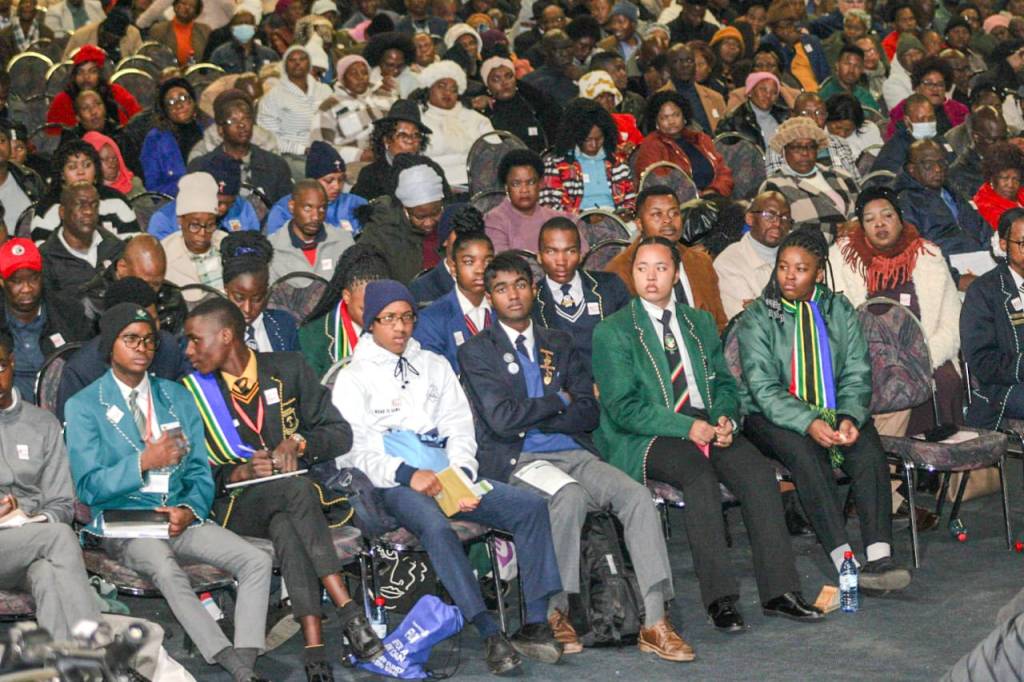
Picture: SGB members and principals during interactive session in Mmabatho Convention Centre in Mahikeng/Supplied
By KEDIBONE MOLAETSI
North West MEC for Education, Viola Motsumi urged School Governing Bodies (SGBs) across the province to give principals necessary support in quest to improve the results of learners. Motsumi held a successful interactive session with SGBs, principals, and education stakeholders at Mmabatho Convention Centre in Mahikeng on Thursday.
She further said the event brings together school principals, SGBs, secretaries, Representatives Council of Learners (RCL) and various education stakeholders from across the province. Motsumi added that commitment is vital to ensure excellence, integrity and a strong dedication to learner success in the governance of schools.
“As the 2024-2026 SGB term of office begins, we express our heartfelt gratitude to all SGB members for accepting this significant responsibility. I’m thankful to the parents who took the role of being invested in their children’s school governance.
“It is important to clearly understand the task ahead. Your term of office is three years, a relatively short period in which you are expected to leave a lasting legacy. Clean governance is not just a goal, but it is a necessity,” she said.
Motsumi said they must strive to be transparent, ethical, and accountable in all our actions. She said the session focused on several critical areas, including the smooth transition and handover processes, stressing the importance of finalising the handover processes from the previous term to ensure a seamless transition into the new administration.
“We also outlined the legal framework within, which SGBs and school governance operate to promote accountability to stakeholders – parents, teachers and the broader community. We emphasised the importance of fostering a culture of collaboration and cohesion within schools to create environments where learners can thrive.
“We also addressed respect and vandalism in schools. It is about time we bring back respect and discipline to our schools. Learners should be taught respect and gone are the days where teachers are held at ransom by our learners,” said Motsumi.
She said vandalism will also be a thing of the past and as SGBs and school governance, they need to put their foot down in the socials they see creeping into their schools. Motsumi said stakeholders and RCL raised concerns focused on expediting school infrastructure, inclusion of RCLs in the school management, and prioritisation of learner transport.
“These kinds of engagement sessions will be held annually to enhance the quality of education in the province,” she said.
Picture: Conflict Criminologist affiliated to the NWU’ School of Philosophy, Dr Casper Lotter/Supplied
By REGINALD KANYANE
The North West University (NWU)urges the newly-appointed Minister of Correctional Services, Dr Pieter Groenewald to improve the country’s correctional service system. Conflict Criminologist affiliated to the NWU’ School of Philosophy, Dr Casper Lotter said it is indeed a wonderful time to be in criminology, when the possibility exists that a government in the developing world is more likely to listen to alternative voices than those in the developed world.
Lotter said this is the opportunity presented by South Africa’s new Government of National Unity (GNU) after the May 2024 elections.
He further said under the previous administration, unethical actions such as the BOSASA tender and supply chain scandal, the violent suppression of prison unrest (often exacerbating the serious underlying problems) and the Thabo Bester escape debacle (possibly with the help of corrupt wardens) were par for the course.
“Our new GNU has the potential to usher in a dispensation of transparency and renewed confidence in the authorities. With this in mind, I have compiled a short wish list for our new Minister of Correctional Services.
“I offer ten items for consideration and possible implementation. It is well known that South Africa has one of the highest and most unsustainable recidivism rates in the world at around 86-94%,” he said.
Lotter added that this is higher if compared to Japan’s 48%, China’s 6-8% (two countries that embrace integrative shaming rather than stigmatising shaming practices) and Finland’s 31%. He said the United States, yet another stigmatising shaming culture, has a recidivism rate of 77%.
“This means that about 9 out of every 10 offenders in South Africa reoffend. In my own PhD, I looked at this problem (also known as the penologist’s stone) and I concluded that the emasculating stigma against ex-offenders is the single most important factor in why offenders are unable to reintegrate into the communities from which they were removed before their incarceration.
“The Australian criminologist John Braithwaite famously described stigma as “counterproductive” and “criminogenic”, in the sense that it drives ex-offenders away from mainstream society and into the arms of welcoming criminal subcultures,” said Lotter.
He said the government’s “criminalization and marginalization practices” (in the words of the British criminologist Eugene McLaughlin), should therefore be urgently scrutinised. Lotter said the foothold that the prison-industrial complex (PIC) gained in South Africa during Zuma’s tenure is evidence of this.
“In addition, I have argued that the stigmatisation of ex-offenders, directly and the profit motive as it has come to be embedded in the PIC, indirectly are important, though certainly not exclusive, drivers of South Africa’s unsustainable rates of incarceration and recidivism.
“If our new Minister were to tackle just this one issue of the stigma that fuels reoffending and cements criminal careers, he would have made a huge impact on our unsustainable rates of recidivism and carved out an enduring legacy for himself. How is this to be done? By outlawing the stigmatisation of ex-offenders, including significant civil and criminal consequences for any proven act or practice of discrimination, marginalisation and/or stigmatisation,” he said.
Lotter said but more importantly, a massive public awareness campaign by the DCS on the dangers of stigma, in terms of crime prevention, should perhaps be highlighted in its budget planning. He said it is vital that the public be educated about the societal costs of stigma [in terms of recidivism rates] if they are serious about creating safer communities.
“No stone should be left unturned to bring the South African correctional system into the admirable position of Finland’s in terms of blunting the impact of stigma through integrative shaming measures.
“This is bound to have a positive impact on both socioeconomic and recidivism rates. It is worth noting that John Burton, one of the giants in the field of conflict management, has contributed significantly to the theory that meeting basic human needs (respect, dignity, employment opportunities, etc.) will prevent prolonged social conflict,” said Lotter.


 The Guardian