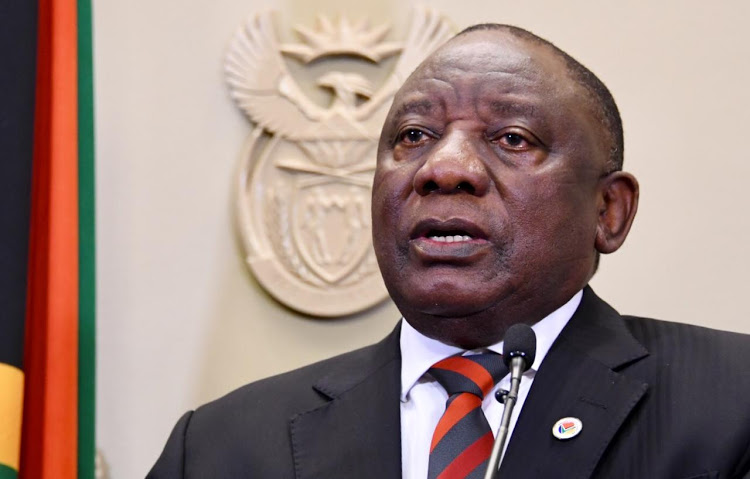
Picture: South African President, Cyril Ramaphosa
By OBAKENG MAJE
President, Cyril Ramaphosa said South Africans are not only celebrating this defining moment on their long journey to freedom, but they also reaffirm their shared commitment to the promise of that momentous day. Ramaphosa, who delivered his keynote address during the National Freedom Day commemorative event at Manzilpark stadium in Klerksdorp said, this day gave birth to a new nation.
“On 27 April 1994, South Africans of all races, languages and creeds stood in long winding queues to exercise the democratic right for which so many have fought and for which so many have sacrificed. On Freedom Day, we recall the great progress that has been made in nearly three decades of democracy, but we also acknowledge that so much of the promise of 1994 still needs to be realised.
“It is on this occasion that we rededicate ourselves to work with greater purpose and unity to give full effect and meaning to freedom in our land. It is fitting that the national celebration of Freedom Day is taking place here in Matlosana, which carries both the pain of our past and the promise of our future,” he said.
He further said, the site of a concentration camp for Africans during the Anglo-Boer War, Matlosana has a history of dispossession and exploitation. Ramaphosa added that, one of the best-known sons of this area, Desmond Mpilo Tutu, was six years old when his family and many others were thrown out of their homes in the vibrant community of Makweteng to clear the area for white settlement.
“Matlosana was home to a mining industry, which under apartheid, was responsible for the exploitation of mineworkers, paying them a pittance and exposing them to terrible working and living conditions. It was here that the National Union of Mineworkers (NUM) was founded in 1982 to fight for the rights and dignity of mineworkers.
“It was here in Matlosana that the Klerksdorp Christian Academy was founded in 1989 as one of the first multi-racial schools in the area, only to be bombed by right-wingers during the transition to democracy. Matlosana, like so many places in South Africa, has known great suffering, but it has also been a place of resistance, struggle, and hope,” said Ramaphosa.
He said, the changes that have taken place in Matlosana since the advent of democracy, reflect the broader transformation underway in our country. Ramphosa said today, mineworkers and other vulnerable workers have rights that those who came before them were denied.
“These include the right to be compensated if they are injured or become sick on duty. These include the right to organise, to the full protection of our labour laws, and to safe working and living conditions. Today, not only are all schools open to all races, but millions of learners from poor households attend no-fee schools. Every day 9 million learners receive a meal at school.
“Last year, just over 900 000 young people sat for matric and more than 80% passed. More and more of the learners achieving bachelor passes are from no-fee schools. Today, through the National Student Financial Aid Scheme (NSFAS), more than 700 000 young people from poor, working-class backgrounds are being funded for tertiary studies,” he said.
Ramaphosa said since the advent of democracy, access to health care has improved. He said many more South African households live in formal dwellings and have access to basic services.
“Social grants support around 18 million poor and vulnerable people. This is what progress looks like. These are some of the fruits of democracy and yet, as every South African knows, we have still much more work to do. Poverty, unemployment and inequality still define the lives of millions of our people.
“At this time in particular, families across the country are experiencing great hardship and uncertainty. Our country has been hit by a global financial crisis, political, social, and economic shocks, worsening natural disasters and the most severe global pandemic in over a century,” said Ramaphosa.
He said, these setbacks have made the devastating apartheid legacy of inequality worse.
“We are also now counting the cost of years of under-investment in our electricity, water, rail, and port infrastructure. We are feeling the damaging effects of state capture and corruption and concerted efforts to weaken our public institutions.
“As we work to rebuild and reconstruct, we face challenges that are far different from those experienced in the earliest days of democracy. We have to secure our energy future. We have to adapt to climate change and grow our economy and create more jobs,” he said.
Ramphosa said, they have to eradicate the scourge of Gender-Based Violence (GBV) and act against crime. He said freedom cannot be meaningful when South African homes and businesses are without electricity for several hours in the day.

 The Guardian