By KEDIBONE MOLAETSI
Congress of South African Trade Unions (COSATU) said it is concern about the mass retrenchments, wage freezes and austerity measures imposed by the capitalist leaning treasury.

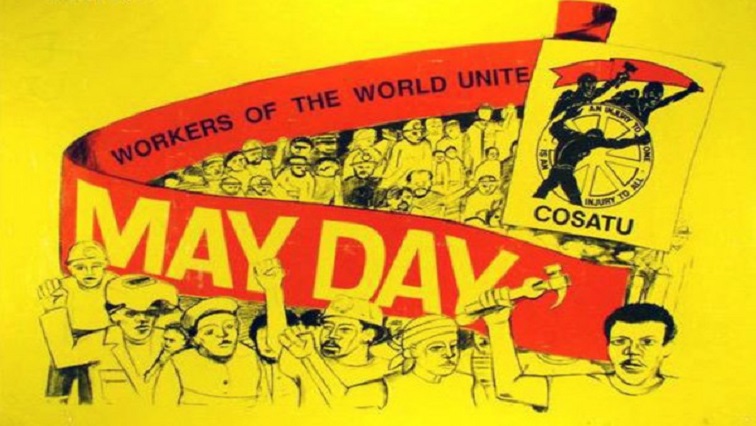
COSATU was celebrating its International Workers Day in Klerksdorp. COSATU’s provincial secretary, Kopano Konopi said North West is one of the provinces that corruption and malfeasance continue to rear its ugly head and this has affected the ordinary citizens.
“We regard this as the abuse of entrusted power for private gain. Its background and context in our province are protracted. Be that as it may, we have been alarmingly shocked at the rate of increase and impunity during this difficult period.
“Both public and private sectors have demonstrated unbelievable levels of grand-scale corruption without regard for the suffering of our people and their needs. Therefore, this is a struggle against greed, parasitism and institutionalised profiteering at the expense of the working-class and workers in the province,” he said.
Konopi further said corruption is anchored in the unholy intersection between public and private officials and interests abusing the system for private personal gains. He said they are also disenchanted by the extent to which law enforcement agencies are slow in prosecuting the criminals, both in the public and private sectors who abuse public and workers’ monies with impunity.
“We call on the Director of Public Prosecutions in the province to move with speed in putting away from society all who steals from the people and workers. We have provided concrete proposals to deal with thuggery decisively to send a strong message that we shall not and never tolerate all norms of corruption and greed,” said Konopi.
He further said as COSATU, they are concern about the high rate of unemployment. According to the statistics, the rate of unemployment in the province has increased from 28.3% to 33.3% between the third and last quarter of
2020.
“This is an increase of 5% on a quarter-to-quarter basis. Between December 2019 and December 2020, it increased from 28.8% to 33.3% which is an increase of 4.5% on a year-on-year basis.
“At the same time, the quarterly labour force survey released by Statistics SA in February 2021, shows a quarter-to-quarter increase in employment in the province from 930 000 to 944 000 which is an increase of 14 000 jobs between the 3rd quarter of 2020 and the last quarter of the same year,” he said.
However Konopi said nonetheless, there is a decline on a year-on-year jobs which shows that in December 2019 there were 992 00 employed people in the province whereas in December 2020 there were 944 000 employed people. He said this is a decline of 48 000 jobs on a year-on-year basis.
“These statistics illustrate that the North West economy is continuing to shed jobs instead of creating them. It is evident that the current economic state of our province represents a high unemployment rate amidst the triple challenges of racial poverty, gendered inequalities and class unemployment,” he said.
Meanwhile, the South African National Civic Organisation (SANCO) in the North West said it has identified labour peace as key to South Africa’s economic recovery.
SANCO provincial chairperson, Paul Sebegoe said: “We call for workers’ rights to be protected and the collective bargaining framework strengthened. An urgent return to the bargaining chamber to negotiate a new public sector salary agreement would be critical for the COVID-19 stricken economy to recover from the aftermath of the devastating pandemic.
“Averting strikes through constructive and meaningful engagements to grapple with the economic realities facing the country should be the first step towards economic recovery.”
Sebegoe also emphasised that workers were the ‘first line of defence’ and the hardest hit by the merciless global pandemic.
He said while most fatalities affected the vulnerable with comorbidities, job losses affected low skilled workers in the private sector and the informal economy whom despite multiple interventions could not be protected from the jobs bloodbath therefore economic recovery must be targeted at these categories of workers.
The National Assembly speaker, Thandi Modise said in a statement that the struggle for better and improved rights in the workplace, which were intertwined with the struggle for social justice, freedom and democracy, has come a long way since 1994.
However, Modise said great strides have been made to transform the labour legislative landscape to eliminate restrictive and oppressive labour laws.
“This has ensured progressive laws that guarantee inalienable rights, such as freedom of association, collective bargaining, the right to strike and workplace freedom.
“Celebrating the contributions of workers inevitably draws attention to the scores of South Africans without jobs. We also note with concern the unemployment in South Africa, which particularly affects the working class, most notably women and young people,” she said.
Modise said the country has experienced a high rate of unemployment and parliament cannot turn a ‘blind eye’ to the reality that workers across the length and breadth of the country live with millions of their unemployed brothers and sisters. She said the situation has further been exacerbated by the realities of COVID-19.
 The Guardian