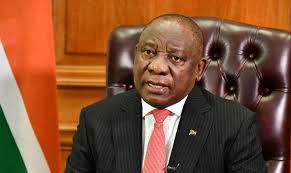
Picture: South African President, Cyril Ramaphosa
By REGINALD KANYANE
South African President, Cyril Ramaphosa has taken a fundamental approach by launching the Presidential Employment Stimulus last week to tackle unemployment.
Ramaphosa said the Presidential Employment Stimulus is unprecedented in its scale and breadth, involving a public investment of R100 billion over the next three years.
“We are undertaking a far-reaching and ambitious public investment in human capital, with the state as both a creator and an enabler of jobs. We will protect and create directly-funded jobs and livelihood support interventions while the labour market recovers from the coronavirus pandemic.
“Each of these is ready for implementation, and is additional to existing commitments. While some of the interventions build on the strengths of existing programmes, the stimulus also includes new and innovative approaches,” he said.
Ramaphosa added that this includes a focus on what they have termed ‘social employment’. He said they are working from the premise that there is no shortage of work to be done to address the many social problems in the society.
“The aim is to support the considerable creativity, initiative and institutional capabilities that exist in the wider society to engage people in work that serves the common good. This work cuts across a range of themes, including food security, ending gender-based violence, informal settlement upgrading and much more.
“This will supplement the efforts of the public sector, allowing for greater scale and social impact as well as new forms of partnership with diverse social actors. The stimulus includes a new national programme to employ teaching and school assistants in schools,” said Ramaphosa.
He further said schools are making these appointments right now, delivering new opportunities in every community across the length and breadth of the country. Ramaphosa said the public employment is not just for unskilled work.
“There is a cross-cutting focus on graduates, with opportunities for nurses, science graduates, artisans and others. The stimulus will also protect jobs in vulnerable sectors that have been hit hard by the pandemic.
“Support will be provided to Early Childhood Development practitioners, mainly self-employed women. Over 74,000 small farmers will also receive production input grants. As a nation, we need arts and culture to lift our spirits once more – the stimulus provides new funding to help the sector back onto its feet, including support to digital content-creation and expansion of e-commerce platforms,” he said.
Ramaphosa added that this will enable artists to adapt to the new market conditions that the pandemic has imposed on the country and to seize new opportunities for growth. He further said a critical enabler for wider job creation, made more important by the pandemic, is connectivity.
“To overcome the digital divide, the stimulus will provide affordable, high-speed broadband to low-income households through innovative connection subsidies and the expansion of free public WiFi.
“As our country recovers from the devastation of the coronavirus pandemic, we are in no doubt as to the size of the task before us. We have to achieve an economic recovery that is swift and inclusive. We have to get as many of our people as possible working again.
“We also have to regain lost ground in the provision of basic services and critical infrastructure, addressing social challenges and transforming townships and rural communities too,” said Ramaphosa.
He said public employment is an instrument that can do all by creating jobs at scale in the short term while markets recover, and creating social value in the process. Ramaphosa said the example is often cited of the massive public works programme undertaken by the United States after the Great Depression in the 1930s.
“This was not just a stimulus, but also promoted social participation and inclusion. There are several examples of innovative public employment programmes in the developing world, including in India, Ethiopia and here in South Africa.
“These programmes make a direct investment in local economies, reaching poorer areas first, supporting local small enterprises and trickling up into the wider economy from there,” he said.
Ramaphosa added that they also promote social participation and inclusion, providing communities with the means to change their lives as they undertake new forms of work. He said in doing so, they contribute to transformation both at a local level and within broader society.
“Direct public investment to support employment and create economic opportunities that generate social value does more than just tackle the unemployment crisis. It is responsive, because it uses the state’s resources to respond to local community needs, be it for greener spaces, food security, more early childhood development centres, or for better and more accessible roads.
“It is progressive, because it offers social protection and income security to those who face destitution because they are unable to find work. It is an investment in the future, in that it supports the broader economic recovery agenda by urgently getting our people to work on improving our national and municipal infrastructure,” said Ramaphosa.
He added that through the interventions in the stimulus, they are creating work for those who need it, while leaving a lasting impact on entire communities. Ramaphosa said like public employment programmes across the world, this employment stimulus supports and complements the critical role of the private sector in creating jobs.
“It is counter-cyclical, in that as the recovery advances, the scale of public employment will decline. The work experience and skills acquired by beneficiaries of the Presidential Employment Stimulus will improve their prospects of securing formal employment.
“The experience gained is also a pathway to entrepreneurial activity. Participants will improve their skills and capabilities to start their own businesses, and can use the steady income provided by public employment to branch out into other income-generating activities,” he said.
Ramaphosa further said he has consistently affirmed that the COVID-19 crisis is also a window of opportunity to build back better. He said at this time of great upheaval, they would be doing themselves no favours by making unrealistic promises that raise expectations, only to come short when they are not met.
“This is why each of the jobs and livelihood support interventions is fully funded, with a clear implementation plan. The employment stimulus is not about vague commitments for some time in the future, but about jobs being created right here and now.
“The stimulus is the result of extensive consultation with national departments, provinces and metros to rapidly design employment programmes that can be rolled out or expanded within six months,” said Ramaphosa.
He said the implementing departments and other stakeholders were rigorously assessed on their capacity to implement. In every one of the programmes that fall under the stimulus, opportunities will be widely advertised and recruitment will be fair, open and transparent, said Ramaphosa.
“The goals we have set ourselves are realistic, measurable and achievable, and draw lessons from past experience and international best practice. Our people are ready and willing to work. This vast potential must be harnessed, and our collective skills and capabilities brought to bear in rebuilding our country in the wake of the coronavirus.
“The Presidential Employment Stimulus provides a respite for families who have endured a long hard winter with greatly reduced income, and for individuals who have spent many years without work.
“Real, decent work is the right of every human being. It is a precondition for economic growth and social stability. By giving effect to this fundamental right, the Presidential Employment Stimulus is making a decisive contribution to building a society that works,” concludes Ramaphosa.
 The Guardian