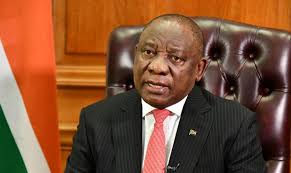
By OBAKENG MAJE
South African president, Cyril Ramaphosa said job creation, re-industrialisation of economy, focusing on growing small businesses, to accelerate economic reforms to unlock investment and growth including combating crime and corruption are some of the components to implement in his Economic Recovery Plan strategy.
Ramaphosa said all these objectives are linked to the vision of our country set out in the National Development Plan (NDP).
“In contrast to the State of the Nation Address, where we address the broad programme of government for the year, today I want to focus on the extraordinary measures we must take to restore our economy to inclusive growth following the devastation caused by COVID-19 to our people’s lives and our country’s economy.
“This has far-reaching implications in every area of human development, from education to health, from food security to poverty alleviation, from the empowerment of women to social stability,” he said.
Ramaphosa further said the pandemic continues to cause severe damage to the global economy, affecting trade, investment, production, international travel and global supply and demand. He said in South Africa, the pandemic has caused great hardship and suffering.
“In the 220 days since our first recorded case, more than 18,000 people are confirmed to have died from COVID-19. We must rebuild, repair and restore our country, not after COVID, but in the midst of COVID.
“Poverty and inequality has deepened, threatening many South Africans with hunger and a sudden loss of income. Our economy, like other economies, has contracted sharply, businesses have closed and jobs have been lost,” said Ramaphosa.
He added that more than 2 million people lost their jobs in the second quarter of this year. Ramaphosa said the economy contracted by 16.4% when compared to the previous quarter.
“National Treasury expects a significant shortfall in revenue collection. This economic shock is unprecedented in our country, and it will take an extraordinary effort to recover from it. As even the darkest of clouds has a silver lining, we need to see this moment as a rupture with the past and an opportunity to drive fundamental and lasting change.
“It is an opportunity not only to recover the ground that we have lost over the course of the pandemic but to place the economy on a new path to growth. We are therefore presenting before this joint sitting of Parliament and the country a reconstruction and recovery plan to drive growth that is inclusive and transformative,” he said.
Ramaphosa said the South African Economic Reconstruction and Recovery Plan builds on the common ground established by the social partners – government, labour, business and community organisations – through intensive and detailed consultations over the last few months.
He said it is informed by the work of Cabinet’s Economic Cluster working together with government departments and Cabinet itself and draws on the contributions of the leading economists who make up the Presidential Economic Advisory Council.
“I wish to applaud the remarkable efforts, particularly from our social partners in NEDLAC, in reaching consensus on the actions required to rebuild our economy, and the firm actions that all social partners have committed to contribute to the country’s recovery.
“We know from the examples of several other countries that social compacts are essential to effective and sustainable growth and development. As we implement this plan, government remains committed to the agreements reached through the NEDLAC process,” said Ramaphosa.
“The creation of jobs is at the centre of the Reconstruction and Recovery Plan. We must get our people back into the jobs they lost in the pandemic. We are determined to create more employment opportunities for those who were unemployed before the pandemic or who had given up looking for work.
“This means unleashing the potential of our economy by, among others, implementing necessary reforms, removing regulatory barriers that increase costs and create inefficiencies in the economy, securing our energy supply and freeing up digital infrastructure,” he said.
Ramaphosa further said this plan directly responds to the immediate economic impact of COVID-19 by driving job creation and expanding support for vulnerable households. He said they aim to do this primarily through a major infrastructure programme and a large-scale employment stimulus, coupled with an intensive localisation drive and industrial expansion.
“The interventions outlined in this plan will achieve sufficient, secure and reliable energy supply within two years. Create and support over 800,000 work opportunities in the immediate term to respond to job losses and unlock more than R1 trillion in infrastructure investment over the next 4 years.
“It will reduce data costs for every South African and expand broadband access to low-income households, reverse the decline of the local manufacturing sector and promote re-industrialisation through deeper levels of localisation and exports and resuscitate vulnerable sectors such as tourism, which have been hard hit by the pandemic,” said Ramaphosa.


 The Guardian