BY REGINALD KANYANE
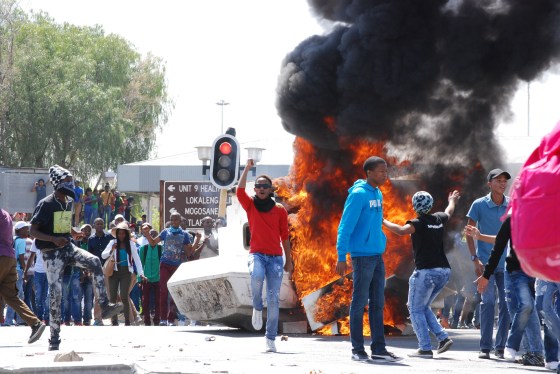
NORTH West University in Mafikeng has been shut down indefinitely by protesting students. The students said they were infuriated by Minister of Higher Learning, Dr Blade Nzimande.
Dr Nzimande announced on Monday that universities can increase the fees in the next financial year. However, he highlighted that no university will be allowed to increase its fees by over 8%.
North West University (Mafikeng campus) administration and laboratory buildings were torched during #Feesmustfall campaign in 2015. This forced the university to go on recession for a month. The damages were estimated to the value of R150 million.
The NWU SRC president, Dikago Pule said they want to put pressure on the university council not to increase fees.
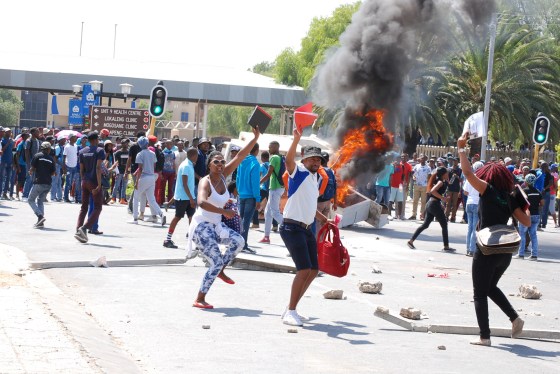
“We reject any talks regarding fees increment. We will never budge in our move and we remain defiant. We met with our students and we took a decision. Even though we embrace the need for education to achieve sustainability, only limited progress has been made on any level. This lack of progress stems from many sources.
“Lack of vision or awareness from both universities and government has impeded progress. We have many students who come from poor backgrounds. However, they continue to drop out of universities because of pricey education,” Pule said.
NWU Vice-chancellor, Professor Dan Kgwadi said they will meet with council to discuss way forward regarding fees augmentation. Kgwadi said they have been waiting for an announcement from government.
“We will meet with council after the announcement made by minister of higher education, Dr Blade Nzimande. We are now in a position to go and finalise our budget proposal to council and take it from there,” he said.
The council is expected to meet on Wednesday to discuss way forward.
Outgoing South African Public Protector, Advocate Thuli Madonsela visited the university on Monday to talk about challenges facing higher institutions of learning in South Africa. The lecture was under the theme: “Prestige Lecture”.
“We have not invested enough in education. This is based on reality that we see. The situation our students are faced with is upheaval. Figures has shown that more students have been accepted in academic institutions, however, there is no enough money that has been invested to cover the new number.
“We urge our students to use their minds to fight social injustice. You must be like Sol Plaatjie who fought the system with his mind. Everyone deserves social justice because it matters. As long as there is injustice somewhere, sustainable peace cannot be experienced anywhere,” she said.
Madonsela further said the difference between the old and new state is that the former would not listen to people. She added that the character of the new state as envisaged in the constitution makes accountability by those exercising public power central while entrenching citizen participation.
“Young persons can fast-track the delivery of the South African dream without violence. If dialogue fails, they can make use of other constitutional avenues such as the Public Protector, the South African Human Rights Commission and Petitions among others. In the 1970s, protestors did not burn down the infrastructure. They knew they were going to need them in the future. When you are disgruntled at home, you do not set alight the house because you will need it for shelter.
“Regarding #Feesmustfall campaign, I believe fees must fall for only those who cannot afford. Otherwise resources meant for the disadvantaged will be lost to those that were historically advantaged. This will also benefit those who are well off due to the fruits of democracy,” Madonsela said.
She also called for the implementation of Chapter 5 of the Equality Act. Madonsela said the act explain that the Promotion of Equality Act has two dimensions. However, she said only one of these has been implemented thus undermining its impact on addressing apartheid disparities including academic injustice.
“The constitution promises an improved quality of life for all and a freed potential to each person. Young leaders have the power to make a difference as they carry the dreams and hopes of our people. We need more innovative young people such as Ludwick Marishane who invented the DryBath and Nkosana Makate who came up with “Please Call Me”.
“We also need our own Marxs and Platos to generate new ideologies and philosophies to help us address today’s problems. The Equality Act provides a systematic mechanism for addressing apartheid, patriarchal and disability disparities. So, without a systematic approach to structural inequality, social justice is a pipe dream,” she said.
Minister Dr Blade Nzimande said: “Our public universities are a significant national asset. They empower the next generation with skills and knowledge. They also contribute significantly to the ability of our economy to compete globally through innovative and appropriate research.
“Our universities currently face serious challenges in terms of funding. At the same time, large numbers of South Africans are currently finding it difficult to access post-school education because of the financial challenges they as individuals or as families face. Government is aware of these challenges and takes them very seriously.
“Indeed, government remains firmly committed to progressively realise free post-school education for the poor and working class, as called for by our constitution, and to assist middle class families who are unable to pay.”


 The Guardian