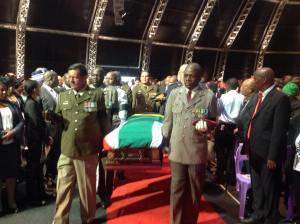
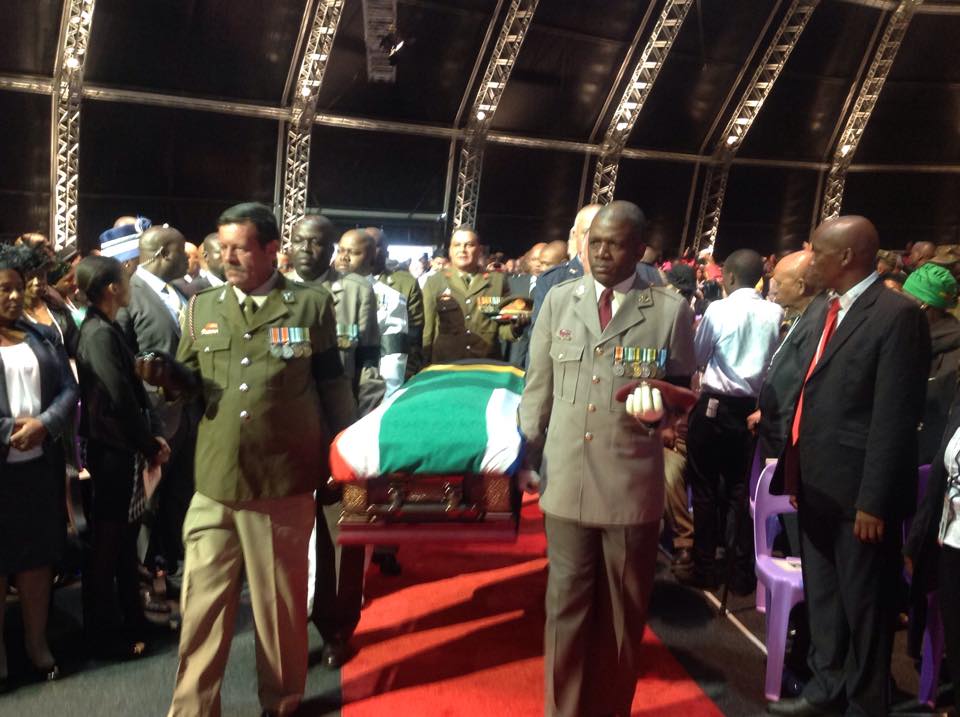
Ventersdorp- The president of South Africa attended a re-burial of one of stalwarts, the late John B. Marks who died in Moscow, in Russia more than 44 years ago.
Zuma said sixty years ago, the people of South Africa proclaimed that South Africa belongs to all who live in it, black and white, and that no government can justly claim authority unless it is based on the will of all the people.
This year South Africa is celebrating 60 years of the Freedom Charter in which these profound words are enshrined.
“We remember these words which have since found a place in our country’s Constitution, on this special day of interring the mortal remains of Comrade John Beaver Marks on home soil. He worked with immeasurable commitment and dedication to bring such ideals to fruition” Zuma said.
Last weekend, South Africa laid to rest his brother, comrade and friend, Comrade Moses Kotane in Pella, in this province of Bokone Bophirima.
Zuma also remembered Minister Collins Chabane.
“Yesterday, we sadly bid farewell to Minister Collins Chabane in Limpopo, a committed cadre who looked up to JB Marks and Moses Kotane” he said.
The former Minister of Public Service and Administration died in a road collision that also claimed the lives of his two protectors, sergeants Lesiba Sekele and Lawrence Lentsoane.
He outlines how the events of the past two weeks have reminded South Africa of the very rich and noble history of its liberation struggle.
“We have had the opportunity to reflect on the heroism of many men and women who sacrificed everything so that South Africa could be free.
“Indeed today is another day of inspiration. We have come together to celebrate the life of a distinguished South African who was totally committed and dedicated to freedom, equality, justice and human rights for all” Zuma said.
Having been raised by a father who loved the African National Congress (ANC), Comrade JB had a bit of understanding of what the true nature of the struggle was.
He said that is why JB Marks quickly noticed that African students and white students were treated differently at the teacher training college that he attended.
“He could see that black African students were discriminated against. He then made it his mission to mobilize other students and showing them exactly how the conditions they were subjected to warranted a revolt. It was the beginning of the conscientisation of this remarkable revolutionary.
“He grew to become a teacher, trade unionist and a consummate freedom fighter who would selflessly dedicate his life to fighting racism and apartheid colonialism. In celebrating JB Marks and Moses Kotane we are celebrating two men who played a very key role in the revival of political activism and trade unionism in the 1940s” Zuma said.
The president said when the ANC was experiencing deep organisational challenges in the 1930s, signs of revival came with the Jubilee conference of 1937, which had been proposed by Selope Thema, James Calata, JB Marks and Moses Kotane.
Comrade Marks in particular, was one of the leaders who played a key role in the Communist Party-led anti-pass campaign of 1944, which drew 20 000 people, including ANC members.
In the preparatory conference for this anti-pass march in Johannesburg on 21 November 1943, JB Marks said:
“This conference has passed a sentence on the pass laws, the sentence of death. The pass laws are a national stigma, and can only be fought by all the black people standing and fighting together. We have been humiliated by these laws. To hell with passes!
Another important achievement with regard to working class and political mobilisation in the 1940s came with the historic 1946 mineworkers strike.
Comrade JB Marks led the strike, as Chairperson of the most powerful and populous trade union federation at that time, the Council for Non-European Trade Unions (CNETU).
The strike mobilised between 60 000 and 70 000 workers, demanding improved working conditions, such as a statutory minimum wage, as well as the elimination of the compound system and the tribal divisions of the workforce among others.
Despite the fact that the strike was brutally suppressed, it had an unintended consequence of radicalising political activism, especially in the ANC.
“It became clear that the racist government would not change, as it was later shown with the adoption of apartheid as official policy in 1948. The success of Comrade JB Marks was remarkable. He had managed to mobilise workers from various countries from Southern Africa under one banner and purpose” he said.
Marks raised their level of political consciousness and collapsed the nationality and tribal divisions that the system had imposed to prevent collective action.
According to Zuma, during those years, the Chamber of Mines dug in its heels, arguing that they could not improve wages as miners were fed and housed in the compounds.
He said in this democratic era, the question of the living and working conditions of mineworkers in some areas still remains a challenge, resulting from the dehumanising migrant labour system of old.
“Through the Mining Charter that we adopted in 2004, the democratic government has sought to work with mining houses to improve the living conditions of mineworkers so that what Comrade JB Marks was fighting for can be achieved in totality.
As part of the transformation process, the Mining Charter enjoined the holders of Mining Rights or Mining Companies to meet certain commitments by the end of last year, 2014” he said.
He said they were to convert or upgrade hostels into family units, to attain the occupancy rate of one person per room in the living quarters and to facilitate home ownership options for mine workers.
The assessment of progress made by the companies in meeting the Mining Charter commitments is underway and a final report is due by the end of April.
The outcome of the assessment report will be used to revise the Mining Sector Strategy and the Mining Charter, as well as the alignment to the Broad-based Black Economic Empowerment Codes of Good Practice.
Government has also begun a programme of revitalising mining towns.
A total of 2.1 billion rand has been ring-fenced for this purpose with 290 million rand approved for Informal Settlement Upgrading in Mpumalanga, North West, Gauteng, Northern Cape, Limpopo and the Free State.
One hundred and thirty three (133) informal settlements are being assessed or prepared for upgrading through the National Upgrade Support Programme.
Thirty two (32) settlements are being upgraded and eighty seven (87) housing projects are being implemented across the prioritised mining towns.
Importantly, Government, the mining sector and the Banking Association of South Africa have signed a Social Contract for the development of sustainable human settlements.
Other support includes technical expertise with regards to Integrated Development Plans and the development of Special Economic Zones.
“We welcome as well the investment of mining companies in communities that they draw labour from. Many have built state of the art schools and other facilities in rural areas.
“We are also preparing to introduce our National Development Plan delivery programme Operation Phakisa in the mining sector to revitalise and build this sector further, to cement the position of mining further, as the backbone of our economy.”
Zuma said working together with the mining industry stakeholders as they are doing currently, they will continue to reposition the mining industry for greater levels of competitiveness and sustainable growth.
Compatriots
“We also urge our labour movement to take a leaf from Comrade JB Marks the trade unionist. Government has introduced far reaching labour laws this year aimed at improving the working conditions of vulnerable workers such a contract workers, farm and domestic workers, workers in abattoirs and so forth.
“Taking a leaf from Comrade JB Marks, all of us, government, labour, business and the community sector should work together to ensure that these laws are understood by all, and that they are implemented effectively to improve the lives of workers” he said.
Bagaetsho,
In addition to organising and mobilising the working class, Comrade JB Marks was one of the people who helped inject momentum to the ANC in the 1940s and promoted unity within the liberation movement.
Comrade Marks and Comrade Kotane and other communists emphasized the importance of cooperation between the ANC and Communist Party of South Africa.
They did this in the face of fierce opposition from among others nationalists such as former President Nelson Mandela then and ANC President General Dr Xuma.
So severe were these differences that sometimes the tensions would in some instances flare up during public activities of the organisations.
Through careful interventions including the formation of the Congress of Democrats in the 1950s, relations improved, leading to Madiba saying;
“It was only the communists who were prepared to eat with us and work with us. They were the only political group which was prepared to work with the Africans for the attainment of political rights and a stake in society.
The ideological rigidity slowly melted such that when JB Marks vacated his position as the Transvaal President of the ANC, due to his banning in terms of the new laws in 1952, he recommended Nelson Mandela as his successor.
This was Comrade Marks the unifier, a man who did not want to see artificial divisions among the oppressed and within the liberation movement.
It should be recalled that JB Marks was an ANC leader, a trade unionist and a communist. He saw no contradiction between the three roles.
So central was his role that he was also part of the ANC Working Committee which Nelson Mandela reported to in Liliesleaf when he came back from his African mission in 1962.
Fellow Mourners,
Compatriots
Ironically, during this year of the Freedom Charter, JB Marks has brought us to Ventersdorp.
This town has had an image of being the bastion of white supremacy and the glorification of apartheid in spite of it having been declared a crime against humanity by the United Nations.
The improvement of race relations in this area is most welcome and appropriate homecoming gift to Comrade JB Marks given that he espoused non-racialism, unity and humanity throughout his life.
The fact that he is to be buried here in Ventersdorp, should be a source of pride for all residents. It should open a new chapter of unity, reconciliation and healing in the town.
We look forward to working with the people of this town and surroundings to further promote the rich legacy of JB Marks.
Compatriots
We cannot celebrate JB Marks without mentioning his contribution together with Comrade Moses Kotane, to paving the way for our international pillar of struggle.
They elevated the cause of liberation in the eyes of the world and were true emissaries of the liberation movement abroad, including Russia.
We again extend our gratitude to the then Soviet Union, now the Russian Federation, for unwavering solidarity and for taking care of our leaders and cadres over many years.
The Russians have walked every step of the way with our Movement during the difficult days of struggle when friends were few.
In this particular case, we appreciate the support provided to Comrades Kotane and JB Marks throughout their lives and in death.
Uncle JB Marks spent over a year in the Central Clinical Hospital in Moscow at the cost of the Soviets. The same generosity was extended to Moses Kotane some years later.
The two stalwarts respected the Soviet Union. Comrade JB Marks referred to the Soviet Union as ‘the land of the proletariat,’ the ‘Mecca of revolutionaries.’
We learn, in fact that two weeks before his death, Marks wrote to fellow comrade, Yusuf Dadoo, prophetically that:
“I am afraid we might have to make the land of the proletariat our sleeping place.”
Indeed it has been their sleeping place for decades until the time came this year to bring them back home to the land of their ancestors.
Thanks to the struggle they waged relentlessly, they have come back home to a different South Africa. They have come home to a country that belongs to all its people, equally, black and white and which upholds dignity, human rights, equality and justice.
Incidentally yesterday, Human Rights Day, would have been the 112th birthday of Comrade JB Marks.
It is fitting that he be reburied during such an important period historically in our country, as he dedicated his life to a South Africa which would respect the human rights of all.
We extend our gratitude to the family of Comrade John Beaver Marks for your resilience and understanding that you share Uncle JB with the whole country.
As government, we are privileged to have been able to present to the family the remains of your beloved son, father and grandfather.
This is the end of a painful era, and the beginning of a new chapter of celebrating his life.
We should ensure that we tell the story of Comrade JB Marks so that our children and youth would know about this distinguished leader and revolutionary who hated racism and the oppression of people because of the colour of their skin, and who wanted only the best for his country and people.
Welcome home Comrade JB Marks. Welcome home our leader, commissar, intellectual, soldier, teacher and accomplished revolutionary.
Your soul may now rest in eternal peace, on home soil, on South African soil.
I thank You!
-TDN
Follow us on Twitter@Taung_DailyNews or @IceT_




 The Guardian