Parliament dismisses concerns of Zuma bias


30c5da1f7d2d44c7a8ecc367a9d44be3
Johannesburg – Parliament on Sunday dismissed accusations by opposition parties that the presiding officers were biased and protecting President Jacob Zuma.”Presiding officers note the repeated, unfounded assertions where, as they manage the business of Parliament, they are often accused of either protecting the president or acting in a biased, partisan manner,” Parliament said in a statement.

“In examining these issues objectively, it is quite clear that they are without basis and are not supported by fact.”

There had been unprecedented events which had the potential to impact negatively on Parliament’s ability to carry out its mandate, it said.

These events were unique to the fifth Parliament.

Parliament said MPs had freedom of speech subject to parliamentary rules and orders and the rules had to be respected.

“Disruptions and disorder can only contribute to undermining Parliament’s constitutional functions.

“The matter of the decorum of Parliament continues to receive attention.”

Decorum agreed to

Opposition parties met with Speaker Baleka Mbete earlier this week.

Parliament said during the meeting parties agreed to maintain decorum.

“The presiding officers are confident that current engagements between the presiding officers and party leaders will go a long way in affirming the integrity of Parliament and ensuring that it is able to function.

“At the last meeting there was recognition of the need to allow matters currently before the courts to run their course.”

It said the presiding officers were committed to that.

The Democratic Alliance has approached the Western Cape High Court to challenge the constitutional validity of section 11 of the Powers and Privileges Act, which allows the Speaker to summon the police into the National Assembly.

– SAPA

No cover up on Nkandla – DA


ed8a1b14ba504ffebe121a55040f9c29

Johannesburg – The DA will not take part in a “secret process” to cover up President Jacob Zuma‘s financial liability regarding the security upgrades to his private home in Nkandla, the opposition party said on Sunday.

“We will not be co-opted, behind closed doors, into agreeing to a sanitised version,” Democratic Alliance parliamentary leader Mmusi Maimanesaid in a statement.

“The R246m spent on President Zuma’s private residence is a public crime that needs to be dealt with publicly, in a transparent and open manner.”

He said during meetings with National Assembly Speaker Baleka Mbete this week it was agreed that the Nkandla ad hoc committee would reconstitute in order to deal with Police MinisterNathi Nhleko‘s determination and report on the security upgrades.

Zuma denies wrongdoing

In a report released in March last year, Public Protector Thuli Madonsela said Zuma had unduly benefited from the non-security upgrades to his private Nkandla residence, which totalled R246m.

She recommended that Zuma pay back “a reasonable percentage of the cost”.

However, during an answer session in the National Assembly on 11 March Zuma flatly denied personal wrongdoing and any obligation to repay state money spent on his home.

Zuma said he faced no criminal charges over the project, and was under no pressure to reimburse the state because at this stage it was still up to Nhleko to decide whether he was liable to repay any portion of the sum.

Nhleko’s decision was only due at month’s end, he added.

According to City Press on Sunday, Mbete wanted Parliament to receive a sanitised version of the latest report.

‘Nkandla debacle gone on for too long’

She reportedly offered opposition party leaders a confidential briefing by Nhleko in return for them agreeing to handle the Nkandla report in secret before an edited version was presented in the National Assembly.

However, some opposition parties had described the offer as “flawed and dubious” and refused to be “complicit” in keeping details of the latest report on Nkandla secret.

Maimane said the Nkandla debacle had gone on for too long and the DA was waiting for Nhleko’s public determination of how much Zuma owed for the upgrades.

“The DA will not be part of any secret process to cover up President Jacob Zuma’s financial liability for the taxpayer-funded upgrades to his private residence at Nkandla,” he said.

“For too long, President Zuma has evaded responsibility for allowing the maladministration of taxpayer money, which should have instead been used to improve the lives of South Africans.”

– SAPA

Malema challenges people to destroy apartheid-era symbols


malema.jpg

Cape Town – Economic Freedom Fighters (EFF) leader Julius Malema has called on South Africans to break the law and destroy all apartheid-era symbols, including the statue of former prime minister Louis Botha outside Parliament.

For more http://www.news24.com

Zuma: JB Marks fought racism and inequality


11013502_10206305878870944_544415166153514881_n

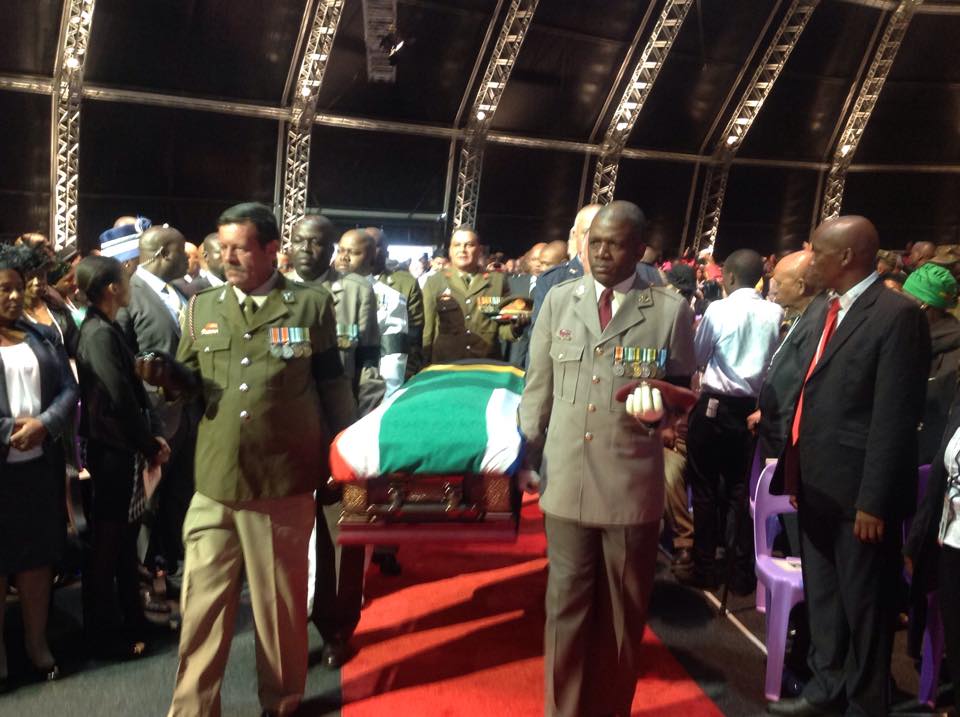
Ventersdorp- The president of South Africa attended a re-burial of one of stalwarts, the late John B. Marks who died in Moscow, in Russia more than 44 years ago.

Zuma said sixty years ago, the people of South Africa proclaimed that South Africa belongs to all who live in it, black and white, and that no government can justly claim authority unless it is based on the will of all the people.

This year South Africa is celebrating 60 years of the Freedom Charter in which these profound words are enshrined.

“We remember these words which have since found a place in our country’s Constitution, on this special day of interring the mortal remains of Comrade John Beaver Marks on home soil. He worked with immeasurable commitment and dedication to bring such ideals to fruition” Zuma said.

Last weekend, South Africa laid to rest his brother, comrade and friend, Comrade Moses Kotane in Pella, in this province of Bokone Bophirima.

Zuma also remembered Minister Collins Chabane.

“Yesterday, we sadly bid farewell to Minister Collins Chabane in Limpopo, a committed cadre who looked up to JB Marks and Moses Kotane” he said.

The former Minister of Public Service and Administration died in a road collision that also claimed the lives of his two protectors, sergeants Lesiba Sekele and Lawrence Lentsoane.

He outlines how the events of the past two weeks have reminded South Africa of the very rich and noble history of its liberation struggle.

“We have had the opportunity to reflect on the heroism of many men and women who sacrificed everything so that South Africa could be free.

“Indeed today is another day of inspiration. We have come together to celebrate the life of a distinguished South African who was totally committed and dedicated to freedom, equality, justice and human rights for all” Zuma said.

Having been raised by a father who loved the African National Congress (ANC), Comrade JB had a bit of understanding of what the true nature of the struggle was.

He said that is why JB Marks quickly noticed that African students and white students were treated differently at the teacher training college that he attended.

“He could see that black African students were discriminated against. He then made it his mission to mobilize other students and showing them exactly how the conditions they were subjected to warranted a revolt. It was the beginning of the conscientisation of this remarkable revolutionary.

“He grew to become a teacher, trade unionist and a consummate freedom fighter who would selflessly dedicate his life to fighting racism and apartheid colonialism. In celebrating JB Marks and Moses Kotane we are celebrating  two men who played a very key role in the revival of political activism and trade unionism in the 1940s” Zuma said.

The president said when the ANC was experiencing deep organisational challenges in the 1930s, signs of revival came with the Jubilee conference of 1937, which had been proposed by Selope Thema, James Calata, JB Marks and Moses Kotane.

Comrade Marks in particular, was one of the leaders who played a key role in the Communist Party-led anti-pass campaign of 1944, which drew 20 000 people, including ANC members.

In the preparatory conference for this anti-pass march in Johannesburg on 21 November 1943, JB Marks said:

“This conference has passed a sentence on the pass laws, the sentence of death. The pass laws are a national stigma, and can only be fought by all the black people standing and fighting together. We have been humiliated by these laws. To hell with passes!

Another important achievement with regard to working class and political mobilisation in the 1940s came with the historic 1946 mineworkers strike.

Comrade JB Marks led the strike, as Chairperson of the most powerful and populous trade union federation at that time, the Council for Non-European Trade Unions (CNETU).

The strike mobilised between 60 000 and 70 000 workers, demanding improved working conditions, such as a statutory minimum wage, as well as the elimination of the compound system and the tribal divisions of the workforce among others.

Despite the fact that the strike was brutally suppressed, it had an unintended consequence of radicalising political activism, especially in the ANC.

“It became clear that the racist government would not change, as it was later shown with the adoption of apartheid as official policy in 1948. The success of Comrade JB Marks was remarkable. He had managed to mobilise workers from various countries from Southern Africa under one banner and purpose” he said.

Marks raised their level of political consciousness and collapsed the nationality and tribal divisions that the system had imposed to prevent collective action.

According to Zuma, during those years, the Chamber of Mines dug in its heels, arguing that they could not improve wages as miners were fed and housed in the compounds.

He said in this democratic era, the question of the living and working conditions of mineworkers in some areas still remains a challenge, resulting from the dehumanising migrant labour system of old.

“Through the Mining Charter that we adopted in 2004, the democratic government has sought to work with mining houses to improve the living conditions of mineworkers so that what Comrade JB Marks was fighting for can be achieved in totality.

As part of the transformation process, the Mining Charter enjoined the holders of Mining Rights or Mining Companies to meet certain commitments by the end of last year, 2014” he said.

He said they were to convert or upgrade hostels into family units, to attain the occupancy rate of one person per room in the living quarters and to facilitate home ownership options for mine workers.

The assessment of progress made by the companies in meeting the Mining Charter commitments is underway and a final report is due by the end of April.

The outcome of the assessment report will be used to revise the Mining Sector Strategy and the Mining Charter, as well as the alignment to the Broad-based Black Economic Empowerment Codes of Good Practice.

Government has also begun a programme of revitalising mining towns.

A total of 2.1 billion rand has been ring-fenced for this purpose with 290 million rand approved for Informal Settlement Upgrading in  Mpumalanga, North West, Gauteng, Northern Cape, Limpopo and the Free State.

One hundred and thirty three (133) informal settlements are being assessed or prepared for upgrading through the National Upgrade Support Programme.

Thirty two (32) settlements are being upgraded and eighty seven (87) housing projects are being implemented across the prioritised mining towns.

Importantly, Government, the mining sector and the Banking Association of South Africa have signed a Social Contract for the development of sustainable human settlements.

Other support includes technical expertise with regards to Integrated Development Plans and the development of Special Economic Zones.

“We welcome as well the investment of mining companies in communities that they draw labour from. Many have built state of the art schools and other facilities in rural areas.

“We are also preparing to introduce our National Development Plan delivery programme Operation Phakisa in the mining sector to revitalise and build this sector further, to cement the position of mining further, as the backbone of our economy.”

Zuma said working together with the mining industry stakeholders as they are doing currently, they will continue to reposition the mining industry for greater levels of competitiveness and sustainable growth.

Compatriots

“We also urge our labour movement to take a leaf from Comrade JB Marks the trade unionist. Government has introduced far reaching labour laws this year aimed at improving the working conditions of vulnerable workers such a contract workers, farm and domestic workers, workers in abattoirs and so forth.

“Taking a leaf from Comrade JB Marks, all of us, government, labour, business and the community sector should work together to ensure that these laws are understood by all, and that they are implemented effectively to improve the lives of workers” he said.

Bagaetsho,

In addition to organising and mobilising the working class, Comrade JB Marks was one of the people who helped inject momentum to the ANC in the 1940s and promoted unity within the liberation movement.

Comrade Marks and Comrade Kotane and other communists emphasized the importance of cooperation between the ANC and Communist Party of South Africa.

They did this in the face of fierce opposition from among others nationalists such as former President Nelson Mandela then and ANC President General Dr Xuma.

So severe were these differences that sometimes the tensions would in some instances flare up during public activities of the organisations.

Through careful interventions including the formation of the Congress of Democrats in the 1950s, relations improved, leading to Madiba saying;

“It was only the communists who were prepared to eat with us and work with us. They were the only political group which was prepared to work with the Africans for the attainment of political rights and a stake in society.

The ideological rigidity slowly melted such that when JB Marks vacated his position as the Transvaal President of the ANC, due to his banning in terms of the new laws in 1952, he recommended Nelson Mandela as his successor.

This was Comrade Marks the unifier, a man who did not want to see artificial divisions among the oppressed and within the liberation movement.

It should be recalled that JB Marks was an ANC leader, a trade unionist and a communist. He saw no contradiction between the three roles.

So central was his role that he was also part of the ANC Working Committee which Nelson Mandela reported to in Liliesleaf when he came back from his African mission in 1962.

Fellow Mourners,

Compatriots

Ironically, during this year of the Freedom Charter, JB Marks has brought us to Ventersdorp.

This town has had an image of being the bastion of white supremacy and the glorification of  apartheid in spite of it having been declared a crime against humanity by the United Nations.

The improvement of race relations in this area is most welcome and  appropriate homecoming gift to Comrade JB Marks given that he espoused non-racialism, unity and humanity throughout his life.

The fact that he is to be buried here in Ventersdorp, should be a source of pride for all residents. It should open a new chapter of unity, reconciliation and healing in the town.

We look forward to working with the people of this town and surroundings to further promote the rich legacy of JB Marks.

Compatriots

We cannot celebrate JB Marks without mentioning his contribution together with Comrade Moses Kotane, to paving the way for our international pillar of struggle.

They elevated the cause of liberation in the eyes of the world and were true emissaries of the liberation movement abroad, including Russia.

We again extend our gratitude to the then Soviet Union, now the Russian Federation, for unwavering solidarity and for taking care of our leaders and cadres over many years.

The Russians have walked every step of the way with our Movement during the difficult days of struggle when friends were few.

In this particular case, we appreciate the support provided to Comrades Kotane and JB Marks throughout their lives and in death.

Uncle JB Marks spent over a year in the Central Clinical Hospital in Moscow at the cost of the Soviets. The same generosity was extended to Moses Kotane some years later.

The two stalwarts respected the Soviet Union. Comrade JB Marks referred to the Soviet Union as ‘the land of the proletariat,’ the ‘Mecca of revolutionaries.’

We learn, in fact that two weeks before his death, Marks wrote to fellow comrade, Yusuf Dadoo, prophetically that:

“I am afraid we might have to make the land of the proletariat our sleeping place.”

Indeed it has been their sleeping place for decades until the time came this year to bring them back home  to the land of their ancestors.

Thanks to the struggle they waged relentlessly, they have come back home to a different South Africa. They have come home to a country that belongs to all its people, equally, black and white and which upholds dignity, human rights, equality and justice.

Incidentally yesterday, Human Rights Day, would have been the 112th birthday of Comrade JB Marks.

It is fitting that he be reburied during such an important period historically in our country, as he dedicated his life to a South Africa which would respect the human rights of all.

We extend our gratitude to the family of Comrade John Beaver Marks for your resilience and understanding that you share Uncle JB with the whole country.

As government, we are privileged to have been able to  present to the family the remains of your beloved son, father and grandfather.

This is the end of a painful era, and the beginning of a new chapter of celebrating his life.

We should ensure that we tell the story of Comrade JB Marks so that our children and youth would know about this distinguished leader and revolutionary who hated racism and the oppression of people because of the colour of their skin, and who wanted only the best for his country and people.

Welcome home Comrade JB Marks. Welcome home our leader, commissar, intellectual, soldier, teacher and accomplished revolutionary.

Your soul may now rest in eternal peace, on home soil, on South African soil.

I thank You!
-TDN
Follow us on Twitter@Taung_DailyNews or @IceT_
Ventersdorp local municipality undergoes intense assessment


collen-maine.jpg

Ventersdorp –   A team of local government experts has been dispatched to Ventersdorp local municipality to conduct an intensive assessment on issues of governance and administration faced by municipality to determine the nature of intervention needed to get it back on track.


The former Administrator and Acting Municipal Manager at Ngaka Modiri Molema district municipality Khulu Nair whose mandate expired at the end of last month, have a period of not more than two months to compile a detailed assessment report with concrete recommendations on the nature of intervention needed in Ventersdorp Local Municipality.  Other team members are Yvonne Mokgopa (expert in Corporate Services) and Rajah Sulliman (Finance expert) are deployed in terms of Section 105 of the Municipal Systems Act to conduct an assessment as follows:


  • Functionality of council and its committees
  • Relationship between council and administration
  • Validity of council decisions
  • Effectiveness of administration and senior management
  • Status of service delivery
  • Status of financial management
  • Status of filling of senior management posts


The intervention at the municipality follows a number of protest actions by both members of the community and officials of the municipality in the past few weeks. At the start of this week, MEC for Local Government and Human Settlements in Bokone Bophirima, Collen Maine met with the representatives of concerned municipal officials in a bid to resolve the impasse between council and officials.


At the meeting, official alleged non-compliance to supply chain and recruitment processes as well as the inability by council to take a tough stance on implementation of recommendations by the Auditor-General of South Africa (AGSA).


MEC Maine said the assessment report will enable the Provincial Executive Committee to make an informed decision on the nature of intervention needed at the municipality.  MEC Maine strongly condemned the workers’ action of forcibly removing other workers including managers from their offices. “Irrespective of the nature of your grievances and concerns, there are proper channels to voice out your concerns.  Service delivery should never be compromised”, he said.

A raging fire left a man injured


mshow.jpg

A man is in a critical condition after a fire at a house in Kameeldrift  this morning. A report from the scene indicate that the man was starting a generator when it burst into flames, exact detail to the cause is however still a subject for investigation.

Netcare 911 paramedics arrived and while firemen was battling the fire they worked tirelessly to stabilise the patient that sustained 40% burns. After the patient was treated at the scene they transported him to a local hospital for the care that he required.

-TDN

Follow us on @Taung_DailyNews or @IceT_

SMALL BUSINESS IS BIG BUSINESS – MINISTER ZULU


Zulu and Sweet USA

Pretoria- Africa stands on the threshold of an unprecedented economic success, and small businesses will be the main drivers of this growth, job creation and poverty reduction. Small business development is the key to unlock economic opportunities and thus achieve inclusive economic growth and sustainable employment.

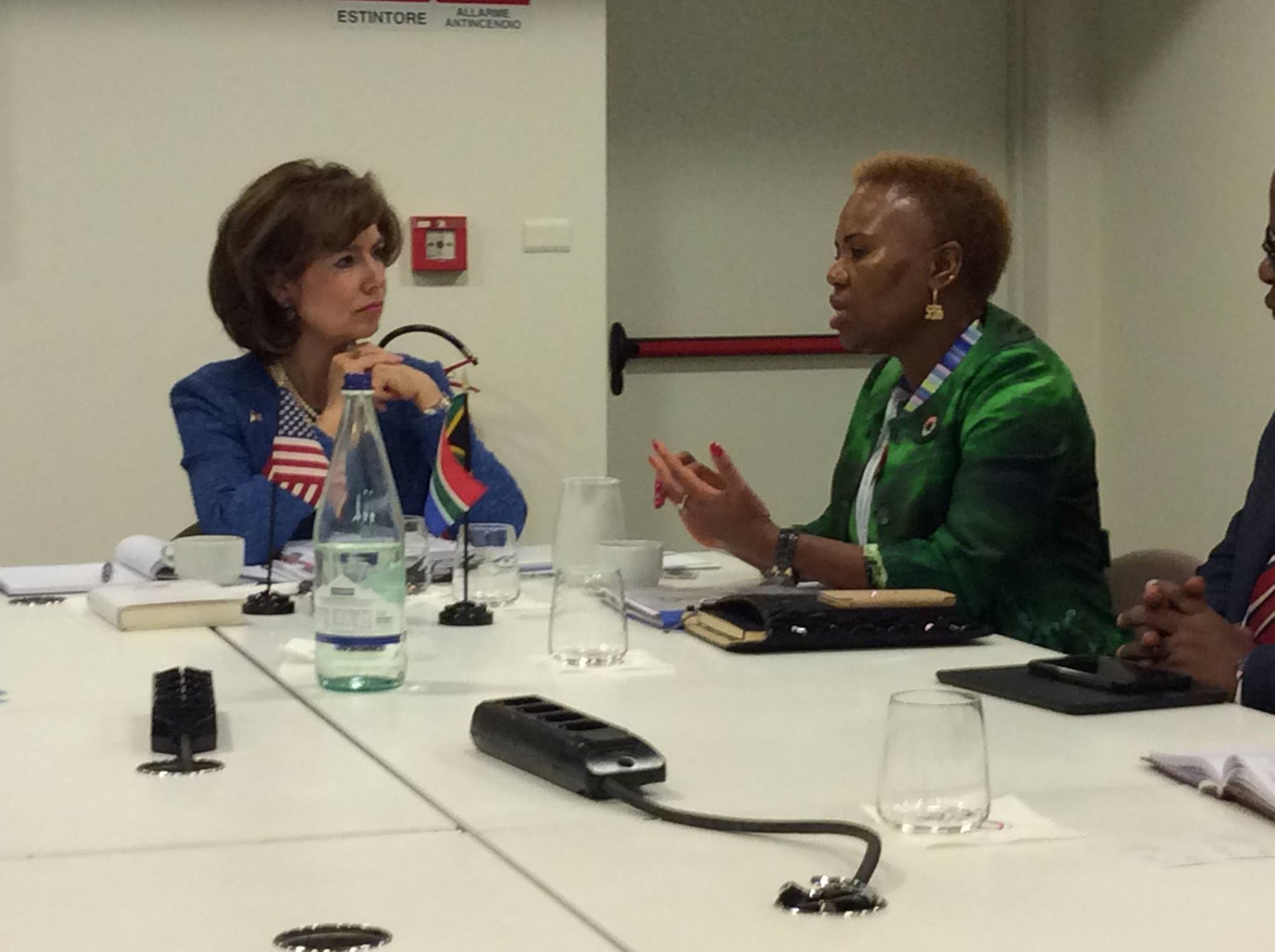
This was the message delivered by the Minister of Small Business Development, Lindiwe Zulu in Milan, Italy during the Global Entrepreneurship Congress (GEC) which ended recently. Minister Zulu addressed Ministers of Small Business Development from various countries and an African delegation shortly after South Africa Johannesburg was announced as the Host City for the 2017 Global Entrepreneurship Congress.

“Small business is big business”, she told the Congress, reiterating the call by President Jacob Zuma. “Our policy interventions in South Africa seek to ensure that small enterprises grow into thriving businesses. They cannot remain small forever”.

She said that the high rate of unemployment, poverty and extreme inequality in South Africa called for bold andfar-sighted interventions.

Minister Zulu also met various Italian agencies and companies as part of her objective to identify opportunities for South African small businesses.

“As government, we remain open and receptive to new policy ideas that will help accelerate the formation of new businesses and sustainability of existing one. We see the GEC as a powerful platform to learn what other successful nations are doing to promote and sustain enterprise development”, said Minister Zulu.

We will focus on providing financial and non-financial support to small businesses. We want to reduce obstacles to doing business wherever possible.

Addressing a separate delegation from the African continent, Minister Zulu said: “There is general recognition that Africa is the next growth pole of the world. It is up to us, Africans, to seize the moment and ensure that Africa becomes an unprecedented economic success”.

Minister Zulu invited delegates to present ideas that would ensure that the Global Entrepreneurship Congress 2017 that would take place in Johannesburg becomes a resounding success. GEC provides opportunities for entrepreneurs to explore business networking opportunities, to learn and interact with their peers across the globe.

Addressing a delegation from the African continent, Minister Zulu also touched on the violence affecting businesses owned by foreign nationals. She reiterated government’s condemnation of the violence, the loss of lives and destruction of property.

“As government, we proceed from the premise that all people living in South Africa, including foreigners, are entitled to the full protection of our law. We will continue to act firmly and decisively against people who break the law and those who take the law into their own hands”.

“I established a Task Team to look at the underlying causes of the problem and to determine what needs to be done. I am confident that the Task Team will deliver a lasting solution.”

-TDN

Follow us on Twitter@Taung_DailyNews or @IceT_
Greater Taung Business Holdings to reposition Taung economy


DSC_2204

BY OBAKENG MAJE
TAUNG- Various business persons around Taung were all under the same roof on Thursday in quest of finding bankable ideas and strategies to grow the economy of Taung.

The Gala dinner was held at famous Paper City Conference Hall.

Some of the delegates who attended the mouth-watering launch of Greater Taung Business Holdings were the president of North West Business Forum, Kelebogile McHarvey Seboka, Greater Taung Municipality’s Acting Mayor, Oageng Seleke, Chief Whip Morutsile Olifant and Speaker Deliwe Zethi.

The Batlhaping Baga-Mankuroane Tribal Authority also graced the launch.

The Greater Taung Business Holdings chairperson, Lesego Lecwe said they formed that forum so that they can have a structure where all businesses around Taung can be incorporated.

“We formed this organisation to better position ourselves and try to bring all businesses persons together as we know Taung is rural area. The objective is one, to make sure our economy grows. The Tribal Authority of Baga-Phuduhucwana said in coming projects, they will not be able to speak to individuals who run different businesses, but all decisions will be discussed through Greater Taung Business Holdings” Lencwe said.

Greater Taung Acting Municipal Mayor, Oageng Seleke said they highly-appreciate the idea of launching a forum that will incorporate many businesses in Taung.

“We really support the initiative and hopefully this will bring new ideas of how to make Taung a better place economically. As we know many people in Taung are unemployed and that is a concern. We will organise workshops for them to learn more and have a clear background of how procurement system operates” Seleke said.

North West Forum president Kelebogile Seboka said the initiative will help the economy of Taung because all businesses will be under one structure.

“The North West Business Forum is a confederation of business organizations with clear purpose to represent, protect and promote the collective interests of business in the province.

“The forum’s membership compromise of district and local chambers. The North West Business Forum further aims to unify business in the province and this we endeavor to achieve by availing an organized structure for business to engage meaningfully at all levels, ensuring that organized business plays a constructive role in the country’s economic growth and development agenda” Seboka said.

Baga Phuduhucwana Tribal Authority said they welcome the launch of Greater Taung Business Holdings and believes by partnering with them that will help most people of Taung.

“We welcome the forum and as we planning to turn Taung into a City, forums like this one will help t achieve that. We will be partnering with them and half of the profit will go to the trust.

“The Taung trust will help many people of Taung especially the youth in supporting their projects or offering them bursaries. We can confirm that Taung will be a city within three years and there are projects that are in the pipeline like Taung Dam Museum, Taung Skull Heritage Site that is under construction preparing for the skull to return home. So we have so many plans to make sure Taung becomes a better place” Palm Modirwa Matlhola concludes.
-TDN
Follow us on Twitter@Taung_DailyNews or @IceT_
 

Eskom board wants to dump chairperson Tsotsi – report


1868224942.jpg

Cape Town – When Eskom chairperson Zola Tsotsi took to the podium 10 days ago to announce the suspensionof the utility’s CEO, Tshediso Matona, and three other senior executives, he made it clear that he was just the messenger.

Now Tsotsi faces the axe, according to an African News Agency (ANA) article published in the Sunday Independent.

According to the article, the Eskom board allegedly turned on Tsotsi over the terms of reference and scope of the inquiry that was announced when he suspended the utility’s leadership.

Sources told ANA that the process to start the inquiry had now paused and might even be canned.

For more http://www.news24.com

Chiefs out of the Nedbank Cup


default (1)

Kaizer Chiefs lost 2-1 to Black Leopards in a Nedbank Cup Last 16 clash, played at the FNB Stadium. The visitors scored the opening goal, before Willard Katsande equalised. However, it was Leopards that got the winner in injury time.

Amakhosi coach Stuart Baxter sent a changed team into the field against Black Leopards. Reyaad Pieterse, for example, started in goal, while others who got game time were the likes of Simphiwe Mtsweni, Ovidy Karuru, David Zulu and Matthew Rusike.

Morgan Gould and Ivan Bukenya were the two centre-backs for the game.

Chiefs started well, having more possession of the ball, even though it didn’t result in many chances.

Zulu’s shot at goal from outside the box was the first kind of an opportunity, but the ball flew over the crossbar.

Amakhosi got a shock in the 21th minute when Leopards took the lead via Morgan Shivambu, leaving goalkeeper Pieterse no chance from close range. Linesman Buyisile Ngqambiyana, however, completely missed that Shivambu was offside when receiving the ball, as the Chiefs defence had moved up.

Zulu came close to the equaliser eight minutes later, but his header lacked the power to surprise Leopards goalie Avhashoni Tshinuna.

Slowly, the home side started to dominate, even though it was Leopards that nearly scored their second on the break.

In the 41st minute, Mandla Masango looked to round the Leopards goalkeeper, but he intercepted – did he get the Chiefs midfielder’s legs or the ball? That was the question. Masango and Amakhosi coach Baxter felt it was a penalty, which it clearly was.

In the end, referee Daniel Bennett got so upset with Baxter’s complaints that he was sent off.

The second half started like the first with Chiefs having most of the ball possession.

Rusike headed the ball at goal in the 50th minute, but the Leopards goalkeeper made a fine save, working the ball to corner.

Doctor Khumalo was now in charge at the bench, after Baxter’s sent off. The assistant-coach decided to ring the changes in the 58th minute, bringing on George Lebese for Karuru and Siphiwe Tshabalala for Zulu.

Amakhosi struggled to really dominate the game with the Leopards players working hard and competing for every ball.

Siphelele Mthembu replaced Rusike in the 75th minute. The tall striker wasn’t even a minute in the field, when his header nearly ended in the back of the net. But the Leopards goalkeeper came to his side’s rescue, punching the ball to a corner.

Eventually, it was midfielder Willard Katsande who scored the equaliser with a powerful header. The Zimbabwean doesn’t score often, but this was a beauty and… An important one as well.

The game was now on, with both teams looking for the winner. Shockingly, it was Leopards that got the goal in the 91st minute, thanks to Roggert Nyundu.

It means that Chiefs are out of the Nedbank Cup.

Kaizer Chiefs (0) 1 (Katsande 79’)

Black Leopards (1) 2 (Shivambu 21’, Nyundu 91’)

Kaizer Chiefs: Pieterse, Moleko, Gould (C), Bukenya, Mtsweni, Masango, Katsande, Bukenya, Maluleka, Karuru (Lebese 58’), Zulu (Tshabalala 59’), Rusike (Mthembu 75’)

Black Leopards: Tshinuna, Maphangule (Mahangwahaya 66’, Bobe 87’), Ndou, Nyirinda, Radebe (Nange 46’), Nyundu, Shivambu, Munganga, Mabotja, Ntshangase, Mumuni

-TDN

Follow us on Twitter@Taung_DailyNews or @IceT_