‘We will take Mandela’s legacy forward’, says Zuma


nelson-mandela
Qunu – President Jacob Zuma undertook on Sunday to take forward former president Nelson Mandela’s legacy at his state funeral in Qunu, in the Eastern Cape.

Zuma said Mandela had made tremendous strides in gender equality, giving it prominence and seriousness under his presidency.

“[This led] to an increase in the number of women in public office, especially Parliament and Cabinet,” Zuma said.

“We dare not reverse your achievements in this regard.

“As your journey ends today, ours must continue in earnest. One thing we can assure you of today Tata is, as you take your final steps, is that South Africa will continue to rise.”

Mandela’s abiding revolutionary spirit would prevail on the country not to rest until the poor and working class had truly benefited from the material fruits of freedom and democracy for which he had fought.

Education

“Therefore, today we undertake to take forward the [promise] of an improved quality of life for all,” the president said.

“We commit to work more intensely to deal a decisive blow against persisting poverty, unemployment, and inequality.

“We pledge to take your vision forward for good schools, hospitals, quality housing, utilities, decent jobs and working conditions as well as efficient and accountable public service.”

Learning from Mandela, education would continue to be used as a weapon to improve the quality of life and bring about change through investing in the development of children and the youth.

“You love children dearly,” Zuma said.

Mandela died at his home in Houghton, Johannesburg, on 5 December. He was 95.

A memorial service was held at FNB Stadium in Johannesburg on Tuesday.

His body was flown to the Eastern Cape on Saturday.
– SAPA

Tributes, tears at Mandela’s funeral


0dcf15eca5554c06b54eac59bbc0922d
Qunu – Former president Nelson Mandela was returned to his home village of Qunu on Sunday in a state funeral that saw political tributes and tears flow.

The farewell by the country and fellow African leaders was a reluctant one.

“We did not want to confront the reality of your mortality,” President Jacob Zuma said in a eulogy that tried to address doubts about the country’s current leadership voiced in the wake of Mandela’s death.

“Thank you. Thank you for being everything we needed and wanted in a leader during a difficult period in our lives… for building a free South Africa,” Zuma told 4500 mourners in Qunu.

Zuma said an outpouring of grief across South Africa in the past 10 days was the nation’s natural response to the goodness Mandela had radiated.

“As your journey ends today, ours must continue in earnest. One thing we can assure you of today, Tata, as you take your final steps, is that South Africa will continue to rise,” he said.

“We plan to take your vision forward.”

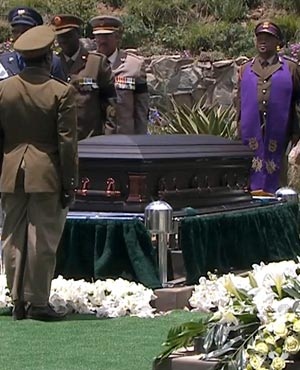
The mourners gathered early for the funeral in a marquee on Mandela’s family farm, awaiting Mandela’s casket that was carried through green countryside in a military procession and placed on cowhides.

“My life is in a void”

European dignitaries included Britain’s Prince Charles, Monaco’s Prince Albert and former French prime minister Lionel Jospin.

African leaders included Tanzanian president Jakaya Kikwete, Malawian President Joyce Banda and Zambia’s first post-colonial president Kenneth Kaunda – all of whom delivered eulogies.

Former president Thabo Mbeki was brought to tears as Kikwete recalled anecdotes of ANC leaders’ days in exile in Dar-es-Salaam, including how Mandela left behind boots that languished in the capital for three decades after he was jailed by the apartheid regime.

Banda saluted the quiet dignity of Mandela’s widow Graca Machel.

“Women across South Africa have told me these past 10 days that they are very proud of you and what you have taught us as African women.”

After she spoke, there was laughter when ANC deputy president Cyril Ramaphosa teasingly said she was from “Malawi. Yes, Malawi” – a reference to a recent faux pas by Zuma when he lamented the poor state of roads in that country.

Mandela’s ex-wife Winnie Madikizela-Mandela smiled and playfully poked Zuma, who chuckled.

Members of Mandela’s family spoke at the service, but the most heart-rending tribute came from his close friend and fellow Robben Island prisoner Ahmed Kathrada, who spoke of being bereft after losing the man he considered a brother.

“My life is in a void and I do not know who to turn to.

“He was my elder brother,” Kathrada said, adding that Mandela had shown love and tolerance in abundance, and that the outpouring of grief over his death had shown how connected South Africans felt to him.

Family graveyard

“Today, mingled with our grief is the enormous pride that one of us has, during his lifetime and now, in your death, united the people of South Africa and the entire world on a scale never seen in history.”

Mandela’s casket was carried from the funeral tent just past noon to be buried in the family gravesite – in keeping with Xhosa custom that dictates that the dead are laid to rest when the sun is at its highest.

Zuma, Mbeki and past and present Cabinet ministers followed on foot.

Mandela was to be buried beside his parents and his son in the family graveyard at a ceremony that would gather only 450 mourners and be presided over by Methodist church general secretary Vuyani Nyobole.

Anglican Archbishop Emeritus Desmond Tutu attended in a last-minute change of heart after saying on Saturday he had cancelled plans to go to Qunu after finding he had not been invited.

Faced with the wrath of one of Mandela’s close friends and allies, the ANC dismissed the imbroglio as a misunderstanding and insisted that he was welcome.

It had caused speculation that Tutu had been sidelined because of his caustic criticism of the current government.

All indications were that grudges had been firmly set aside for Mandela’s funeral, as senior ANC members who have fallen foul of Zuma attended – among them former Cabinet minister Tokyo Sexwale.

Friends, colleagues, comrades and family of Nelson Mandela are invited to share their memories and tributes, and to light a candle for him, on his profile at Remembered.co.za.
-AFP

Nelson Mandela: RIP 1918 – 2013


94d34f0c8fab4d858c5235478a46c6ec
Qunu – Nelson Mandela, South Africa’s first black president, was laid to rest Sunday after a state funeral filled with tearful eulogies and strident vows to pursue his ideals of equality and justice.

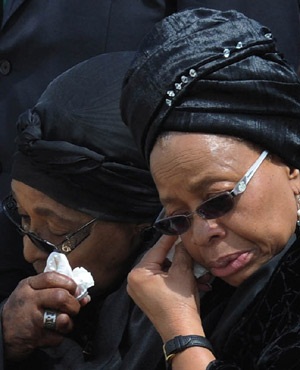
Mandela’s casket was buried at his family plot in his rural boyhood home of Qunu, watched by his widow Graca Machel, ex-wife Winnie Madikizela-Mandela, other family members and around 450 selected guests.

The interment followed a ceremonial state funeral that ran well over its allotted two hours, as speaker after speaker paid emotional tribute to the man who led South Africa out of the apartheid era.

“The person who lies here is South Africa’s greatest son,” said ANC deputy president Cyril Ramaphosa in an opening address.

A 21-gun salute and full military honour guard had escorted Mandela’s coffin to the marquee where 4 500 mourners said their final goodbyes.

His flag-draped casket was placed on cow skins, surrounded by 95 candles – each signifying a year of his extraordinary life.

The frail and ageing leaders of South Africa’s anti-apartheid struggle also attended: George Bizos, Desmond Tutu and Ahmed Kathrada, whose voice broke with as he delivered a eulogy for his old friend.

“I first met him 67 years ago,” said Kathrada, who along with Mandela was sentenced to life in prison in 1963.

He recalled his fellow inmate as a powerful amateur boxer who could cope far better than others with the physical challenge of hard labour.

“What I saw in hospital was a man helpless and reduced to a shadow of himself,” he said struggling not to break down.

“We can salute you as a fighter for freedom. Farewell my dear brother, my mentor, my leader.

“Now I’ve lost a brother my life is in a void and I don’t know who turn to.”

A towering public figure

His words left many in tears among the invited guests, whose ranks included foreign dignitaries and celebrities ranging from Britain’s Prince Charles to US talk show queen Oprah Winfrey.

The funeral closed the final chapter on a towering public figure whose courage and moral fortitude turned him into a global symbol of freedom and hope.

During 10 days of mourning, hundreds of thousands of South Africans had turned out across the country to bid the founding father of their “Rainbow Nation” farewell.

They braved a rain-sodden memorial in Soweto and queued for three days to see his remains as they lay in state at Pretoria’s Union Buildings.

For 50 million compatriots, Mandela was not just a president, but a moral guide who led them away from internecine racial conflict.

“Ever since he passed away, I wanted to walk the journey with him,” said Pascal Moloi, 52, who made the trip from Johannesburg to Qunu.

For the rest of the world he was a charismatic leader of the anti-apartheid struggle.

While Mandela had been critically ill for months, the announcement of his death on December 5 still sent a spasm through a country struggling to carry forward his vision of a harmonious multi-racial democracy of shared prosperity.

‘South Africa will continue to rise’

During the funeral, South African President Jacob Zuma told the country to carry on his legacy.

“One thing we can assure you of today Tata (father), as you take your final steps, is that South Africa will continue to rise.

“South Africa will continue to rise because we dare not fail you,” Zuma said.

After the ceremony, Mandela’s coffin was transported to a graveyard sitting on the sprawling family estate Mandela built in Qunu after his release from prison in 1990.

“It was in that village that I spent some of the happiest years of my boyhood and whence I trace my earliest memories,” he wrote in his autobiography.

As the coffin was lowered into the ground, a formation of military aircraft – six jets with one spot left vacant in a symbol of a missing man – flew overhead.

After a life spent in the public spotlight, Mandela’s final rites were a private affair.

A family deprived of their husband and father during his 27 years in apartheid prisons and many more years in public service seized it as an intimate last goodbye to a man who meant much to millions.

A live television broadcast followed the coffin to the graveside but was cut after several minutes in line with the family’s wishes.

Overseen by male members of his clan in line with traditional Xhosa rites, the burial included the slaughter of an ox – a ritual marking of a life’s milestones.

Mandela was referred to throughout as Dalibhunga, the name given to him at the age of 16 after undergoing the initiation to adulthood.

Friends, colleagues, comrades and family of Nelson Mandela are invited to share their memories and tributes, and to light a candle for him, on his profile at Remembered.co.za.

– AFP

Qunu says farewell to Tata Madiba


ac6618af0faf42b4a4390a2e1ba85048
Qunu – Perched above the pomp and ceremony of Nelson Mandela’s state funeral, villagers and visitors to his rural home said a final goodbye among the open spaces and grasslands of his boyhood.

A few hundred people watched a live broadcast on a big screen, framed by sweeping views overlooking Mandela’s home in Qunu village.

“I felt that I was a part of it,” said local Samora Makasi, 35, sitting in an open-walled tent as presidents, foreign dignitaries and celebrities gathered below.

“I could have watched it at home but I wanted to be around people,” Makasi said.

Qunu has, in the 10 days since his death was announced on December 5, been a hive of round-the-clock activity as funeral organisers rushed to construct a venue for the 4 500 people who wanted to attend the event.

The usual rural tranquility was interrupted by the constant thumping whir of military helicopters and convoys bringing in troops as the village was placed under a security clampdown.

“I’m sad. It’s unbelievable that Mr Mandela today is no longer with us,” said Qunu resident, photographer Monde Sikweza, 48, as the sound of a 21-gun salute echoed over the village.

“This long walk to freedom is gone now,” he said, holding a framed photograph of Mandela and fellow comrades in 1991.

Traditionally, funerals are open to anybody, but the South African government had limited the number of guests, citing security concerns and space constraints.

“I am happy watching this on television. My eyes are bad. I can see it better this way,” said villager Dickson Gangatele, 73.

Many watching in the viewing area had come from out of town.

“Ever since he passed away, I wanted to walk the journey with him,” said Pascal Moloi, 52, who came from Johannesburg to watch with Mandela’s fellow villagers.

Watching in the village, with a wide view of the valley below, made him “feel much more connected” to Mandela, he said, saying afterwards he thought the ceremony, which was over two hours long, was “brilliant”.

But local Nonkuleleko Mfoboza, 45, felt differently.

“We want to be there as residents, but now there is no space for us,” she said.

Several of the speeches drew standing ovations, but Mfoboza gave her stamp of approval to only a handful.

“Otherwise it was boring… too long,” she said.

While the formal section of the state funeral was broadcast live to the world, the burial rituals were closed to the public on the wishes of the Mandela family.

“We really don’t know whether there will be access to the grave. We are watching this from a distance,” said Milisa Manxiwa, 34, sitting on a chair next to the main road near the funeral, draped in a South African flag.

As Mandela’s final gun salutes rolled over the valley and an air force flypass thundered overhead, a group of men in traditional Zulu dress, carrying sticks and shields, cried out in succession.

“He was an old man, he deserves his rest, and I think it’s been overdue,” said Ntsika Madyibi, 35, who came from a neighbouring village to watch.

Friends, colleagues, comrades and family of Nelson Mandela are invited to share their memories and tributes, and to light a candle for him, on his profile at Remembered.co.za.

Nelson Mandela will be laid to rest in Qunu. Say your final farewell and be published on News24 by e-mailing or uploading.
– AFP

Killing of two and wounding of mother of three by ex-husband shocking and tragic -Premier Modise


1550824704
Potchefstroom-The incident in which renowned musician Zirk Bergh allegedly shot dead two people, i.e. his wife’s ex-husband, a social worker and wounded his ex-wife before turning the gun on himself and fatally shooting himself is shocking and tragic,North West Premier Thandi Modise said on Sunday.

“We condemn in the strongest terms possible the wicked and ghastly act that has shattered the lives of three innocent children who are now left without the love and care of their parents. That the incident occurred a few days after the closure of the 16 days of activism on no violence against women and children campaign should challenge us to intensify our effort for a 365 days campaign” said Premier Modise.

In calling for men who are experiencing pressure in their personal relationships to seek counselling and professional advice instead of resorting to violence, Modise called on real men to stand up to be counted in the fight against the scourge of gender based violence which transcends class and race.

According to a media report by Rapoort, Bergh who was supposed to pick up his daughter for a day’s visit reportedly shot and wounded his ex-wife Nicolette Du Randt on her back and head, shot 23 –year- old social worker Deon Kondos and proceeded to shoot her husband Dr. Charl du Randt who was waiting with his four year old daughter car an infant in his car.

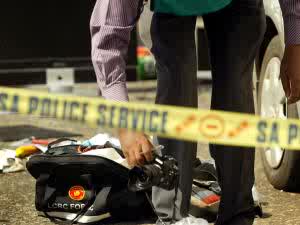
The incident reportedly occurred outside the Suid-Afrikaanse Vrouefederasie (SAVF) offices in Potchefstroom at around 8:00 am on Saturday morning.

“Real men do not to hurt women but protect them against violence. Our prayers are with the mother of the three children who is hospital and the families that lost their loved ones in the tragic incident,” stressed Modise.-TDN
Follow us on Twitter@Taung_DailyNews or @IceT_