More turn to sex for money – YCL


1673717743
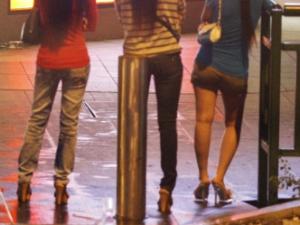
Kimberley – Street prostitution is apparently on the increase in the Northern Cape due to the growing number of child-headed households.

This is according to the Young Communist League of South Africa, which said in a statement issued on Monday, that an increase in street prostitution, especially involving girls and young women, had been noted.
For more http://www.iol.co.za

Accused in abduction case gets R200 bail


3320468903
Kimberley – A Roodepan resident, accused of abducting a 16-year-old girl and allegedly keeping her against her will in a flat, was granted bail of R200 in the Kimberley Magistrate’s Court on Monday.

The girl, who is currently being kept in a place of safety, was found at Beatrice Court at the Roodepan flats on Friday.
For more http://www.iol.co.za

North West cop in court for rape


SAPS
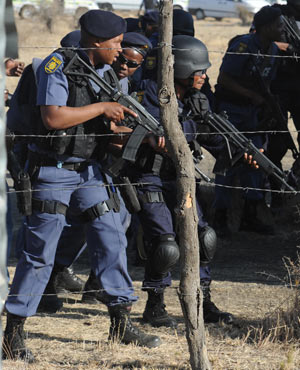
Sannieshof – A North West policeman accused of raping a woman appeared in the Delareyville Magistrate’s Court on Tuesday.

The matter was postponed to December 3 and he was released on bail of R1000, said the Independent Police Investigative Directorate.

Police said the victim, a 28-year-old Johannesburg woman, was in Sannieshof to attend the trial of her boyfriend on charges of housebreaking.

The woman sent the investigating officer a text message that she wanted to speak to him in connection with the case, said Brigadier Thulani Ngubane.

“When she met with the… officer in Sannieshof, it is alleged that the officer misled her into believing he was going to assist her with the case of her Tanzanian boyfriend.”

The officer took her to a house and allegedly raped her.

Sapa

Three held for N West murder


OLYMPUS DIGITAL CAMERA
Zeerust – Three men have been arrested in Zeerust in connection with murder and house robbery, North West police said on Wednesday.

Two men were arrested last month and one took the police to where the stolen items were, said Colonel Sabata Mokgwabone.

“The men took the police to a bush at Ikageng township and police dug out a plastic which contained three pistols, three rifles and rifle ammunition,” said Mokgwabone.

Police also found a silencer, a set of binoculars and an empty magazine.

Mokgwabone said the discovery of the firearms led police to arrest the third suspect on Tuesday.

“The third suspect took the police to the bushes where five firearms and four rifles were recovered.”

Mokgwabone said it was discovered that three firearms belonged to a farmer who was attacked in April.

“Police were further taken to Dinokana village in Lehurutshe where they found a hunting rifle with empty magazine dumped in the bush.”

Sapa

Independent judiciary vital to fight graft


912933799
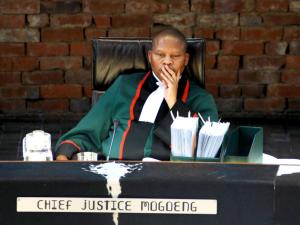
Cape Town – An independent judiciary was vital to corruption-busting efforts in South Africa, Chief Justice Mogoeng Mogoeng said in Cape Town on Wednesday.

Delivering the fourth annual National Institute for Crime Prevention and the Reintegration of Offenders (Nicro) human rights lecture, Mogoeng said corruption was frustrating the realisation of socio-economic rights for too many citizens.

Mogoeng acknowledged corruption was rife in South Africa, but said at times it was “exaggerated”.

“How we make sure it’s rooted out 1/8is 3/8 through this independent judiciary, that we make sure that whoever is brought before our courts because of corruption, this corruption that frustrates the objective of socio-economic rights that our constitution promises… is dealt with and dealt with effectively,” he said.

Mogoeng said it was also vital to ensure the bench was free of corrupt judges who took bribes.

“Imagine if you have three corrupt judges… if we are corrupt it will take the word from one of the most powerful to say we have won this tender… and even oil your hand,” he said.

He made reference to those who won tenders for government build projects, but did not deliver or underperformed despite lining their pockets with taxpayers’ money.

Sapa

Red berets get their licence to lead


3703049531
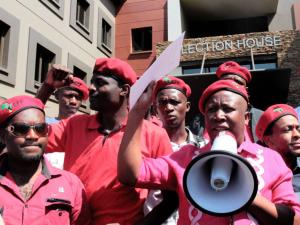
The EFF now has the licence to lead a charge, and it finally feels like the mythology around Malema the doomed, wandering alone through his rows of cabbages, has imploded, writes Janet Smith.

Johannesburg – The elderly white man jumps from his seat behind the till, pushing his chair back in a bit of a clatter. It’s taken him a moment to register. “Julius!” he shouts out, pushing his spectacles up before launching himself towards the Economic Freedom Fighters (EFF) leader. “Oh, I’m so glad to see you.”

His arms are wide open as he skins the counter.
For more http://www.iol.co.za

More voting stations for 2014 – IEC


5475198dfece4d7baa9a518018edc424
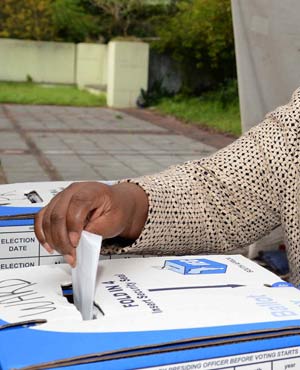
Johannesburg – Next year’s elections will have 22 264 voting stations compared to the 20 859 in 2011, the Independent Electoral Commission (IEC) said on Wednesday.

“[The IEC] has worked hard to increase its voting station network by 9.4% as compared to the 2011 local government elections,” chief electoral officer Mosotho Moepya said in Midrand.

This was in line with the settlement development patterns across the country.

Moepya was speaking at the IEC’s media launch for the 2014 national elections. Next year, the country will celebrate 20 years of democracy.

The official logo, with the slogan “I vote South Africa”, was also launched.

IEC chairperson Pansy Tlakula announced that registration for next year’s election would take place on 9 and 10 November.

“All our voting stations in the country will be open for the purposes of voter registration from 08:00 to 17:00,” she said.

“The commission invites all eligible citizens who are not yet registered as voters to use this opportunity to join the millions of South Africans who are already on the national voters’ roll.”

Moepya said the number of people on the voters’ roll had risen by 21.3% since it was first compiled in 1998.

“The South African voters’ roll remains a fundamental contributor to the credibility of the country’s elections.

“It is regularly updated against the national population register [at least once a month].”

The IEC had also maintained audit trails of all voters since the first voters’ roll.

Registration gap

Moepya said the IEC had consistently attained registration of 80% of the voting age population.

Following the release of the 2011 census, the IEC had established a potential registration gap of about 8.3 million.

“This census data places our current registered voting age population at 73.6%.

“In keeping with our trend of maintaining the voting age population in the 80% region, it is clear that our registration efforts will be targeting 2 006 229 new registered voters,” he said.

The greatest registration gap was in the age categories of 18 to 19 and 20 to 29. The current registrations stood at 8.4% and 49.4% respectively.

Moepya said from the IEC’s analysis of the registration gap it was clear that its communication campaign needed to be more “youthful, fun and engaging”. This would be done without alienating other age groups.

Young people urged to register

Tlakula urged young people, especially those who would be voting for the first time, to register.

She said the youth belonged to a special generation – the first to be born in a democratic country.

“Democracy and freedom came at a great price and cannot be taken for granted.

“We should therefore treasure and use the opportunity to exercise this right,” Tlakula said.

She said although a date for the elections had not yet been proclaimed, the IEC planned to be ready at the earliest possible date within the legislative framework.

The DA said it was pleased that the IEC preparations for next year’s elections were on track.

It urged all unregistered South Africans of voting age to register to vote during the IEC’s registration weekend, DA MP James Selfe said in a statement.

“We also urge all registered voters to ensure they are registered in the province where they live if they have moved since the previous election.”

– SAPA
Crime stats are reliable – police


CrimeTapeSmall
Johannesburg – Crime statistics for the past two financial years can be trusted despite claims that they are incorrect, police said on Wednesday.

National spokesperson Solomon Makgale said analysts first criticised the police for using ratios in the statistics, then later argued that the ratios were important but incorrect.

“When we released the latest crime statistics… some of the so-called analysts and experts said crime ratios were not important, and alleged that we were using them to conceal the real crime situation in our country,” he said in a statement.

“It is now argued by the same analysts and experts that crime ratios are crucial, and that the population estimates we used for 2011/12 crime ratios are wrong, outdated, and incorrect. This is not true at all.”

He said this argument was interpreted by some to mean the crime statistics of the past two financial years could not be trusted.

“Such interpretation is equally untrue.”

Makgale said the 2011/12 ratios were based on a population estimate of 50.6 million people.

However, according to the Statistics SA 2011 census results, released in October 2012, the estimated population for 2011 was 51.6 million.

“The argument is that we should have used this restated, estimated figure. This would have required us to adjust the crime ratios of 2011/12,” he said.

“Based on our approach, this is not necessary… We should only apply the new population estimates, which are based on the 2011 census results, from the 2012/13 financial period onwards.”

Questions around the results

The crime statistics were released by Police Minister Nathi Mthethwa on 19 September.

Since then some political parties, experts, and media questioned the use of ratios and the calculations used to determine the results.

Mthethwa said the number of murders increased by 0.6% in the past financial year. However, it was down 16.6% over the past four years, and 27.2% over the past nine years.

There was also a 6.5% increase in attempted murder in the year under review. This was in contrast to the 16.8% decline over the past four years and the 51.7% decline over the past nine years.

Makgale said the police had a particular approach to the statistics, while analysts had their own.

“We don’t agree on the approach and there is no policy to guide either of us. In other words, in 10 years’ time, the country could be subjected to the same confusing debate.”

– SAPA

Western Cape pleads for gang unit


82486b2b4f4748fe8705fa83f7f7c711
Cape Town – The creation of a specialised gang unit for the Free State should set an example for the Western Cape, the province’s Community Safety MEC Dan Plato said on Wednesday.

Plato said he wanted to ask provincial police commissioner Lieutenant Genearl Arno Lamoer why he still refused to set up a gang unit for the Western Cape, which had 13 times more drug-related crimes than the Free State.

“The latest crime statistics [2012/13] reveal that there were 6 168 drug-related crimes in the Free State, whereas in the Western Cape there were 82 062 drug crimes for the same period,” he said.

“Despite this, Lamoer has responded to my calls for these units by saying they are not necessary… With this latest development, the commissioner will have a lot of explaining to do.”

Plato said Lamoer would have to “explain himself” at a provincial executive meeting in a week’s time.

Lamoer was not immediately available to comment.

Gang unit

On Friday, Free State police commissioner Thabetha Mpembe said a gang unit was being created because of the gang activities that had plagued Bloemfontein, Virginia, Welkom, Botshabelo and rural towns in recent years.

Youth gang activities in Botshabelo had also led to school closures.

Mpembe said gangs and gang activities had been identified as an issue to be addressed by the local police.

The focus on gangs would also lead to measures against drug use, drug smuggling and illegal firearms.

Plato said the National Development Plan (NDP) recommended the re-establishment of specialised units to respond to changing crime trends.

“The best way to make the people of the Western Cape safe from drugs and gangs is through targeted, sustained and specialised interventions.”

– SAPA

Hlophe case more than a mess – Zille


c8c5cb19fcd94526903e63205fb9061a
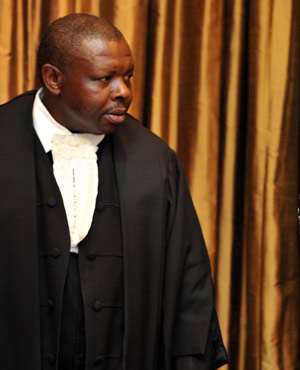
Cape Town – Developments in the Judicial Service Commission (JSC) tribunal on allegations against Western Cape Judge President John Hlophe constitute a crisis, DA leader Helen Zille said on Wednesday.

In her weekly newsletter, Zille said the delay in the tribunal’s proceedings had left the Bench divided.

On Tuesday, the tribunal postponed the hearing into misconduct allegations against Hlophe.

The postponement followed a request by the advocate representing Constitutional Court judges Chris Jafta and Bess Nkabinde – the two who alleged in 2008 that Hlophe had sought to unduly influence them in a corruption case against President Jacob Zuma.

Jafta and Nkabinde have indicated they will approach the high court for a review of the decision to continue with the hearing.

They want to be excused from appearing and testifying pending the finalisation of the review, despite tribunal chairperson, retired Judge Joop Labuschagne’s ruling that Hlophe has a case to answer to.

Zille said Tuesday’s postponement and the pending court case meant the tribunal hearings could drag on for a few more years.

“Until it is cleared up, none of the judges involved can regain credibility and public trust. This includes a judge president, and many of the judges of the Constitutional Court, as well as some retired judges,” she said.

The Hlophe case would be the biggest test of the credibility of South Africa’s courts.

“It is not possible for judges to adjudicate cases with authority and public respect if there is a possibility that they may have lied in a case that could result in the impeachment of a colleague,” Zille said.

“It is equally untenable that a judge president may have committed an impeachable offence, which his judicial colleagues agree to cover up.”

– SAPA